


by Stephen Vagg
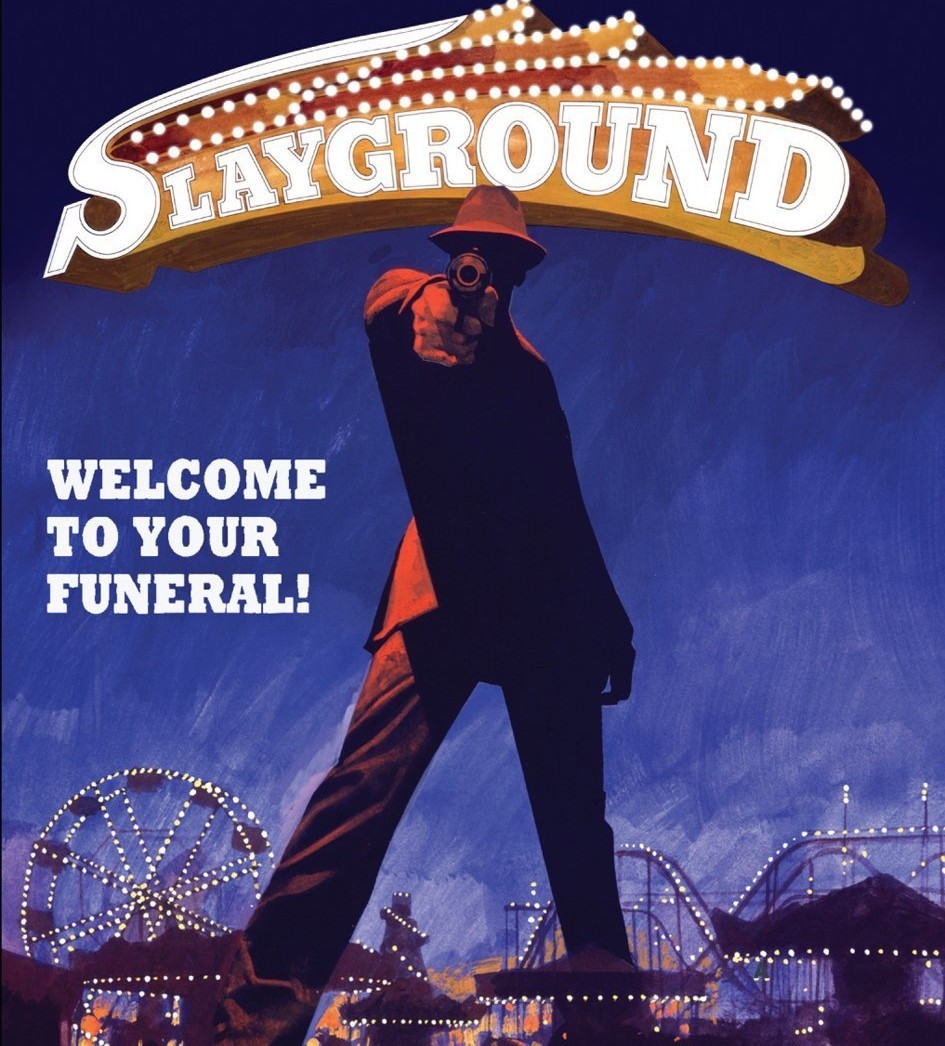
Sometimes, we can get a little parochial here at FilmInk, so in the interests of spreading the love internationally, we’d like to spin off our regular column, Wrecking Australian Stories, to do one on wrecking American ones. Because for all their rampant colonial imperialism, sometimes American artists can suffer at the hands of foreigners and nowhere was this true more than the 1983 thriller Slayground.
Chances are you haven’t seen it – the film flopped at the box office – though for some reason the trailer was in a lot of VHS tapes that we rented back in the day. That trailer seemed to consist of people yelling each other, Peter Coyote holding a gun in a spinning tunnel in a fairground, and Mel Smith from Not the Nine O’Clock News in drama mode. It never gave off much of a sense of what the film was about.
Slayground was based on a novel by Richard Stark, one of several nom de plumes used by author Donald Westlake, who specialised in crime tales (with a sideline in softcore porn). Chances are you would have seen a film based on a Westlake novel or script: just some of the adaptations over the years include The Hot Rock, Point Blank, The Grifters, and The Stepfather. He was a really good writer.
Westlake’s most famous character was a hardened crim called Parker, who featured in more than twenty novels (written under the name of “Richard Stark”). Parker was a super tough dude forever committing heists that went wrong, getting betrayed and seeking revenge. The part was catnip to movie stars: over the years, Parker has been played by actors such as Mel Gibson (Payback), Lee Marvin (Point Blank), Jim Brown (The Split), Robert Duvall (The Outfit), Jason Statham (Parker) and Mark Wahlberg (Play Dirty). (NB for contractual reasons, the character isn’t always called “Parker” in films).
The novel Slayground was published in 1971. It started with Parker having just committed a heist; an incompetent getaway driver crashes the car, forcing Parker to take refuge in a nearby amusement park. He’s spotted by some gangsters, who figure out that he’s part of a robbery and thus has cash – the gangsters and corrupt cops try to get the money and Parker has to figure out how to survive and escape.
Slayground the novel is fantastic – fast, taut, full of twists. The setting of the amusement park is fresh and offers clear scope for any director. There are two main challenges for a film adaptation, but both are surmountable: first is that at the end (SPOILERS) Parker escapes without the money, vowing to get it back (the plot of another Parker novel Butcher’s Moon) – you could easily tweak that. Second, Parker is alone the whole time, so much of the action (his thought processes) take place inside his head; but you could get around that via adding a character for him to talk to.
Film rights wound up in the hands of EMI Films. Barry Spikings greenlit a movie written by Trevor Preston, an experienced television scribe, and produced by Gower Frost and directed by Terry Bedford, who both owned a commercial production house with Adrian Lyne. John Dark co produced.
Before filming started, Spikings was fired from EMI and replaced by Verity Lambert, who agreed to make the film anyway – it would be the first movie from her (ultimately short lived) management.
There’s no reason why British filmmakers couldn’t turn Starks’s novel of Slayground into a first rate movie. Point Blank (1967) was made with British talent, notably director John Boorman and writer Alex Jacob; Jacob later wrote the Oliver Reed thriller Sitting Target (1972), described by Josh Olson in Trailers from Hell as the best Parker movie made from a non-Parker source. British cinema has a long track record of thrillers in the Parker vein: Get Carter, Robbery, Villain, The Squeeze, etc.
But somewhere along the way, things went disastrously wrong. We’re not sure who was responsible, but some person(s) on the film made a series of atrocious decisions.
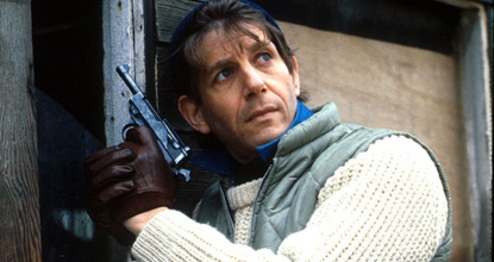 The film of Slayground (spoilers to follow) begins in America with a criminal picking up a teen girl hitchhiker (Kelli Maroney), who then kills him. It turns out the criminal was a getaway driver for an upcoming heist, forcing his partner Stone (the Parker character, played by Peter Coyote) to employ a less experienced driver on the job. Stone and his colleagues commit a heist, but the inexperienced driver crashes the car, killing a nine year old girl. This annoys the father of the girl, who arranges for a hitman, Costello (Philip Sayer) to take out those responsible. This hitman kills both of Stone’s colleagues, so Stone gets his wife to hide in Mexico, then, with the help of an associate, flees to England where he seeks refuge with a friend, Terry (Mel Smith) whose life Stone once saved. The hitman continues to kill everyone who helps Stone, including the associate, a girl who knows Terry and eventually Terry. Stone kills the hitman in an amusement park but mostly because Costello acts like he’s in The Shadow, killing people in dramatic ways using hidden voices and stuff.
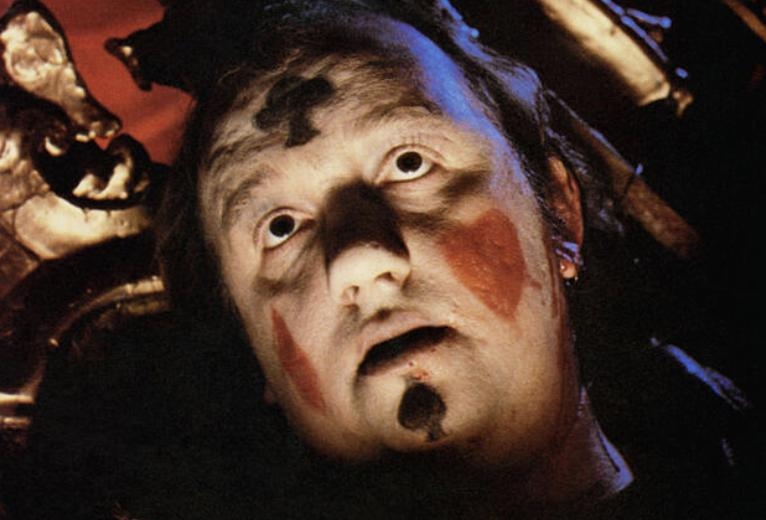 As a film adaptation, Slayground is a mess. It makes so many mistakes that it’s almost a text book example of how not to adapt a novel. Very little is kept from the original – a heist going wrong, a poor getaway driver, some scenes in an amusement park, Stone/Parker has a wife that doesn’t feature too heavily. That’s about it.
Instead, there’s three other stories going on – one about a killer trying to get Stone on behalf of a vengeful father, another about a teen Lolita who kills men who pick her up, and another about ex criminal Terry trying to establish a new life in Blackpool with his lady (Billie Whitelaw), only to encounter troubles with local gangsters and then to have Stone turn up. None of these stories are done well. All have potential but are extremely unsatisfactory – the teen Lolita figure (compelling enough for her own movie) isn’t seen again after the opening sequence (or even referred to); the avenging father story is played out like a slasher with no nuance or twists (there’s no interesting reversals, for instance, or even a scene between Stone and the dead girl’s father), the Terry in Blackpool stuff only comes in during the last half hour and is skimmed over far too quickly.
The remnants of the novel Slayground only make you annoyed because that’s so superior: the amusement park setting in the book offers up all sort of atmosphere and cool action sequences, with Parker setting up booby traps and eavesdropping and getting caught and so on; the movie throws in some amusement park stuff at the end, and that is cool, but there’s not enough of it.
The movie completely betrays the character of Parker, one of the great bad-asses in literature. In the novel, Parker is smart, tough, and cunning, constantly getting out of tight spots. In the film, Stone is a wimp, who talks too much, gets all his friends killed, and doesn’t do anything tough or clever until the end, and even then, it’s only the assassin’s ego that enables Stone to shoot him dead.
In the book, we are on Parker’s side the whole way through – yes, he’s a crook, but he’s up against corrupt cops and gangsters. In the film, Stone’s associate is responsible for the death of a nine year old girl – how is any movie protagonist meant to come back from that? There’s a vengeful mob boss in the novel, but he’s avenging the death of his surrogate son, another gangster – we don’t care that Parker killed a gangster, we care that he helped kill a young girl. To be honest, we’re on the side of her father. The film tries to lessen Stone’s guilt by having him rush back to the scene of the accident to check if anyone is hurt (a very un-Parker thing to do), then wail at the death of the girl (very un-Parker) and later admit guilt (even more un-Parker). But sorry, he’s still responsible for her death – and the death of two of his friends who try to help, and another innocent girl who gets caught up in it. What emotion did the filmmakers think they were going to get out of the audience by telling this sort of story?
Why were these decisions made? Did they get bored with novel? Scared at filming too much in an amusement park? Have an idea that they could do better? Was there another script that the filmmakers were working on that they reworked to include the Westlake novel? It’s a mystery.
The frustrating thing about the movie of Slayground is that it could have been good and there are terrific things in it. The look of the movie is ideal, with its grim seedy towns, backroads, gambling dens, amusement parks. The acting is fine – Mel Smith impresses in a straight character role and Peter Coyote might have registered in a stronger film. The action scenes are well handled. There’s plenty of style. But they wrecked the story.
If they’d just shot the novel – relocating it to England – the filmmakers could have made a minor classic. Instead, they have a mess.
