



By Gill Pringle
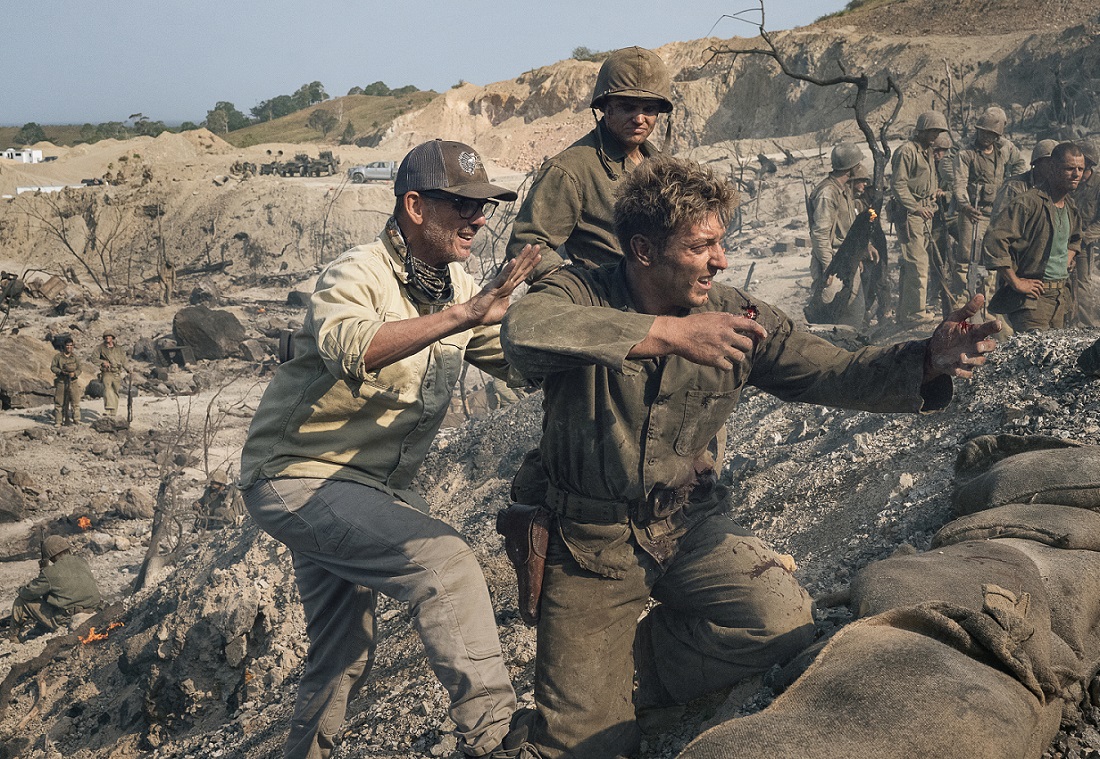
Director Peter Berg and actors Ray Nicholson and Nicholas Galatzine mix sports and war in the true life WW2 drama The Mosquito Bowl.
There is something especially heartbreaking about a story that begins with young men who have their entire lives ahead of them – and ends with the realisation that some of them may never get the chance to grow old.
That is the emotional heart of Peter Berg’s The Mosquito Bowl, a World War II drama that combines the excitement of American college football with the devastating realities of war. Based on the bestselling nonfiction book by Pulitzer Prize-winning author Buzz Bissinger, the film is a moving reminder of how quickly dreams can be interrupted by history.
War and sports are familiar territories for Berg, celebrated for his 2004 sports drama Friday Night Lights – which later became a popular TV series – and also for his 2013 Afghanistan war movie Lone Survivor and 2012 military sci-fi movie, Battleship.
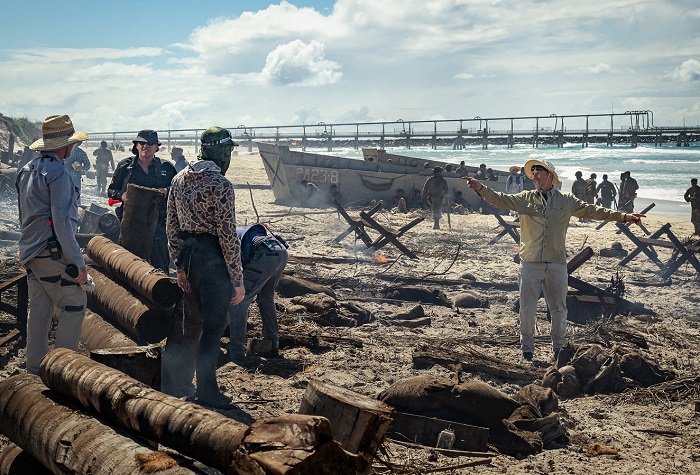
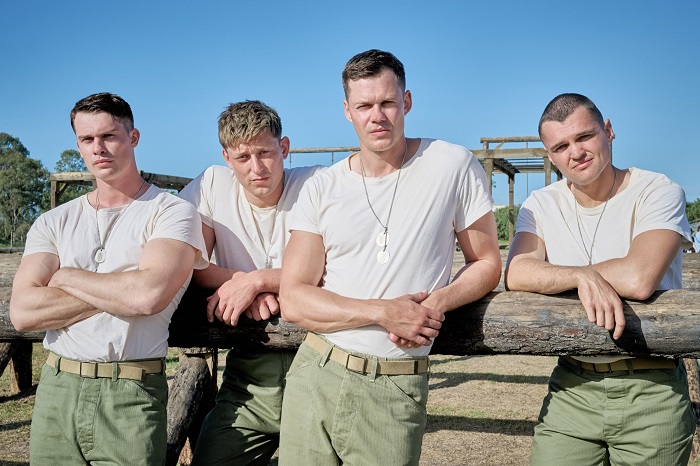
Set against the backdrop of America’s entry into World War II following the Japanese attack on Pearl Harbor, The Mosquito Bowl follows four talented college football players who abandon promising athletic careers to enlist in the United States Marine Corps. They are young, competitive, confident and accustomed to being admired. Football has given them recognition, friendship and a sense of identity. But suddenly, the playing field is replaced by a battlefield, and the rules of the game become matters of life and death.
Nicholas Galitzine, Bill Skarsgård, Tom Francis and Ray Nicholson star as the four young men: each comes from a different background, yet they share a remarkable athletic ability and the kind of youthful optimism that makes their circumstances all the more poignant. “In World War I, the total death count globally was somewhere around 18 million people killed. World War II was 75 million people killed,” says Berg, allowing the facts to sink in. “And I guess as I get older and I start looking at younger people, like my son, like these young men here, I start to feel a more paternal energy than I have in the past. I’ve been on this planet for 62-odd years. I’ve seen death. I’ve seen birth. I care.
“And I look at the planet that we’re living in today…you know, people have said, ‘Okay, you’ve made a movie that says war is hell.’ And yes, this is an anti-war film. War is hell. Well, haven’t we heard that too much? Well, okay, have we? Because where are we right now as a planet? We’re not in a great place in the Middle East. In eastern Ukraine, I’m hearing 45,000 deaths a month. People are lasting 25 minutes, and these are young Russian kids. I love Moscow. I’ve been there several times. But to think that busboys or bartenders or whatever are being blown up in trenches in eastern Ukraine, I’m not a fan of that. And I’ve just been to Okinawa, and we have 150,000 American military there now. We have nuclear aircraft carriers. We have Apaches. We have Marine landing crews. The Chinese have the same thing. That’s one accident away from a real problem…
“This film does a lot of things, and one of them is to ask the question: Do we want more war? Is that what we want? Okay, maybe someone does, but if we do, why? And what’s the plan? And how are we getting out? As this movie shows, these guys did a really great job of bringing humanity in.
“And if you ask a soldier to go, you better know why you’re asking them and what the plan is and what the exit plan is, because they’re gonna go. So that’s what I was thinking,” says the filmmaker who is set to direct a live-action version of the popular video game Call of Duty next year.
What makes this story particularly compelling is that these are not fictional superheroes. They are based on real young men whose lives were changed forever by the war. The film takes us from the excitement and glamour of college football into the demanding world of Marine training and eventually to the Pacific theatre, where the young men discover that courage on a football field is very different from courage under enemy fire.
All four of them bring their strengths and talents to the roles, but it’s Ray Nicholson who is so compelling with his startling resemblance to his three-time Oscar winning father, Jack Nicholson. Yet, despite being the son of Nicholson and actress Rebecca Broussard, his path to the big screen was not entirely straightforward. In fact, he admits that acting was initially the last thing he wanted to do. As a youngster, he considered a career as a sports agent. He was also interested in football, but a serious staph infection during his final high school football game nearly cost him his arm.
The frightening experience forced him to reconsider his future and ultimately helped him recognise that drama was his destiny. Nicholson makes no apology for who he is, as he slowly comes to terms with his legacy. “I am me. I am who I am. And I think it’s this version of self-realisation that I can only give what I can give,” says Nicholson who was just 14 when he had an uncredited role in the sports comedy The Benchwarmers.
“From my first Meisner exercises, knocking on the door to come in, to something I’d compare it to three Oscars, you know?” laughs the actor whose father is famously a Method actor, using the Meisner technique in all his award-winning performances including Chinatown, One Flew Over the Cuckoo’s Nest and The Shining.
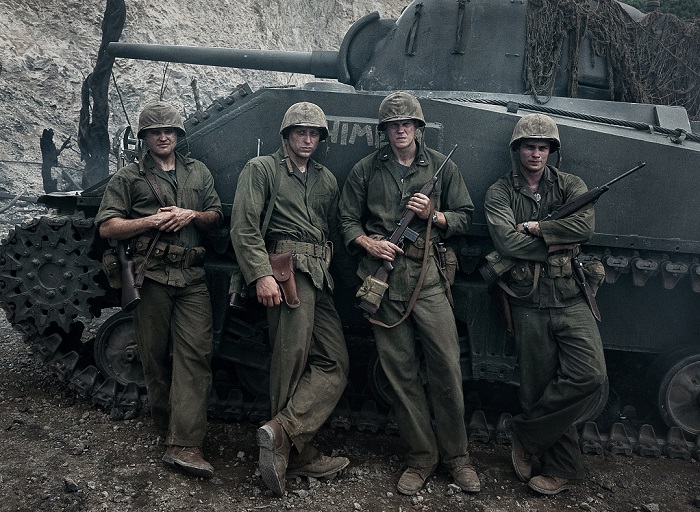
With strong performances in Promising Young Woman, Licorice Pizza and Smile 2, the script for The Mosquito Bowl was a role that really spoke to him. “We went through the auditioning process, where we auditioned for all four characters. And afterwards I wrote Pete a letter and pledged my heart and soul. I told him how much his films over the years have meant to me. I was doing this while the L.A. fires were happening. I was watching my childhood home burn down at the same time, with my mother, with all this feeling and emotion and weird memories,” recalls the actor who was raised by his mum in Pacific Palisades.
In portraying real-life football player Tony Butkovich, he was the only one of the four actors to bring real skills to the role. “And all this time I thought I peaked in high school!” he quips.
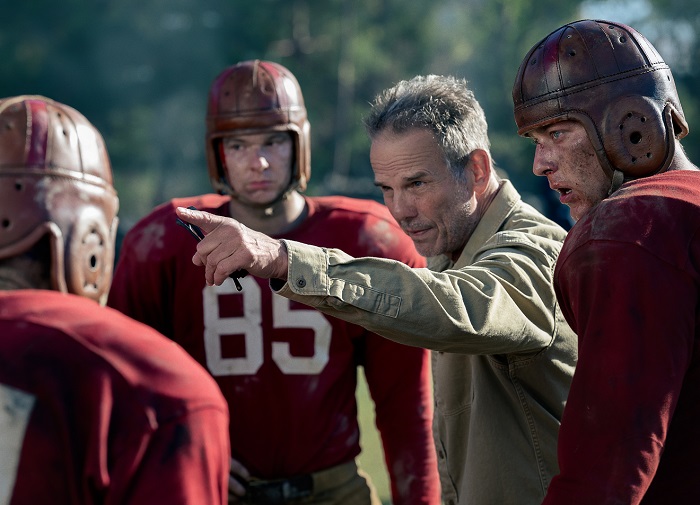
The title of the film refers to an extraordinary football game played on Guadalcanal between two Marine regiments, both of which had assembled impressive rosters of former college players. This was no ordinary recreational game. The lineup included three All-Americans and seven former college captains. For these men, football represented a temporary escape from the terror and uncertainty surrounding them. For a few hours, they could forget the war, remember who they had been, and enjoy the familiar excitement of competition. It was a chance to feel young again.
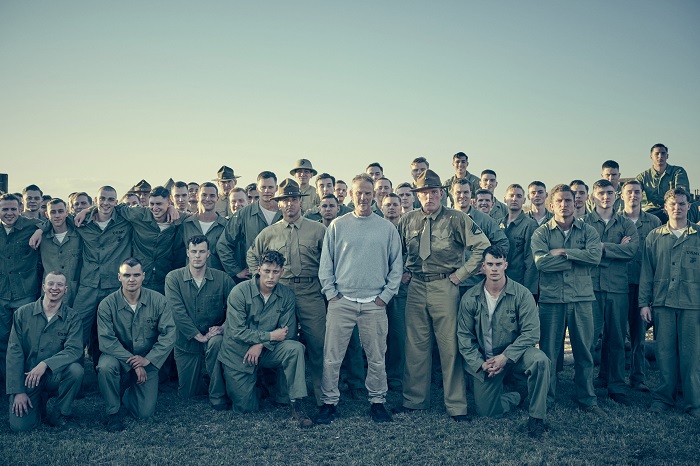
Filmed in Australia, the movie recreates the demanding physical conditions of military training and the brutality of combat in the Pacific. The production team searched all over Queensland and New South Wales – both on the ground and with Google Earth – to find an environment that not only allowed them to do what was needed to do but also looked authentic enough to play for Shuri Castle on Okinawa.
Certainly, this band of four actors feel forever changed by the experience. “The gift of this project was the fact that we could kind of walk this journey with each other, and walk this journey with these young men and what they experienced, getting to know each other; a couple of these guys’ rivalry turned to friendship,” says Galitzine (Masters of the Universe, Red, White & Royal Blue), who recalls the sorrows of filming the battle scenes. “I remember that week was a really heavy week. And having to say goodbye to these guys and this special friendship that was created. We can only imagine what these real young men experienced: the brotherhood, the fraternity, suffering through these things together. I just feel incredibly grateful that I got to watch these guys work, and their performances are incredible.”
The Mosquito Bowl is in select cinemas from November 12 and streaming from November 25.
