


By Patrick Scott
After reading a newspaper article about a single father diagnosed with a terminal illness and forced to find a foster home for his 4-year-old son before he dies, Uberto Pasolini extrapolated this heart-wrenching situation into his latest film Nowhere Special starring James Norton.
We understand that the inspiration for the film came from a newspaper article, can you tell us why that article made you want to make it into a movie?
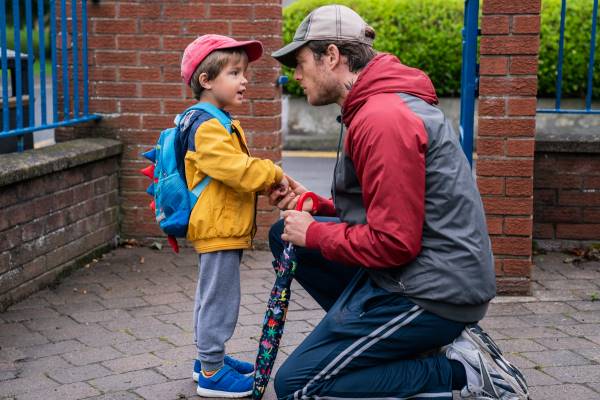
“[Holds up the newspaper article] Well, I’m a father. I’m a father of three grown-up girls and I tried to put myself in those shoes. There are two different things, which are the centre of the film I think, one is to try and think about the future of my child, and how best to help him after I’m gone. And so, what is a family? What is the best family for my child? And do I know my child well enough to make that choice?
“And the other thing, of course, is, how do I explain with my four-year-old child what is happening, and why life is going to change and how it’s going to change. And, of course, death. How do I explain to a four-year-old death without traumatising him forever? Those were two things that this man had to deal with two years ago when I read this.
“And I think, already parenthood is an extremely difficult job. To find the right balance between support and guidance without putting too much of yourself in it, it’s a complicated job. And this seems to be a moment for fathers, for parents, that was enormously more difficult. In particular, because of the age of the child, but in general, a situation that I wouldn’t want on my worst enemy, really.
“So, it became, first of all, research on what it is to adopt, why do people adopt, how do adoption agencies put these people together, and adopters, etc. And then it became about life and how you communicate with somebody; and it’s really a love story for me, between two individuals who happen to be a father and a son, that could have been somebody else. But in this case, they were father son.”
In previous interviews, you’ve had the article with you as well. Does the story still inspire even though you’ve finished the film?
“It’s not so much the text. It’s the photograph within the story. The photograph I had in front of me for a year while I was researching and writing the script. It was a demonstration of enormous love and intensity and the importance of love.
“In this case, as you know, the mother of the child had decided to leave the family, very early on. And the father spent the rest of his life completely dedicated to this young boy. It’s very moving. It’s very powerful. I’m sure both parents would behave in a similar way, but this was a concrete example of paternal love. And looking at his photograph, I was looking in his eyes, throughout my writing in my research, and so I became very close in a funny way without ever meeting them.”
What kind of research did you do in preparation for the film?
“Well, I did two different things. One was reading a lot of biographies and autobiographies about people at the end of their lives confronting death. What does it feel knowing your time on Earth is limited?
“Then I talked to lots and lots of people who are involved in the process of adoption. Whether they were people who went on to adopt, or people who had been adopted themselves, to try and understand why they had come to the decision of adopting, what they were looking for in the child that they were hoping to adopt. And how that interest and desire to adopt would affect the conversation they had with somebody who has to make the decision of whether they should or should not have a child.
“Of course, the situation is very specific and very particular here because the majority of children who are put up for adoption, do not have parents involved in the process. Either the parents are simply not there, or the parents are deemed by the social services to be insufficiently capable to look after the children. And so, the choices and the decisions are made by social workers, sometimes with the advice of foster workers who would be there in the initial meetings between potential adopters and the child because they’ve been with these children for a while.
“The father had been a perfect father, was a wonderful father. And so, he was involved in this choice, and this looking for the “perfect family” in a way; it’s a very, very rare occurrence. But because he was the father, the meetings between potential adopters and the child, and the father is much more intense. It’s far more powerful, it’s much more tentative at the same time. They are not trying to convince a social worker who is dealing with one of the many, many cases he would be dealing with, they’re trying to convince the father of the child, to give them this child. In order to fill that in, I needed to talk to many people who had been there, or even who had been involved, to try and guess how these meetings could have actually happened
“I tried to connect with social workers who dealt with the specific case. For privacy reasons, they couldn’t tell me anything more than was in the newspaper. And, in a way, that was liberating because it allowed me to explore things that might not have happened specifically to this couple and put in some of my experience of parenthood, my experience of being a father. Even the practical ones, you know, taking lice out of a child’s hair, you know, those kinds of things I did 20 years ago, but I used to do it all the time.
“But as I said, research was reading about death and how somebody who’s been told they’re going to die might feel. They might look at the world and might look at other people walking in the street and say, ‘why me?’ That kind of feeling to me, is very important. I tried in a very subtle way to introduce it in the film, in the relationship between John and his work and the life around him. Lastly, but very importantly too, I had long conversations with charities who deal with child bereavement who help young children deal with the event of death. They helped me to try and imagine more clearly how a child of four would register certain situations, how even a child who is charming, as sweet, as loving, as faithful, would have his tantrums but is confronted with feelings which he doesn’t quite understand, that come from a lack of knowledge of what is happening. And the reality of a four-year-old reacting to a situation like this, was important. There is a wonderful charity in England called Winston’s Wish, which helps children in these situations.”
Even though it has a very depressing subject matter on paper, the film still has a very light and hopeful tone and mood. Was it important to convey hope instead of dwelling of the depressing subject matter?
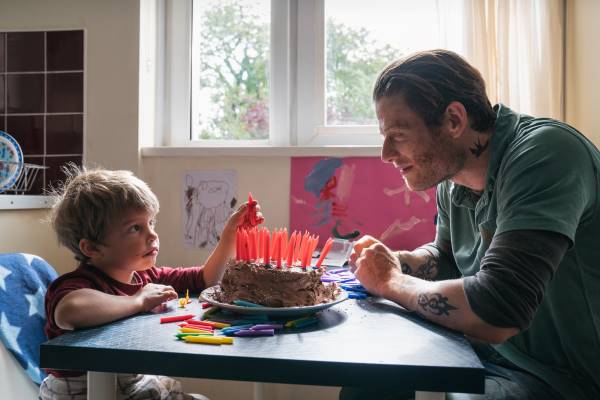
“I wouldn’t call it depressing. I think maybe the situation is sad. Yes, it was very, very important to me because the thing that drives John is not desperation as a whole, it has to be hope. He’s not giving up, he’s not thinking about himself, he’s thinking about the life of the child. And the search has to be one which is driven by the desire to find the right person that will be living with his child. That energy has to be positive. Otherwise, he wouldn’t have been able to do what he did in reality and in the film.
“Not so much the subject, the situation is dramatic and tragic. But because the concept is dramatic and tragic, it was to me very important to treat it with the lightest possible way, and to focus on the positive, which is the love between these two people, rather than the reality of hospitals or doctors, or sickness or anything like that. It’s a love story. It’s a film that hopefully encourages you to hug your friend a bit closer, to give another kiss to your child, to look at your neighbours with positive emotion. It’s dealt with as lightly as possible. And I think it’s one of the things that we succeeded in doing is making a film, which is charming, and full of hope, in spite of the situation that it’s portraying.”
From your own personal point of view, did you learn anything about yourself as a father in creating the character of John?
“In a way, yes. What seems to be particularly complicated for certain parents, in particular fathers, is to express emotions and to be emotionally available. My daughters always complained, whenever they have a problem, my first instinct is to find a practical solution to the problem, a rational practical solution. Whereas, what children often need and partners need and friends need, is emotional recognition of where they are, and sharing that emotional state. What they really want is a hug. They don’t want the practical solution. The thing that made me feel more strongly, this lack of emotional availability on my part, is the fact that in the case of John, that had to be a constant. The first and foremost thing he had to do, was trying to feel and be aware of the emotions and the feelings, his emotional intelligence had to be more powerful and take precedence on his practical ones. And I’m not sure if I’ve learned anything in terms of putting this in practice in my life, but I’ve certainly become much more aware of how men very often tend to find immediate practical solutions to issues that first and foremost are emotional ones and need an emotional recognition.”
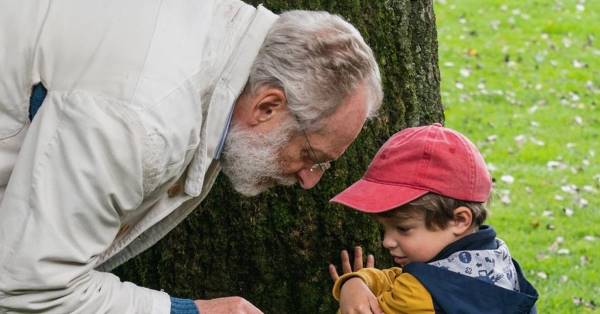
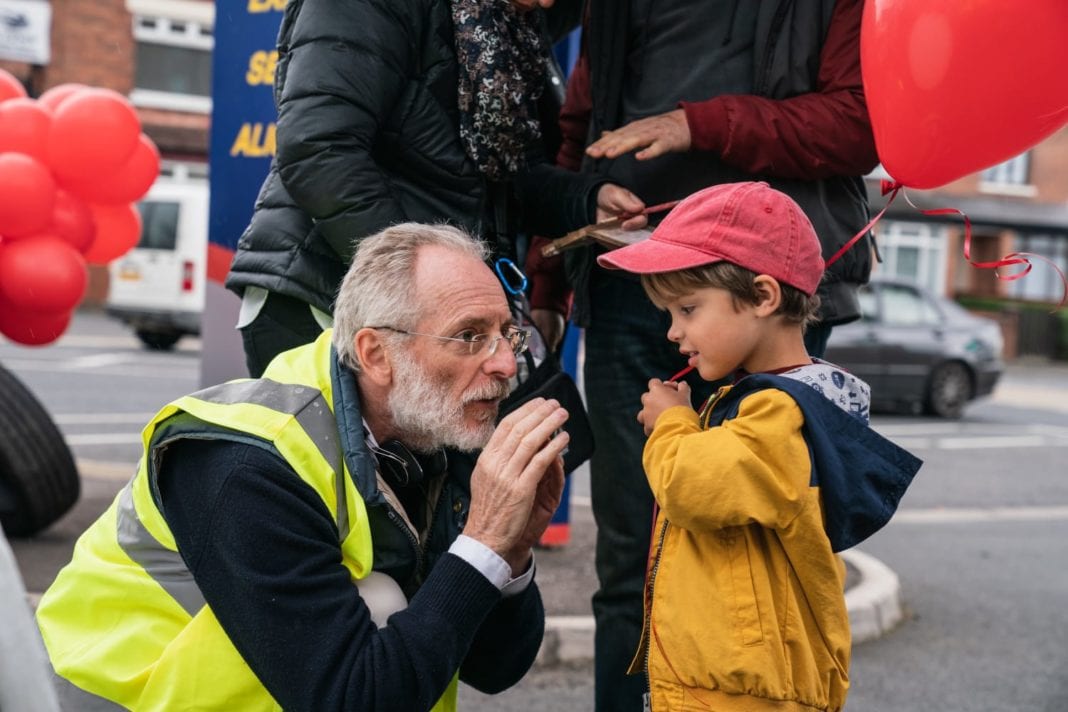
A lot of the tenderness from the film is derived from Michael and the performance of Daniel Lamont as he reacts to the world around him. How long did it take to find Daniel and what made you cast him for the role?
“We had wonderful casting directors in Northern Ireland, where we shot the film in Belfast. And we went through 100 children of this age, within three and a half, and four and a half. I saw 40 or 35 children face to face of the 100. Daniel was number six. And when I saw Daniel, everybody, after them had to be better than Daniel. And in fact, nobody was better than Daniel.
“When I say better, I’m speaking about a natural way of communicating and the readiness to play. What we did with all these children was start talking about them, their families, their relationship with their siblings, if they had any, and then we did little games of performance, of imagination, etc. And he was very much at ease with all these things. So, when I thought he was the best boy, I then got him together with James Norton. Of course, the first thing that needed to happen was to create a believable father-son relationship. And Daniel was immediately taken by James and James was immediately taken by Daniel, and there was an ease to their interactions from the beginning.
“But of course, I have written a boy who was very introspective and quiet and, in a way, a mirror image of his father who’s also very introspective and quiet. I needed to see in the boy an ability to focus and go inside himself. I needed the energy of a boy who would be prepared to come for 30 days, one after the other without getting bored. That was a big production gamble. A normal four-year-old, after three or four days around the set, they would say, ‘okay, this is interesting, but actually, I want to go back to school and to play with my friends’, or whatever it is. And that miracle of miracles did not happen with Daniel. He was a complete and true professional, from the point of view of always being there, always being ready to work, always being cheerful. But at the same time, when we were working, I didn’t want Daniel, I needed Michael. So, James was very important in this, to make sure Daniel kept the energy and interest in the process, which is bubbly. A lot of credit needs to go to James. He was enormously generous in giving his emotion and of his time, to Daniel. To make sure that he not only enjoyed himself, but also enjoyed the process of the actual filming.”
Did you have to explain to Daniel what the film is about in the same way John has to explain death to Michael?
“I left that to the parents. But it wasn’t the question of me telling him ‘Now, we are going to talk about death.’ It wasn’t a specific motivation. On a daily basis, or on a scene-by-scene basis, it was more ‘today, you’re going to have breakfast, and this is what the scene is about. You see that James is not very well, so you bring him a glass of water.’ It had to be more in terms of practical and in terms of visuals rather than emotional.
“I was quite keen on not making it an emotionally heavy process for Daniel with the dramatic scenes. I scheduled them for the end of the shoot. We shot almost in continuity so that we got to the scene when John has to explain to Michael about him dying, we kept it for the last day. I think the crew was more emotional than young Daniel in that moment. Certainly, James was more emotional. Actually, my problem was to contain James, because I didn’t want an overly emotional performance from the father. The father has to respect and has to help understand and adjust and accept what is happening and that would not be possible if the father is in tears, feeling sorry for himself. It’s important for the audience to find their own connection with it.”
Nowhere Special is in cinemas March 24, 2022
