



by Stephen Vagg
A little remembered blockbuster of Australian cinema.
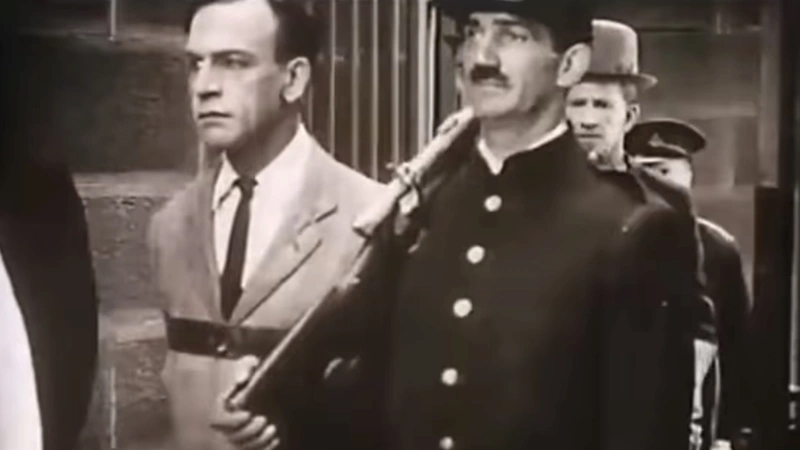
What is the most profitable Australian film of all time? No one knows for sure – getting accurate financial data in showbusiness is next to impossible – but before anyone gets caught up in Mad Max versus Crocodile Dundee arguments, we’d like to throw another contender into the mix – or two, rather: the 1912 opus John Lee, or the Man They Could Not Hang and its 1921 remake.
Yes, you heard that right – we are talking about a pair of movies that are over a hundred years old. The first was made for a reported £300, the second for probably not much more. Within thirteen years, both had taken in a combined estimate of £50,000 world-wide.
Now, that is a pretty good rate of return.
Of course, figures for film budgets and box office need to be taken with a grain of salt, and that £50,000 amount was only an estimate. (One account said the 1912 film made £20,000 another says the 1921 one took £27,000) And admittedly we are talking about two films rather than one.
Nonetheless, it’s still a lot of profit, especially when you take in the fact that the films were also successful in New Zealand, Canada and England. Indeed, The Man They Could Not Hang was, arguably, Australian cinema’s first international blockbuster.
 What makes this achievement even more remarkable is that everyone was taken by surprise at this success. Oz cinema historians Andrew Pike and Ross Cooper called the 1912 movie “by far the most extraordinary ‘sleeper’ of Australian film history.” Everyone’s called it “a freak”.
Neither picture had stars or a famous director. The script was based on a play that was popular but not that popular. The story was well known but not cutting-throats-to-grab-movie-rights well known. Indeed, said film rights were originally given away without much thought by the original author. And – get this – even the producer who made the 1912 version of The Man They Could Not Hang didn’t think his movie had much long-term commercial value and basically gifted ownership to some colleagues for next to nothing.
Why, then, were they such a hit?
The Man They Could Not Hang was based on the true saga of John Lee, an Englishman (the story is entirely set in England) famous for surviving three attempts to – you guessed it – hang him. In the 1880s, Lee was convicted of murder and sentenced to death. The execution took place, but the trap door of the scaffold failed to open – not once, not twice, but three times (all on the same day, apparently). After this, the authorities gave up, and Lee’s sentence was commuted to life imprisonment; he was released in 1907.
The incident became a tabloid sensation, and Lee cashed in by writing his life story in 1908. This account was then adapted into a stage play which heavily fictionalised events. From what we can gather, there were a few different stage versions going around – copyright law was a little more fast and loose back in the day. An Englishman called Claude Murrell wrote one play of The Man They Could Not Hang, but an Australian actor living in New Zealand, Frank Davenport also had a go. Davenport said he originally read about the Lee case in a book that he picked up in Wellington, New Zealand; he wrote a stage adaptation which invented a love story and some comedy, made it clear Lee was innocent (we gather that the real Lee was a little more shifty), and made up a coda where the British government paid Lee compensation for wrongly imprisoning him (which Davenport thought was a key reason behind the play’s popularity, as it provided a happier ending).
From 1911 to 1912, Davenport toured with the play through New Zealand and then Australia. It wasn’t a blockbuster, like, say, Struck Oil (a hoary old melodrama whose appeal formed the basis of JC Williamson’s fortune in Australia) but it was popular, particularly in rural areas, where apparently the punters couldn’t get enough of faulty trap doors and hints of divine intervention.
Davenport’s success impressed Phillip Lytton, a tent theatre entrepreneur (i.e. he’d travel from town to town performing in tents rather than theatres) who bought the rights off him. Lytton had a decent run presenting The Man They Could Not Hang in his tents and decided to turn the play into a film. This was quite common at the time – most Australian movies made before World War 1 (including The Story of the Kelly Gang) were stage plays adapted for the screen by theatre entrepreneurs.
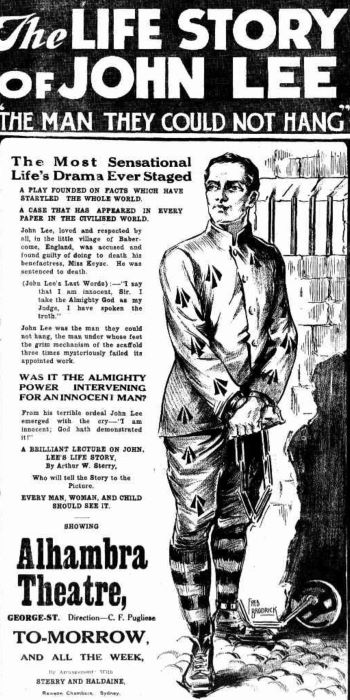
The full title of Lytton’s film was originally In the Shadow of the Scaffold, or The Man They Could Not Hang. It played in cinemas from 1912 to 1913 and from what we can gather, did okay but not that great – based on contemporary newspaper advertisements, it seemed Lytton struggled to get it into cinemas, and he was probably too busy focused on his stage shows to give much attention to distribution. A columnist even later alleged Lytton was “disgusted” with the film.
Anyway, Lytton decided to give away (or sell at a very cheap price) ownership of his movie to two of his employees, both actors – Frederick Haladane and Arthur Sterry – who were able to devote their full time attention to the film. (Lytton may have felt sorry for Sterry whose wife only recently went missing at sea). They took The Man They Could Not Hang to Newcastle in 1916, where one of them would lecture to the audience while the movie screened. To everyone’s surprise, this season was a blockbuster, selling out all its sessions. This wasn’t a weird Newcastle freak thing, either – the film’s success was repeated in other towns, including Sydney where The Man They Could Not Hang had a hugely popular run in 1917. Two years later, advertising claimed that the movie had been seen by more than one million people throughout Australia – and our population then was a little over five million. The Bulletin called it “highly crude – but popular”.
Sterry and Haladane decided to remake The Man They Could Not Hang in 1921 with a new cast. We’re not exactly sure why they did this – maybe the original print was getting faded, or they were a little embarrassed by the 1912 version, or they wanted to expand it out to over an hour, or it was to renew copyright, or they just thought it was a way to make some more cash, or a combination of the above. Unlike most Australian silent films, a copy of this version survives – you can see it here.
The 1921 version of The Man They Could Not Hang isn’t bad; not in the class of, say, The Sentimental Bloke (1919) but perfectly adequate by the standards of the day, and nicely photographed by Tasman Higgins. Everyones, the industry trade paper, said the film had “a story most flimsily constructed, and lacking in many essentials” but allowed that “the title carried a punch and there is enough morbid interest in the theme to assure for it a wide measure of patronage”. Variety called it “the worst film ever made”, which it most definitely was not, but we think that Variety was annoyed that the movie was so popular.
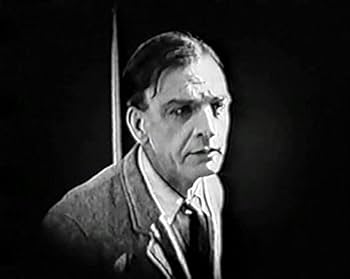 This version of The Man They Could Not Hang also kept packing them in. And not just in Australia – it was a box office sensation in New Zealand, Canada and England (though not South Africa where it was banned – presumably the government didn’t want the public to lose its faith in the dependability of scaffolds). Still playing in cinemas until he the late 1920s, it was arguably Australian cinema’s first real international blockbuster.
Why was it a hit?
Normally there’s some obvious reason to these things. For instance, there was another Australian silent-era freak hit, The Martyrdom of Nurse Cavell, which earned around £25,000 for a reported cost of £450. This mostly seems to have been because of timing: the film dramatised the execution of British nurse Edith Cavell by Germans in October 1915 and reached cinemas by January 1916; it thus was the first movie on the greatest propaganda story of the war.
There was no such clear explanation for the success of The Man They Could Not Hang, either the 1912 version or its 1921 remake. Pike and Cooper admitted the reason for the film’s success “remains an enigma”, suggesting that the story might have appealed to “both to the prurient and the pious in the community”.
The tale of an innocent man falsely accused is always solid drama. The fact that it was based on a true incident was sexy, as was the whole three-times-fail-to-execute thing – high concept, as they say. Being set in England presumably would have helped internationally – no one had to explain where England was. The film spends a lot of time with Lee’s character before anything that interesting happens to him, but that does build empathy for the character. Contemporary reviews said that Haldane and Sterry gave great lectures which added to the audience’s enjoyment.
But to be that successful? There had to have been something else.
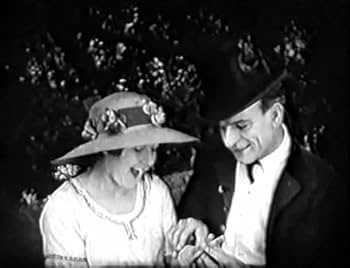 Our theory is that the story of The Man They Could Not Hang took on this unexpected resonance during and after World War One. The conflict tore Australia apart, with most people knowing someone who was killed or wounded, and the nation divided over issues such as conscription, religion, industrial relations and so on. Somehow, this story – ostensibly based on a true incident (which gave it verisimilitude) – with its theme of an innocent person unjustly persecuted, who escapes death due to (seemingly) divine intervention, and who recovers to find true love and government compensation, really spoke to people at the time, and continued to do so for several years after the war. Not just in Australia, but New Zealand, Canada and England – all countries greatly affected by the war.
In 1934, a producer decided to remake The Man They Could Not Hang as a sound picture. This made complete sense – the most popular early Australian sound films were remakes of silent hits (On Our Selection, The Squatter’s Daughter, The Hayseeds, The Silence of Dean Maitland). So, producer Joe Lipman blew the dust off The Man They Could Not Hang, hired Raymond Longford to direct, and cast Arthur Sterry in a key role as Lee’s father.
The story had worked gangbusters from 1916 to the late 1920s – surely people would rock up with the added appeal of sound?
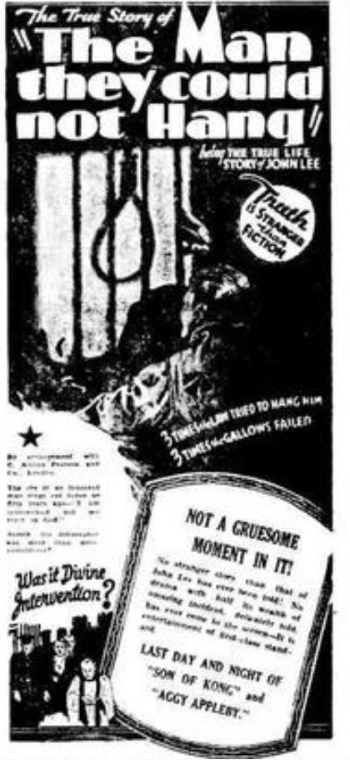 Well, no, but also yes. The 1934 version wasn’t a blockbuster but it made some money, particularly in country areas. Reviews were vicious and Longford never directed again. It definitely didn’t have the impact of the silent version. Maybe the story was better suited to silent cinema. Maybe too much time had passed.
There’s always – always – an element of mystery and magic in why some films work commercially and others don’t. And nowhere was this more true than in the case of The Man They Could Not Hang.
Still, it’s a film(s) that should be remembered and discussed. Because when one is that popular with audiences, it tells us something about who we were as a nation at the time… even if it’s not exactly clear what that thing was.
