




by Stephen Vagg
Part four in our series on the films of Lee Robinson and Chips Rafferty examines Dust in the Sun, aka the film where it all started going horribly wrong.
In 1956, Lee Robinson and Chips Rafferty were riding high. The first three movies they’d made had all been increasingly successful – The Phantom Stockman, The King of the Coral Sea and Walk into Paradise. Indeed, Walk into Paradise could claim to be the highest grossing Australian film made until that time.
They were solid adventure stories, which leaned into the strengths of both men (location work and Rafferty); they were realistically budgeted and assembled, familiar yet fresh. It was an impressive achievement – there had been nothing like it since Ken G Hall’s string of successes in the 1930s, and Hall had the backing of a major cinema chain. Robinson and Rafferty did it as independents, raising the finance themselves.
Over the course of five years, they hadn’t really put a foot wrong.
Well, that was about to change.
 Dust in the Sun hasn’t always been an easy movie to see – it barely got a cinema release in Australia or overseas; it was given a few runs on television, but generally in the middle of the day; the film is not available commercially today, despite its clear cultural importance. (We’ve only seen a black and white print of the film at the NFSA, although it was shot in colour.)
The movie was part of Robinson and Rafferty’s desire to evolve, creatively and commercially. Every production they had made until this date tried to improve upon the one prior; Dust in the Sun was no different.
For starters, it was the first Robinson-Rafferty movie based on a novel – Justin Bayard by Jon Cleary, then one of the best-selling authors in Australia (The Sundowners, You Can’t See Round Corners). Cleary actually knew Robinson; when we interviewed the novelist for the National Film and Sound Archive in 2004 he recalled: “Lee was my clerk in New Guinea in Military History and when I got out of the army they were setting up the Australian Film Board under a Canadian, I forget what his name was [Ralph Foster], but they brought him out here and he got in touch with me and asked would I join. I said ‘No I’m going to England.’ He said, ‘Well do you know anybody who would be interested?’ and I wrote to Lee because Lee was still in the army. Lee had been a junior journalist on The Daily Telegraph. And I wrote to him and said would you be interested. And he wrote to them, and they took Lee on. And they developed him and he branched out with Chips and they got some money from somewhere else and they made movies.”
It’s easy to see the appeal that Justin Bayard had for Rafferty and Robinson – it’s a solid detective story set in the Kimberley about the eponymous character, a patrol officer, pursuing an alleged Aboriginal murderer being chased by other Aboriginals who wish to kill him; they wind up at an isolated outback homestead full of intrigue where there’s another murder. (You can read a serialisation of the book here.)
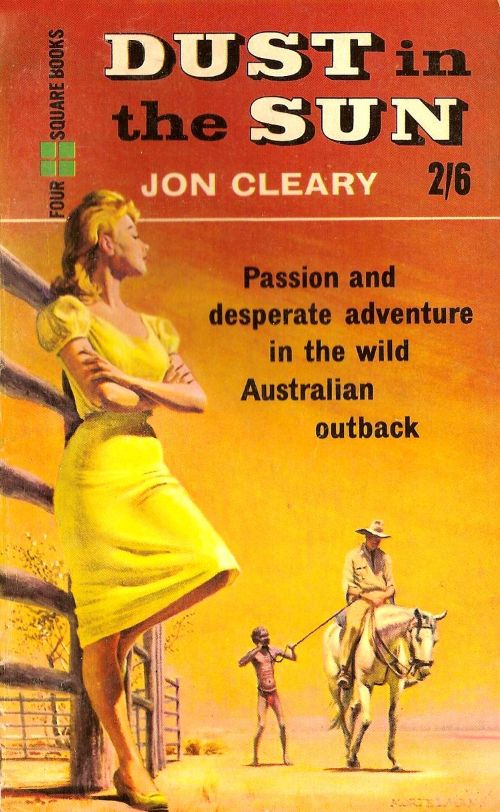
The novel contained more plot than the previous Rafferty/Robinson movies, but it was still a combination of adventure tale and murder mystery like their first two efforts; the producers would also have been comfortable with the Aboriginal characters, bush cop hero and outback location (although they shifted the setting from the Kimberley to the more logistically easy Northern Territory for the movie). Robinson was drawn to tales about bush policemen – in addition to Walk into Paradise, he’d made two documentaries about Justin Bayard style officers, Outback Patrol, narrated by Rafferty and Bush Policeman, and he would later make Camel Patrol for his TV series Australia Unlimited.
Robinson elected not to write the script himself, but had it done by a “proper” writer – W.P. (Bill) Lipscomb, an English author who’d authored several Australian themed screenplays, including Bitter Springs, A Town Like Alice and the dodgy 1957 version of Robbery Under Arms. The screenplay was reasonably faithful to the novel.
Then Robinson and Rafferty started making mistakes.
First was the casting of the lead role. One hears the words “bush patrol officer” and instantly assumes Chips Rafferty would play it. However, the role was given to little-known New Zealand actor Walter Brown – who wound up being fired during the shoot after a clash with Robinson and was replaced by Ken Wayne. Rafferty isn’t even in the film.
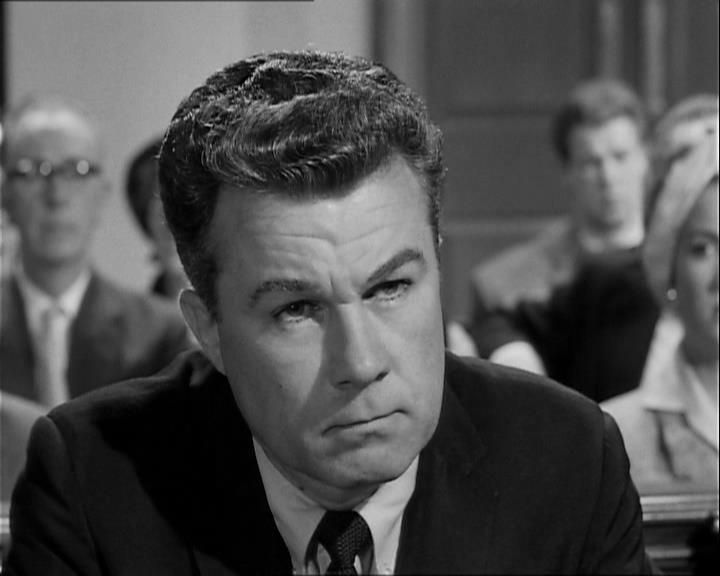
This was a major, major error. Rafferty’s screen presence and fame was one of the key strengths of the Rafferty-Robinson films until then; he was an internationally recognised actor, coming off a big hit in Walk into Paradise. Walter Brown and Ken Wayne were fine actors, but basically unknown to the general public; Wayne had been in Sons of Matthew and enjoyed some fame for his radio career, particularly playing a hero in the popular series I Hate Crime, but he was no Rafferty, whose films had been seen around the world.
Why was this decision made?
Because the plot involved Justin Bayard romancing the daughter of a homestead foreman, and the producers feared that Rafferty was too old. This fear was likely influenced by memories of the harsh reviews given to Rafferty’s performances in The Loves of Joanna Godden and especially Eureka Stockade, which involved unconvincing romantic scenes.
It was still a mistake. They could have (a) given Rafferty an age-appropriate co-star to make those scenes work, or (b) removed the romance (which isn’t that crucial as Bayard rides off into the sunset at the end of the film, or (c) created a new character to handle romance duties – a sidekick for Bayard, say. The adaptation of the novel didn’t have to be faithful.
Or, if they were insistent on Bayard being young, Rafferty could have played another role – the foreman, or the station manager whose wife is murdered. Neither part was the lead, but they could have built it up.
It was a remarkably poor choice. Ken Wayne wasn’t even that handsome.
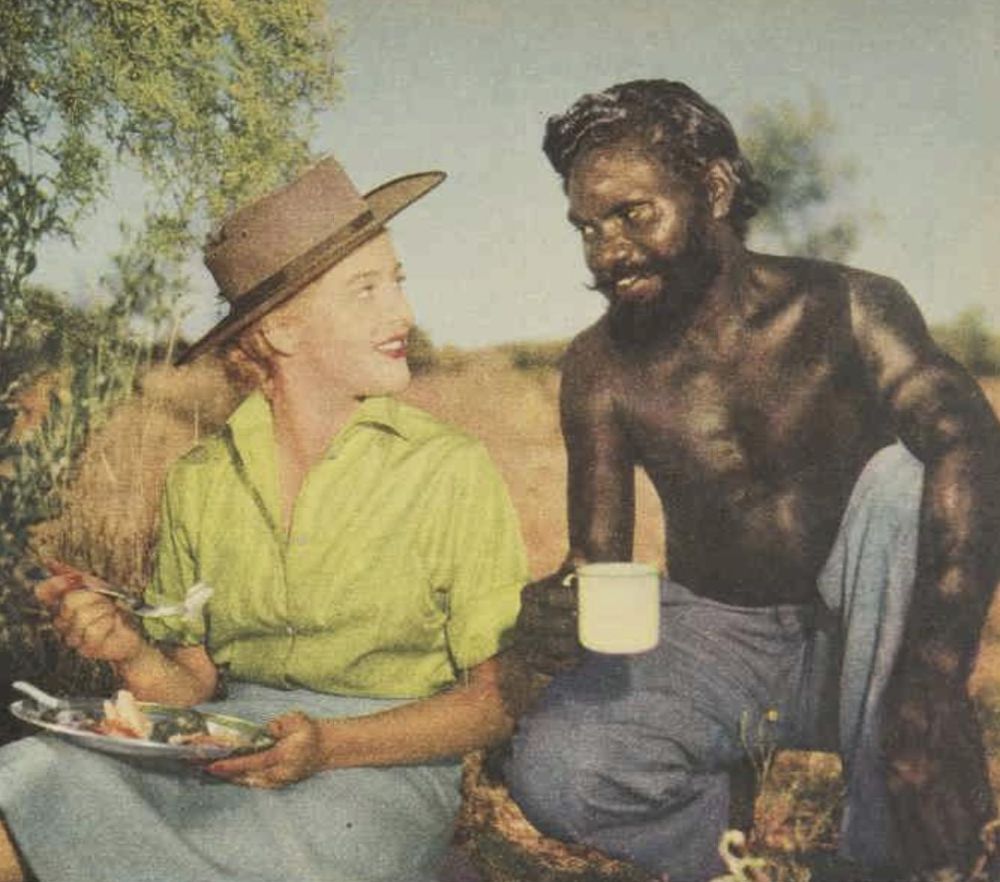
The second problem of Dust in the Sun is that it featured too many inexperienced actors in the cast. We exclude Ken Wayne from this, and the two leading Aboriginal actors, Robert Tudawali (of Jedda fame), and Henry Murdoch, who did not have great demands put on them (and were excellently used). The four other key cast, however, were all relatively green with challenging roles.
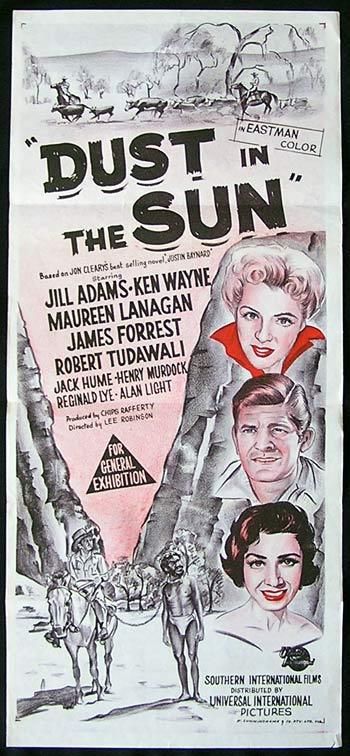
The part of Bayard’s love interest was given to Maureen Lanagan, a model; Robinson had used models on his first two features to great effect, but they performed all their scenes opposite super experienced Sydney radio actors. That was not the case for Dust in the Sun. Lanagan’s father was played by Jack Hume, a busy Adelaide actor with no screen experience, while the manager was played by James Forest, an Adelaide journalist who had barely acted before (he later moved to Hollywood and earned some TV credits). The part of Forest’s wife, the murder victim, was played by someone called Jill Adams, imported all the way from Britain. We get that Robinson wanted to appeal to the British market, but doubt that Adams was worth the money; she had British film credits, but mostly small or supporting parts in films like All at Sea, and her name would have meant nothing at the box office. She wasn’t up to the acting demands of her part either, which was challenging.
That is cruel to write, but Robinson needed good actors to help overcome his weakness in handling actors – in the past, he’d been able to rely on people like Charles Tingwell, Reg Lye, Rod Taylor, Guy Doleman, Lloyd Berrell, Max Osbiston, Francois Christophe and most of all Rafferty. Now, he only really had Wayne, who was a last-minute replacement. The best of the cast was Tudawali, whose on screen presence was electric; Henry Murdoch was also very good.
As a sidenote: Adams’ role would have suited a French actress, because the character had to feel like an outsider in the Australian outback. In hindsight, it’s a shame that Robinson and Rafferty didn’t use their new French connections to employ a French actress instead. They might have gotten some French financing and/or European sales that way – or simply a better actor.
Robinson later did an oral history with Graham Shirley in which the producer-director was defensive about the casting choices for Dust in the Sun, saying that there were not enough experienced actors around. This was, with all due respect, simply untrue – there were plenty of talented Australian actors with stage and radio experience, some of whom had even done TV and films.
Our theory is this: Robinson used to know a lot of actors when he was working in Sydney radio in the early 1950s, but most of those had moved overseas (Guy Doleman, Janette Elphick, Rod Taylor, Charles Tingwell; Lloyd Berrell died on the boat to England)… and as the decade went on and Robinson spent so much time away on location, he lost track of the current good actors. We also think that he was excited by the idea of discovering fresh faced newbies and importing “stars” from Britain. Which is all good and fine in small doses but not in this film, where there are so many dramatically heavy scenes.
A third problem of Dust in the Sun was its tone. It was always clear what sort of movies the first three Robinson-Rafferty collaborations were – adventure tales, with the first two having a murder mystery spine. Dust in the Sun could have easily slotted in with that genre… but after a brilliantly exciting start, the film gets far too bogged down in character scenes, with endless exchanges of people talking and actors capital “A” acting. Robinson needed to keep characters on the move, constantly emphasising the dangers of the physical environment. But he didn’t, in part because of problem four…
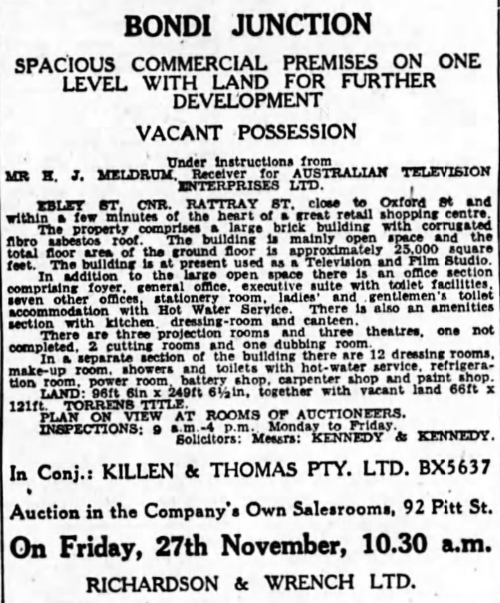
Not using locations enough. This seems odd, considering it’s a Lee Robinson film, but far too much of Dust in the Sun was studio-bound. This was no doubt due to all the acting, but another reason was that Robinson and Rafferty had bought the former Cinesound studio at Bondi Junction and wanted to use it.
Buying the studio was, in hindsight, a huge mistake for the producers. We get why they did it – television was coming to Australia, they wanted a base to make films for television (they formed a company specifically for this purpose, Australian Television Enterprises). But it was a needlessly reckless move. There was no guarantee that Australian stations would buy locally made television shows (and they didn’t – they had to be forced to by quotas, which did not come in until the 1960s). Furthermore, Robinson and Rafferty were not ideal men to run studios: their expertise was in the field of location work, not studio management and they were always running off to some exotic corner of the globe and weren’t around to keep an eye on the store.
In the short term, the purchase of a studio led them to shooting far too much of Dust in the Sun indoors. In the long term, it caused them to go broke. (Australian Television Enterprises would be in receivership by the end of 1959.)
The fifth and final problem with Dust in the Sun was its racial attitudes. We’re not going to pretend that the 1950s was a beacon for racial understanding, and acknowledge the racist tropes of King of the Coral Sea with its oversexed and villainous “half castes”, and the depiction of locals in Walk into Paradise as dangerous children. However, even in the 1950s, it would have been a jolt to see a movie where the hero treats his Aboriginal prisoner like a dog, chaining him up with a collar, storing him in a boat tree and taking him for exercise walks. We’ve no doubt this is historically accurate, but this would have been confronting to watch.
Having said all that, we feel obliged to stress that there was/is much to admire about Dust in the Sun. The photography, some of the acting, the attractive women, the electric charisma of Robert Tudawali, the story, the location work, the opening sequences, its usefulness as a cultural document. It’s a great crime for Australian culture that this movie is not more readily available – surely Tudawali’s presence and the Aboriginal content would ensure there was a decent educational market for it at the very least? We don’t get it.
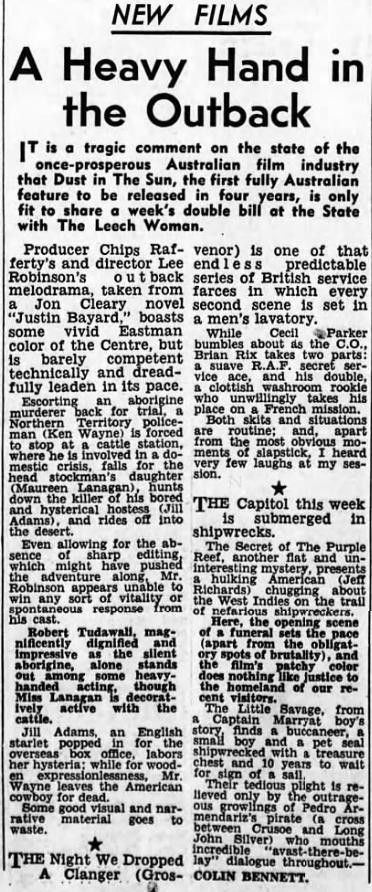
The film was shot in late 1956; according to Cleary, “the crew called it Lust in the Dust” although he said that he never saw the movie as “we were living out of the country when it went into release.” The film had its premiere at the 1958 Sydney Film Festival and received atrocious reviews (Colin Bennett of The Age made the point of bagging it in two separate articles – thanks Colin); there was a minimal cinema release in 1960 in Australia and England although it popped up on television from time to time. (As a side note, Cleary worked on the script for the 1959 film The Siege of Pinchgut based on a story by Robinson.)
What lessons can be learned from Dust in the Sun?
- If there’s a choice between using a star and an unknown, use the damn star. We doubt that the film would have vanished so easily with Chips Rafferty in it.
- Accentuate your strengths and minimise your weaknesses. Robinson was strong on locations and visuals, and weak at directing actors and building tension; he made a movie that had lots of scenes indoors with weak actors. Dust in in the Sun needed more scenes outdoors and much better actors.
- When in doubt, add suspense and violence. Watching the film, you keep wanting things to be jazzed up. Dust in the Sun needed more violence. People in peril. Tense scenes at night. Less talk.
- Know thy genre. The film should have been an adventure tale with a murder mystery spine. It starts off that way but turns into more of a character drama with murder mystery elements and forgets its adventure.
- Don’t have a hero treat human beings like dogs.
- Don’t buy a studio when your experience is mostly doing location work and you aren’t home to supervise the studio, and you don’t have a guaranteed source of income. It is hard to lose money on real estate in Australia, but very possible if you overexpand and can’t pay the interest. That’s what happened with Lee Robinson and Chips Rafferty.
Dust in the Sun was the first major misstep from Lee Robinson and Chips Rafferty.
Unfortunately, it would not be the last…
The author would like to thank Graham Shirley for his assistance with his article. Unless otherwise stated, the opinions are the author’s.
