



by James Mottram
Sometimes, you hear a movie pitch that is so good, you just know that it’s going to fly. Take Dangerous Animals. The story of a serial killer who feeds his victims to sharks, it’s a brilliantly grisly high-concept that instantly appealed to filmmaker Sean Byrne, who was sent the script, written by Nick Lepard, by producer Brian Kavanagh Jones. “My pet subject is serial killers,” explains the Australian director, “and this also had the safety net of the loyal shark fan base to hold that up.”
Two sub-genres fused into one is smart enough, but particularly, given that this flips the shark movie genre on its head. “The shark wasn’t the monster, for once,” says Byrne, the Hobart-born filmmaker whose earlier features include The Loved Ones and The Devil’s Candy. “The man was the monster, which I thought kind of cracked the code in a way, because ever since Jaws, shark films have followed the same formula.”
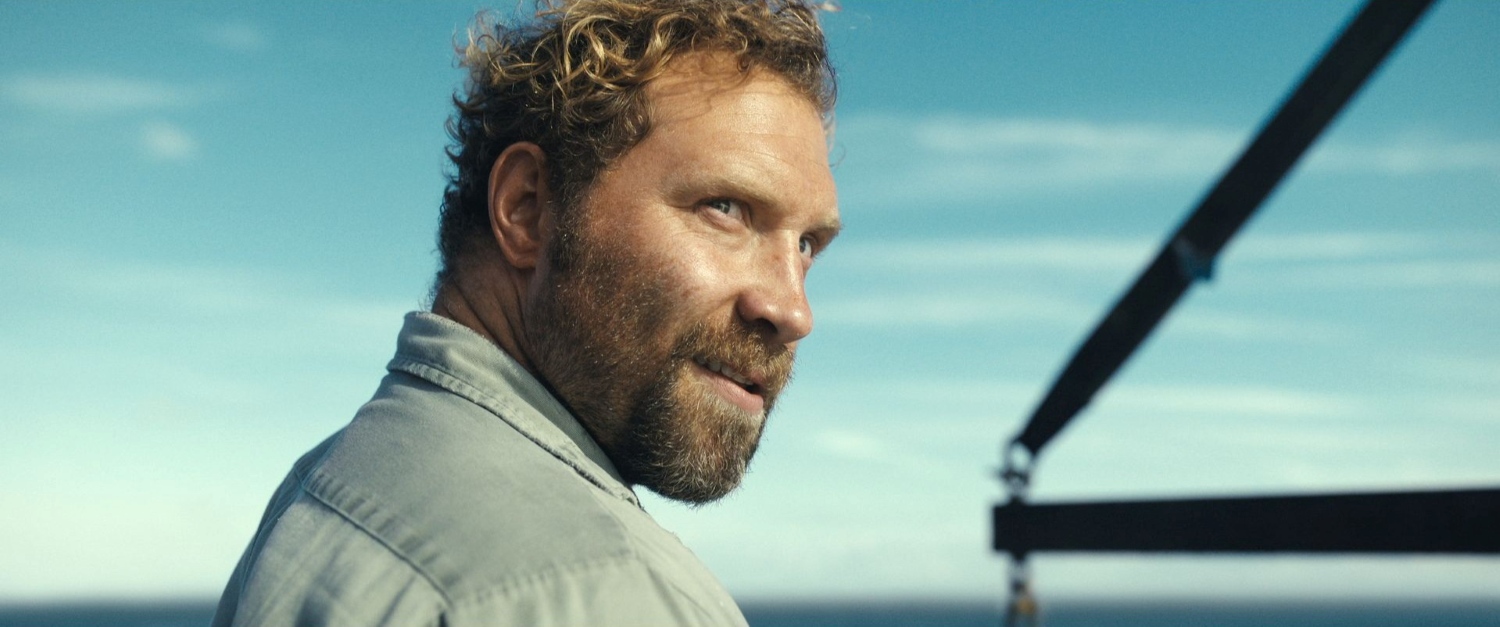
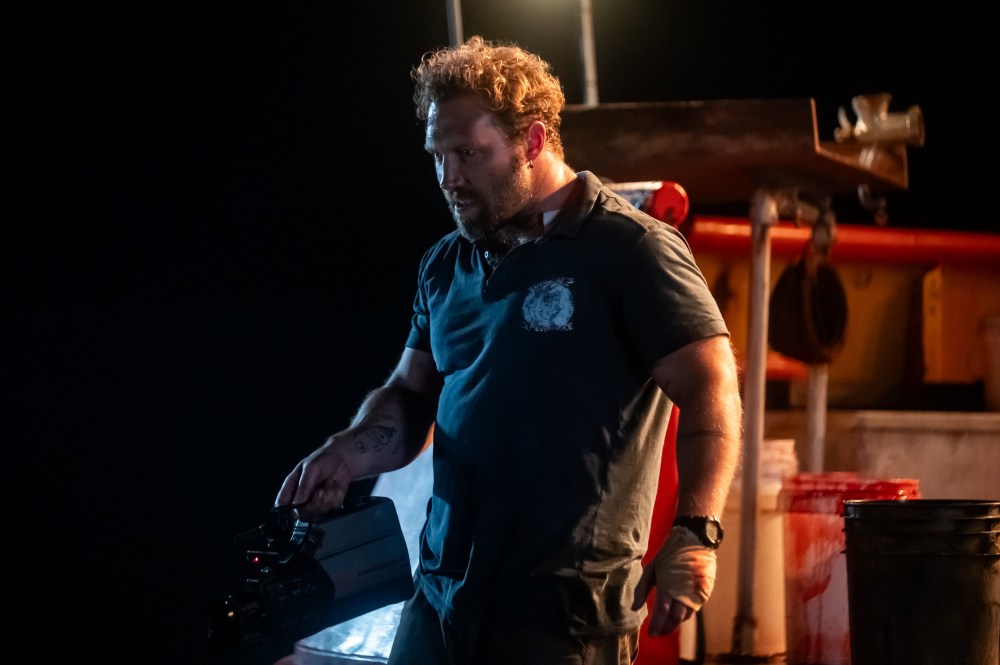
In Dangerous Animals, Jai Courtney plays Bruce Tucker, who makes a living from ferrying tourists out into the ocean and taking them cage-diving with sharks. Before long, it’s revealed that Tucker is also psychotic, capturing women, stringing them up on a hook and over the side of his boat, before lowering them into shark-infested waters. Oh, and he films it all, the sick puppy.
“I mean, it’s pretty fucking out there,” laughs Courtney, the Sydney-born actor who has mixed roles in indie and Australian fare with a string of blockbusters including The Suicide Squad, Terminator Genisys and A Good Day to Die Hard. “Definitely, there’s a read on that script that if it was in different hands, it could become something exploitative. It just would have a different tone. But I think that the alchemy here has created something that I’m really proud of. It’s the best version of what this could have been.”
Byrne had seen Courtney in Felony and Catching Dust, and knew that he was a strong enough character actor “to capture the broken child inside the man” that was required. “On top of that, you add this physical intimidation, because he’s such a big guy. He’s got a real physical intimidation where he could kill you with a punch. I just thought that he was going to eat this role up. But it didn’t mean that he’s going to take the role, there’s a stigma associated with shark films.”
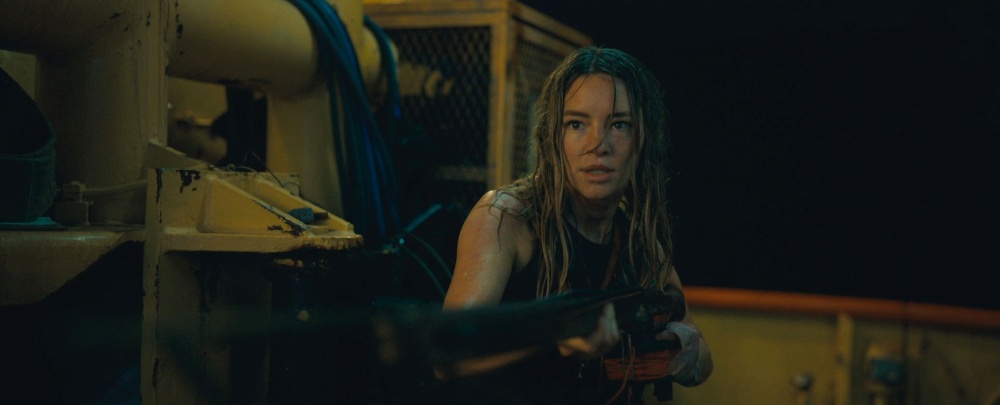
Indeed, for every Jaws, there are ten Sharknado films waiting to gobble you up. But Byrne was never going to turn Lepard’s script into the lowest-common denominator, especially as the story witnesses Tucker come up against a female surfer named Zephyr (Hassie Harrison). A film that sees women tortured and tormented, curiously Dangerous Animals might just be a movie about female empowerment, as Tucker’s “outmoded version of toxic masculinity” gets “demolished”, says Byrne. “I thought that was always clear.”
As the director adds, “Zephyr is a force to be reckoned with, and it’s there in the title. I think she is the most dangerous animal, and the shark ultimately decides who deserves to live and who deserves to die. But I was so glad that, when I spoke to Jai, he saw the opportunity. In many ways, horror is such a great stage for antagonists. And we talked about Kathy Bates in Misery, Eric Bana in Chopper, Jack Nicholson in The Shining and Christian Bale in American Psycho.”
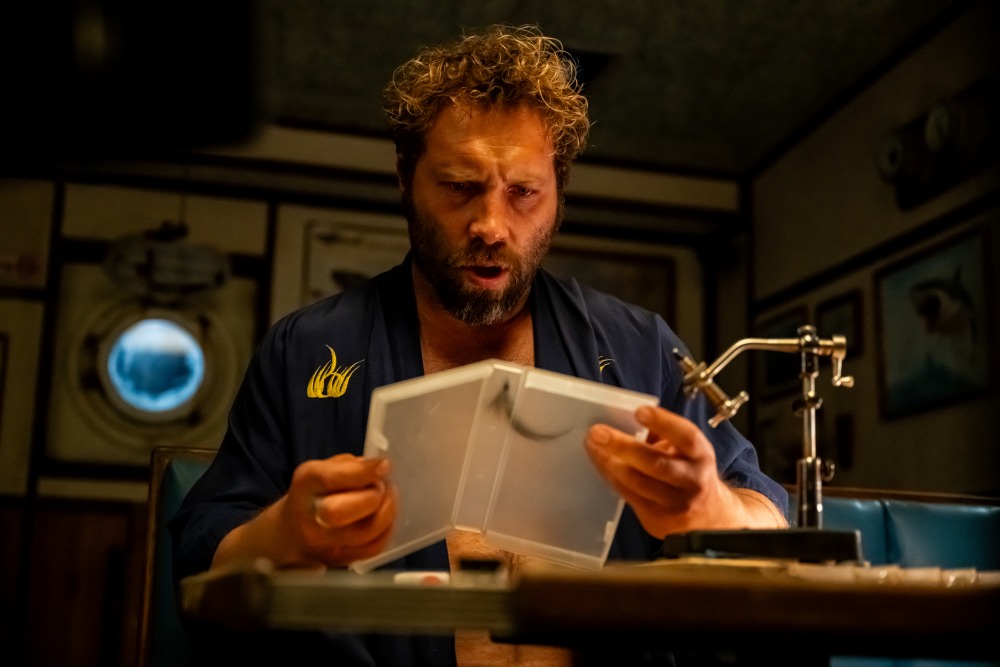
While Tucker can easily sit alongside Wolf Creek’s Mick Taylor and other terrifying antagonists from Australian genre cinema, Courtney didn’t want to see him as a plain and simple villain, even though he’s a moral vacuum. “If I go in with a judgment around that, it stifles what I’m able to access with him. I never want to go into something and feel like he’s evil. Therefore, you play a wash of that. In his reality, he’s not. He’s not twisting his moustache going ‘Let me create chaos.’ He actually believes in his crusade and his role in the order of things.”
As for the sharks, Byrne claims that he was never an obsessive. “I’m not that scared of them. Growing up in Tasmania, there are sharks off the coast. I’ve got friends that are surfers that are always scouring the waves, seeing if something’s going to turn up. But I’ve never been someone that’s just watching Shark Week, until this script crossed my desk.” After ingesting the screenplay, Byrne started watching dozens of nature documentaries and working with shark experts. “The film doesn’t shirk on shark carnage, but it’s always at the manipulation of man. What I’m most proud of is that it really does show sharks in their majestic light.”
Meanwhile, Courtney doesn’t try and b.s. it. “They are fucking terrifying! I’ve actually been in the water and seen one before, while swimming in Australia. It was pretty rowdy. I managed to get on the beach. All I saw was a big black fin come through a wave. Me and my mate were out swimming, and there’s actually a bloke further out than us. The wave rolled through, and he bobbed over the wave, and a shark pulled in over the back of that wave, and we got the fuck out of there, but there was no attack. Dolphins are one thing, but if there’s a big old shark out there, mate, it’s pretty scary.”
Set and shot on the Gold Coast, the Dangerous Animals production spent two weeks at sea, with Tucker’s boat stationed out at Jumpinpin, moored off pontoons, before it was taken back to a marina and connected to a jetty for filming to continue for a further two weeks. And, yes, shooting on water wasn’t easy. “You don’t hear all these stories about Jaws and Waterworld for no reason,” says Byrne. “It’s fraught with practical difficulties and danger… so it was an incredibly difficult exercise.”
Still, it was also effective doing it for real, rather than in a water tank. “There were definitely days on this set – and I’ve never experienced this before – where I was disturbed, personally,” says Courtney. “There were moments where I was like, ‘Oh, man, I’m done!’ We were stringing actors up on hooks, hanging ‘em out over the water in the middle of the night. This young girl screaming for her life. There are definitely moments within that where you’re like, ‘Have we got it? I’ve had enough.’ It’s tough to get through.”
Byrne nods in agreement, noting that the scene with Ella Newton – as Heather, another of Tucker’s victims – was hard to take. “It was three o’clock in the morning at an isolated marina with shrill screams cutting through the night, and it did feel genuinely upsetting,” he says, noting that he wanted to push the characters to the edge of realism. “That’s what I love about survival films. My favourites are when the protagonist has to truly earn their survival. I’m a big Rocky fan… just look at him at the end. He’s been pushed beyond. You got to take a beating, y’know?”
To top it all, Dangerous Animals received its world premiere at the Cannes Film Festival last month, in Directors’ Fortnight, the strand that, in the past, has unveiled bonkers films like Mandy and The Lighthouse. Curiously, Byrne didn’t even know the film had been submitted to Cannes. “It wasn’t a part of the release strategy. It was actually the French distributors, The Jokers, that went, ‘Oh, we actually think this has got a chance.’ I wasn’t told until a couple of weeks beforehand that we’d even submitted! So, it was an incredible surprise.”

After travelling 29 hours to get to the French Riviera, then doing a day of press, it was a surreal moment for Byrne to be presenting the movie. While he had tested it and was “optimistic” that it hit the right beats, he admits that he was “absolutely terrified” to show the first shark film ever officially selected for Cannes. Thankfully, the audience lapped it up, giving the movie a wild, 10-minute standing ovation. It almost became a little bit embarrassing. “Jai was like, ‘Oh, enough’s enough! We’ve gotta go.’ And so, he started to leave!” Thankfully, Courtney was held in check to soak up the well-deserved applause – acclaim that’ll only get bigger as Dangerous Animals hits Australian shores.
Dangerous Animals is in cinemas 12 June 2025
