



by Christine Westwood
“This is the story of my best friend, he has issues.”
So begins the funny, fast paced and heartwarming story, Standing Up for Sunny, described as an ‘Australian romantic comedy.’
The deadpan Kiwi accent belongs to Gordo, played by newcomer Italia Hunt, who is introducing Travis, a young man with cerebral palsy.
“Travis lives and works alone – and nobody dreams of being alone forever.”
Travis is a comedian with Cerebral Palsy played by RJ Mitte, an actor with cerebral palsy.
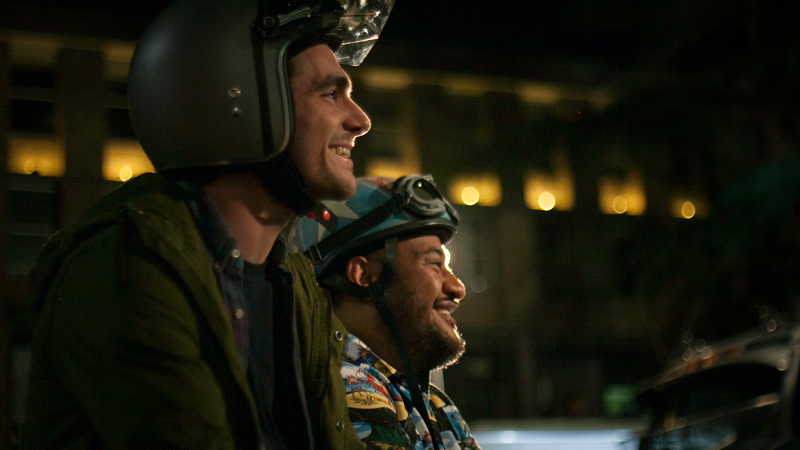
Travis has issues, demonstrated when he crashes a car while trying to run over a bunch of guys who are taunting him. But he’s no match for Gordo, a pot smoking, beer drinking blind man with no boundaries, who moves in with Travis and punctures his isolation.
Travis and Gordo meet Sunny (Philippa Northeast) at a Newtown pub where she is being groomed by her Svengali boyfriend Mikey (Sam Reid). Mikey wants her to do stand-up so she can join him in a male/ female double act on his successful radio show. Sunny’s dream is to be a mechanic and she has major issues with self-confidence, which makes her cave-in when heckled by an audience. Travis, hilariously caustic and a natural at fighting back, comes to the rescue, and Mikey employs him to teach Sunny to handle herself.
We can see where this is going, but it’s a fun ride getting there. Will the handsome Travis get the girl when the obstacle isn’t so much his disability as his hostility, born of self-loathing and prejudice from others. This is what really isolates him. Meanwhile, blind Gordo gives us some of the funniest scenes as he refuses to be marginalised or isolated.

Mitte spoke to FilmInk at the Sydney Film Festival about playing Travis, his passion for acting and increasing diversity in film.
“I started at age 12 and it was always camera, I never really had an arts or theatrical background. I can do stage plays but I still treat it like a camera but with a really big lens! I was an extra, I was doing classes and taking coaching but no major parts til Walt White Jnr in Breaking Bad. [5 seasons from 2008]
“The way I approach a part stands on my experience and reality, and I go from that to asking, what is the character’s experience and his reality, and try to recreate that as much as possible. We are emotional creatures. Some people shut off aspects of who they are because of traumas but I try to utilise all of it, from joy and bliss to pain and anger, and I try to make it as real in the moment as possible.
“The way in with Travis, was this wall of anger and resentment about his life. He’s like many people who are isolated and have a lack of self-belief, while at the same time, they want a life but they resist it. Travis’s attitude stemmed from what he didn’t like in his history, so I used all those things in my life that I wanted to change, and all my regrets, and I used those moments. Then working with Philippa and Italia and Sam, they brought such reality to their characters so you can use these real reactions they’re giving you.
“Open casting started in Australia, they looked everywhere. Then they went out further, globally. When I came onboard Philippa and Sam were attached to the film, but they were still looking for Gordo. He’s unique and it was hard because the character is blind. Italia was the best actor that we found for the role. He brought such heart and comedy. We were very lucky to have this group because they brought such passion to the story. We were based in Bondi and Newtown, so it was a Sydney movie, an Aussie movie. I’m American, Italia’s from New Zealand, it’s a reflection that Sydney’s a melting pot. As for why did they hire an American to play the lead – same reason they hire Australians to play leads in American movies.
“Steve’s a great actor and director, he knows how to get the information across, he has a vision of the scene and knows what’s supposed to be happening. He was very focused, and he knew the emotions he wanted. We had a week of rehearsal to go over the script, it was a great experience. I believe the story we told is one of a kind. And it’s funny.”
Pivotal to the film are a couple of stand-up comedy performances that Mitte pulls off convincingly. He starts off with a paper bag over his face and dubs himself Bag Man until Sam cruelly undermines him, and he’s forced to get rid of the mask to perform as himself. There’s a nice moment of backstage support from real life comedians Akmal Saleh and Arj Barker, while Barry Humphries pops in for a cameo as a judge for the stand-up competition. It’s to Mitte’s credit that you assume he’s had experience in stand-up. He’s charismatic and funny with the right undertone of bitterness and self-deprecation that marks many good comedians’ routines.
“We shot with multiple cameras to get the main audience stuff first, get all the good jokes in, knock out the audience with a live performance. Then you say, ‘sorry guys, party’s over and this part of filming sucks!’ That’s when you’re going over sections and doing close-ups, when you get those looks and moments. In the scenes where I wore the bag on my head, the theatre training came in, where you need to get centred and always make it a fully projected thing.”
Mitte is the official Ambassador for United Cerebral Palsy and Shriners Hospitals for Children and a face for the #CutTheBull campaign launched in October 2014 in support of children with disabilities. He’s involved with SAG-AFTRA as a member of the union’s Performers with Disabilities Committee and appeared as a spokesman on panels including the Sundance Institute.
“I do work for many organisations, supporting and bringing awareness and understanding to what CP is. There’s a lot of ignorance, it’s so important to get information out, and accurate information. There’s a lack of understanding about trauma and injury, people are too quick to judge others without knowing the real facts.
“I’m excited to see the impact and growth of diversification in film, like at the Screenability program strand at the Sydney Film Festival for instance. People who love and watch films are hungry for diverse, unique and intricate characters. For a long time, we were seeing the same cookie cutter characters, just sending them down the line. Now there’s so much more and hopefully with festivals we can keep getting it out there. It’s a massive trend in Hollywood, the biggest trend right now.”
Next up for Mitte is a ‘quirky, dark’ project called The Oak Room, and he wants to direct and produce more.
“Something big – I’d like to have the money to hire the best actors and make something really good. Directing, producing, collaborating, there’s lots more to do!”
If he takes inspiration from Sunny’s story, and what he’s achieved already at 26, including being a catwalk model sensation and continued TV and movie roles, Mitte is set to be an influential presence for a long time to come.
Standing Up for Sunny is in cinemas December 5, 2019
