


by Cain Noble-Davies
Worth: $15.99
FilmInk rates movies out of $20 — the score indicates the amount we believe a ticket to the movie to be worth
Cast:
Nick Murcott, Matilda Mclellan, Jordan. M. Briggs
Intro:
… a viscerally distressing work…
Nick Murcott is a fascinating gremlin within the Aussie underground. With a style self-described as “white trash arthouse”, his work both through his dreamboy videos YouTube channel and his more recent festival entries resemble a rough mixture of early Brandon Rogers, Adult Swim infomercials, and Dankmus visually rendered at double-digit pixel fidelity. His terminally-online sense of humour and keen awareness of media influence has garnered him a solid selection of short films thus far, from the children’s TV nightmare scape of Calcium’s Clubhouse, to the Ocker mockumentary (Ockumentary?) The Pies, to the porn addiction dramedy Gooners. And now, he makes his full feature debut with The King of Darkness.
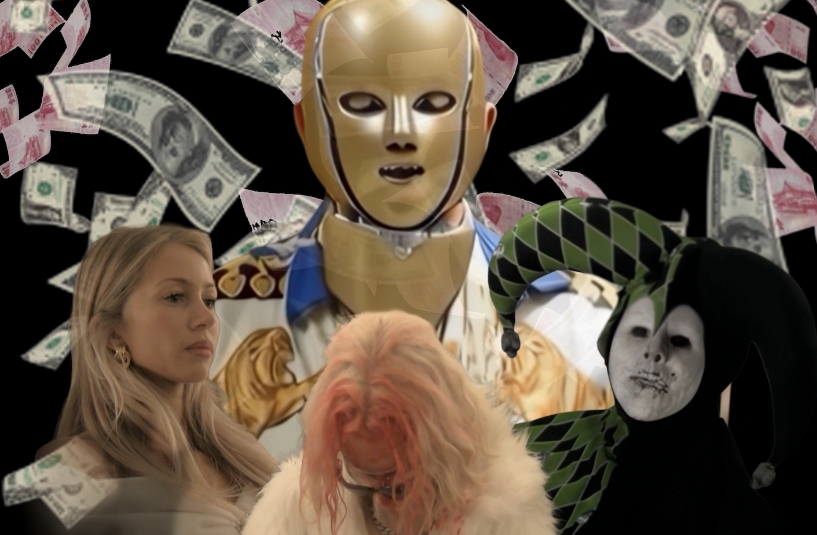
Watching The King of Darkness feels like drowning. Like being submerged in digital detritus to the point where you are being buried alive. Its depiction of sunny California is primarily composed of generative AI images, from the scenery to the people to the spoken dialogue to the subtitles. Palm trees morph and fold into each other, faces shunt into the backs of heads, and at particularly intense moments, the voice replication becomes so distorted and fragmented that it barely resembles anything, let alone organic human speech.
This is, it should be noted, all intentional. Rather than wielding generative AI as a means to convince a prospective viewer of something that didn’t happen, or otherwise aggrandise a certain figure through audacious, ‘triggering’ imagery, as it is too often used in modern social media, Murcott seeks to actively disturb and unsettle. Taking inspiration from Neil Breen and his memetically unconvincing approach to digital filmmaking, Murcott uses the uncanny nature of gen AI as texture for his story all about superficial beauty and the ethereal deception of the material world.
It is also, just to make this whole thing even weirder to contemplate, a riff on Shakespearean tragedy. Murcott’s on-screen role as the Prince and later King of California V, has him wrestling with the death of his father, his ascension to the throne, and his crumbling sense of self amidst all these consumerist symbols and glyphs. Murcott’s scripting is alarmingly convincing in its aping of Shakespearean prose, up there with the works of Ian Doescher. Take, for example, this line from “Hollywood” Heidi Holly (played with refreshing physicality by Matilda McLellan): “Then what has consumed thou’s beauty? Contorted beyond integrity. A 1080 image compressed to the ethos halls of 240 hell!”. While the dynastic tragedy within the drama can be tricky to fully appreciate when set against so much post-digital dementia, it has its moments of legitimate inspiration.
In essence, this film seeks to use the tool that has rendered so much of modern society, both on- and off-line, into a prolonged migraine, as a means of critiquing its effect on that same society. Now, the ultimate dilemma with all forms of satire is whether it functionally serves the same purpose as what it satirises (there’s also the classic Audre Lorde quote to consider, “The master’s tools will never dismantle the master’s house”). In fairness, this film passes the sniff test as far as thematic commentary, as none of this material hits on the wannabe Hollywood aesthetics of, say, that dogshit Paul brothers “$300,000,000” film. It isn’t trying to be photorealistic, or believable, or even legible in places. It is a rendering of how broken the world is, where everything from the people to entire countries have been mashed together into this viscous blob of simulacrum. How AI makes fools of us all.
But there’s also the real-world impact to consider, beyond the psychological and cultural. The film makes frequent mentions of and allusions to rain, both in its standard aquatic definition and ‘reign’ referring to the King and his lineage. In the film’s coda, an apex of bleak nihilism in a film soaked to the bones with it, it proffers that if this ‘norm’ is allowed to continue, the only rain we will ever see again is money fired from Supreme-branded guns. For want of water, we will all drown. The film shows awareness of one of the bigger talking points concerning generative AI – its tremendous water consumption and the larger ecological issues that raises; but by participating in these processes, it is ultimately part of the exact same problem. As pointed as it is in the juxtaposition of glossy artificiality and grungy but necessary reality, and its use of much older AI models for visuals and speech potentially giving it some leeway, the film is functionally identical to any earnest example of generative AI, despite its vehement sledgehammer attitude towards it in terms of text.
The King of Darkness is the nightmare, unreal shitpost we deserve as a species. Its aggressively fabricated textures and aesthetics evoke a sense of existential despair so strong that it feels like it saps one’s will to live from across the bandwidth. It wields generative AI in arguably the only artistic context that makes sense, as a wilful distortion of reality that reflects how much it has warped our collective understanding of it, but its use in and of itself takes the sting out of its sharper critiques of modern vanity culture. To its credit, it carries more genuine artistic merit than the vast majority of AI media that is currently circulating, to the point where entirely writing it off on the basis of its medium feels disrespectful. But by that same token, it would be just as disingenuous to entirely ignore its contribution to the very societal issues it tries to tear down. For what it’s worth, it’s a viscerally distressing work that, both because of and in spite of its production approach, effectively captures how bloody exhausting regular life has become in the wake of AI.
