



by Jamie Henry
Worth: $16.50
FilmInk rates movies out of $20 — the score indicates the amount we believe a ticket to the movie to be worth
Cast:
Vittoria Pasquini, Jamie Kenyon, Valerio De Simoni, Kris 'Ted' Davant
Intro:
... real, intimate and irreversible.
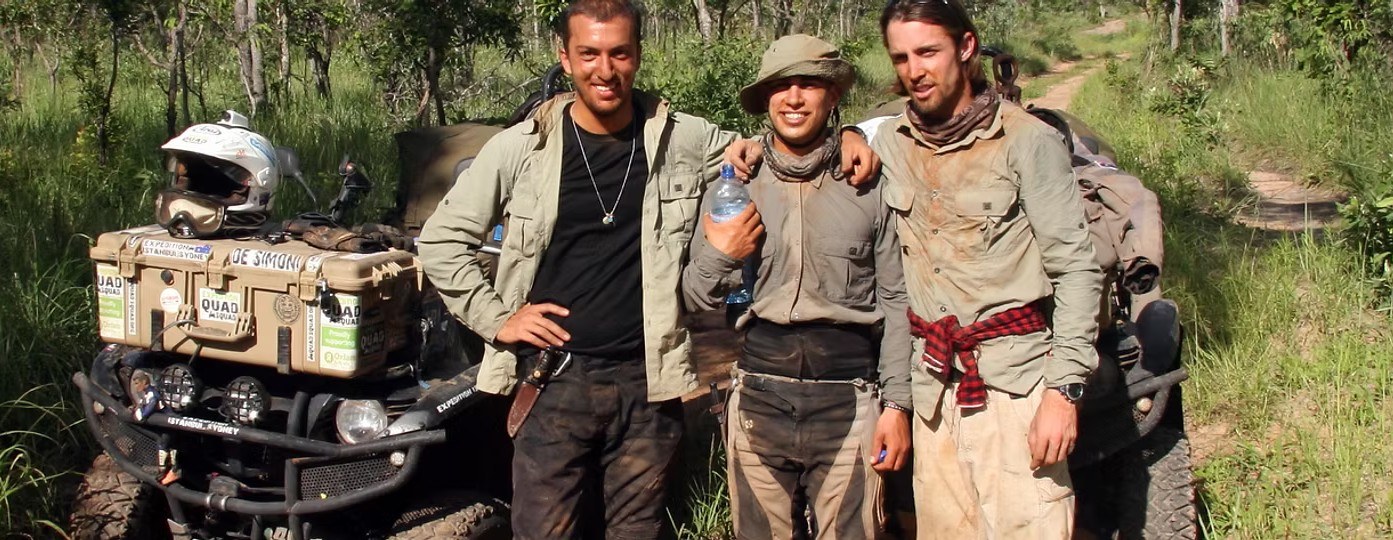
In 2010, Valerio De Simoni, Jamie Kenyon and Kris ‘Ted’ Davant set off from Istanbul on quad bikes, determined to cross Europe and Africa, raise money for Oxfam and break a Guinness World Record. They took cameras with them and filmed almost everything. More than 200 hours of that footage would eventually become part of this film.
That footage is extraordinary precisely because it isn’t extraordinary filmmaking. It is home footage: shaky, chaotic, sometimes poorly framed and often completely spontaneous. The camera is there because three young men wanted to document their adventure, not because they knew one day that strangers would be watching it.
At first, the footage is infectious. Valerio, Jamie and Ted are young, excited and completely immersed in the adventure. They laugh, explore unfamiliar places, meet people, deal with mechanical failures and push themselves across Europe and Africa.
But the reality of the journey gradually catches up with them. The physical demands become exhausting, tensions emerge and Valerio’s diary reveals his growing frustration and desire for the journey to end.
Then, in Malawi, Valerio is involved in a horrific accident. He is taken to hospital and dies. From that point, the footage becomes almost unbearably poignant.
A young Valerio laughing at the camera is no longer simply a moment from an adventure. It is a moment from a life that has ended. Even the ordinary images acquire a significance they could never have had when they were filmed.
Sixteen years later, Jamie and Ted are watching those same images.
This is where the film’s emotional weight really settles in.
There is a remarkable fragility to the people that Sand Roads places in front of the camera. Jamie and Ted aren’t simply recounting an old story. They are confronting it, watching their younger selves and trying to make sense of a journey whose ending they could never have anticipated.
At times, they break in front of you. At others, it feels as though revisiting it threatens to break them all over again.
The contrast with the old footage makes those moments even harder. The young men on screen are energetic and carefree; the people watching them years later carry the knowledge of everything that happened afterwards. The contemporary footage is carefully composed, while the archive material is messy and immediate.
Vittoria, Valerio’s mother, brings another kind of vulnerability. Jamie and Ted lost their friend. Vittoria lost her son. Her determination to keep Valerio’s memory alive gives the film an emotional centre beyond the original adventure.
Importantly, Sand Roads doesn’t turn Valerio into a saint simply because he died. His diary and the footage show someone complicated and recognisable: ambitious, funny, frustrated, affectionate and occasionally difficult. We see the friendships as they really were, including the tensions that existed before the tragedy.
Jamie and Ted eventually returned in 2011 to complete the journey without Valerio and claim the world record. It is an extraordinary achievement, but by this point the record feels almost beside the point.
The journey was never going to bring Valerio back.
What remains is the footage, the diary, the memories and the stories that can still be told.
Sand Roads is a difficult film to sit through. There are moments when the grief feels uncomfortably close, particularly as Jamie, Ted and Vittoria confront the past in front of the camera. It isn’t difficult because the film is manipulative; it is difficult because so much of what we are seeing is real, intimate and irreversible.
And that makes it worthwhile.
This is an important film because it doesn’t allow Valerio to become simply the victim of a tragic accident. It gives us time with him first: to see him laugh, argue, travel, dream and live. But the real journey is the one that continued after Valerio was gone.

I really like this review: it has been able to get all the different nuances of the doco, well done!
Only one clarification.
The footage was shot as a record of the journey but also having in mind (especially Valerio) a possible documentary, exactly with this type of rawness and in this I think there was the novelty, for that time.
Two days before dying Valerio (who had an editing program in his computer) made an editing of around 30’ of some of the footage they had shot.
I did not see the documentary as described. Many things were unclear to me, especially the accident, which killed Valerio. What really happened?
Second, when they were from Sydney, why spoke Valerio’s mother Italian throughout ?
It seemed to me they had different motives for this journey? Teddy, Jamie were to me the two fun loving typical carefree Aussies, whereas Valerio was serious about his goal, and life’s ambition.
And why did the two of them later break this wired record, when they were only two, and they headed back too, where they left off. I thought to break a record you must complete it in one go…? You can’t run 1000 m, stop at 500 m, and in some days resume the other 500 m, and win a medal. It does not make sense to me. And did not see, the two were very grieved.
Were their families extremely rich? To have so much money for these bikes from London? When they were sponsored, did they give the money they made to poverty stricken communities… l found this documentary confusing, the motives shallow, and the editing not good.
Sand Roads is more than just a documentary—it is a powerful journey through memory, identity, history and the human stories connected to a land and its people.
What makes this documentary special is the way it brings personal experiences and historical realities together. Through the voices and stories of those who experienced these events, the film encourages us to look beyond headlines and statistics and understand the human side of history.
The documentary carries a strong emotional message about displacement, memories, resilience and the lasting impact of the past on future generations. It reminds us that history is not simply something written in books—it is also carried in the memories, experiences and stories of ordinary people.
Sand Roads is thoughtful, moving and important. It gives audiences an opportunity to listen, reflect and ask questions about the stories that have shaped communities and individuals.
A documentary worth watching—not only to understand the past, but also to think about how we remember it and what we pass on to the next generation.
Congratulations to the entire team behind Sand Roads for bringing these stories to the screen.