


by Flynn Shan Benson
Worth: $13.50
FilmInk rates movies out of $20 — the score indicates the amount we believe a ticket to the movie to be worth
Cast:
Jeon Do-yeon, Sul Kyung-gu, Zo In-sung, Cho Yeo-jeong
Intro:
… a film that makes admiration possible, if not love.
What on earth does Possible Love mean? Love that exists in potential, if not in reality? Something ambiguous, between basic need and genuine affection? It’s the kind of phrase that sounds like it should mean something, like it could be an allusion to something you haven’t heard of, but comes off closer to the pseudo-English that covers t-shirts in Asia. You can only guess that it sounds better in the original Korean. Still, it’s a strangely fitting title for the new film by Lee Chang-Dong, one of Korea’s pre-eminent directors: it promises a work of emotional and artistic depth, but instead offers a narrative that, for all its artful technique, has precious little to say.
The film starts with a family going to a funeral. Ho-seok (Sul Kyung-gu) is a worker who was laid off by his industrial plant two years ago. Now he lives in a state of continuous despair, while his wife Mi-ok (Jeon Do-yeon) works at a mask factory and warns her husband not to drink in public. But, given that the funeral is for one of Ho-Seok’s former colleagues who has committed suicide, her husband ignores her and goes into a drunken rage among the mourners.
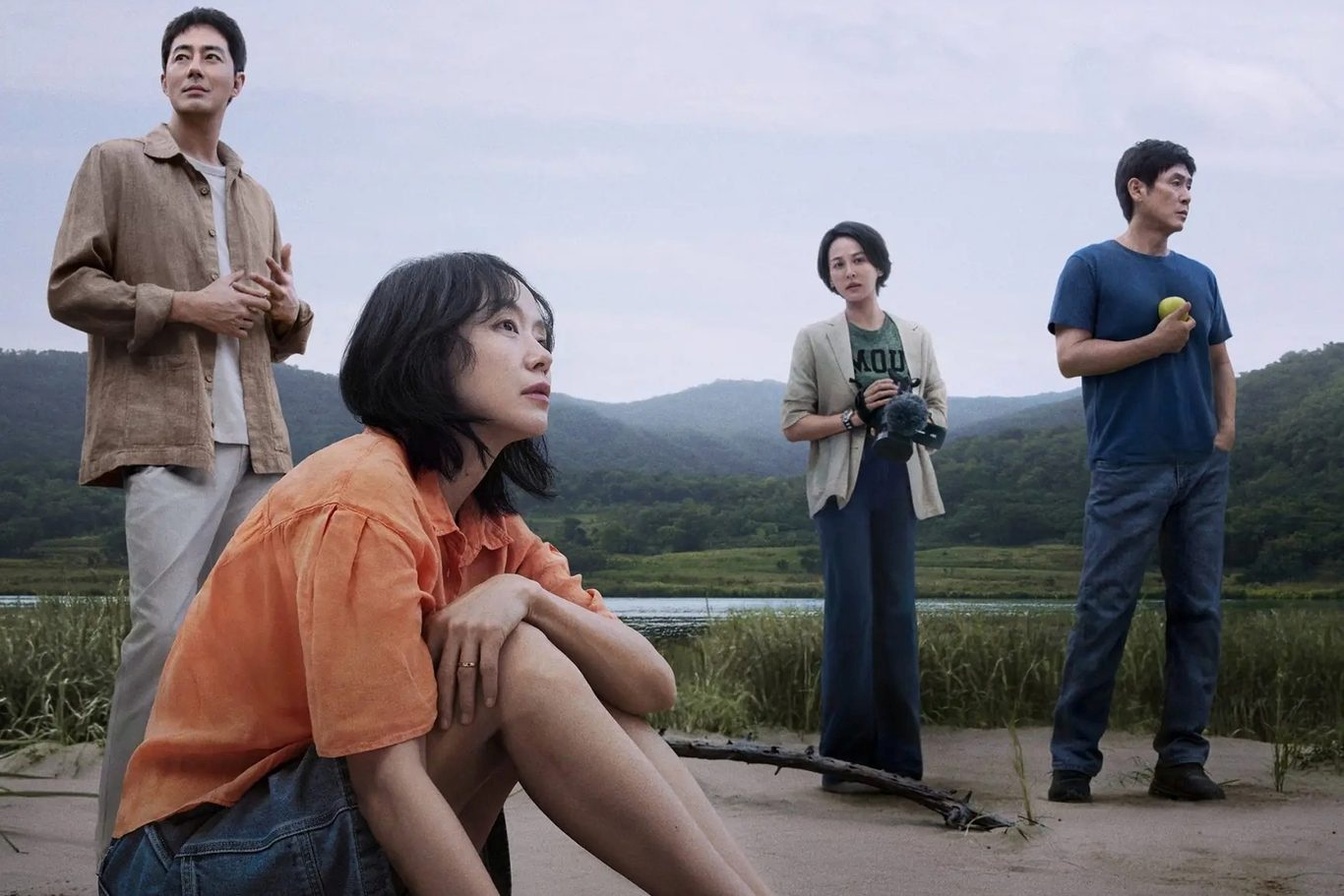
It is in this sequence that Possible Love shifts, with a camera documenting the funeral in the background whilst capturing Ho-Seok. The lens belongs to Ye-ji (Cho Yeo-jeong, familiar as the elite mother in Parasite), a documentary filmmaker whose work concentrates on Korea’s workers — though her designer handbags suggest that her solidarity doesn’t come entirely naturally to her. But she, together with her urbane husband, Sang-woo (Zo In-sung), sees potential in the story of this couple, and starts a relationship that sits uncomfortably between friendship and what David Attenborough has with the animals of Africa.
Fans of Lee’s other work will be disappointed that, after establishing his premise, the director seems content to let the film move along with little intrigue or complication. While his earlier films (Burning, Peppermint Candy) were provocative works that continuously made their viewers reappraise what they were seeing, Possible Love just keeps striking the same thematic notes: workers are exploited by the capital-owning class, who can brutalise them at a moment’s notice, while even those who seek to document their struggle and ‘give them a voice’ may simply be enacting a more subtle form of the same cruelty. It’s as good a political starting point as any for a film, but it never feels as if the director has anything subversive or original to make out of it.
Ultimately, Possible Love makes two things clear about Lee Chang-Dong: firstly, he is the most technically brilliant filmmaker working today. As in Burning, he favours a deft camera — often hand-held — that delicately frames shots and unexpectedly moves across spaces, without ever becoming ostentatious or self-indulgent. The actors deliver immaculate performances, subtly shifting in register. They are also cast so that they look like they could plausibly be the people they’re playing — a rarity in a cinema landscape where most films have actors too artificially beautiful to be anyone but a celebrity (see Hope, The Odyssey, The Housemaid and Hamnet, to name only a few examples). In Possible Love, a single shot of a couple in a bedroom achieves more than most films manage across their entire runtime.
But the film also shows that Lee is a seventy-two-year-old man — a man who can devote a film to the question of manufacturing authenticity on video, without any consideration of the masses of influencers desperately marketing themselves across social media. Perhaps the great director is out of step with his time, without anything left to say. But, even working with tepid material, Lee still makes a film that makes admiration possible, if not love.
