

by Pauline Adamek
Worth: $14.50
FilmInk rates movies out of $20 — the score indicates the amount we believe a ticket to the movie to be worth
Cast:
Floeur Alder, Lucette Aldous AC, Alan Alder, Robert Bestons, David McAllister AC, Chrissie Parrott AO
Intro:
… deeply personal and emotionally charged …
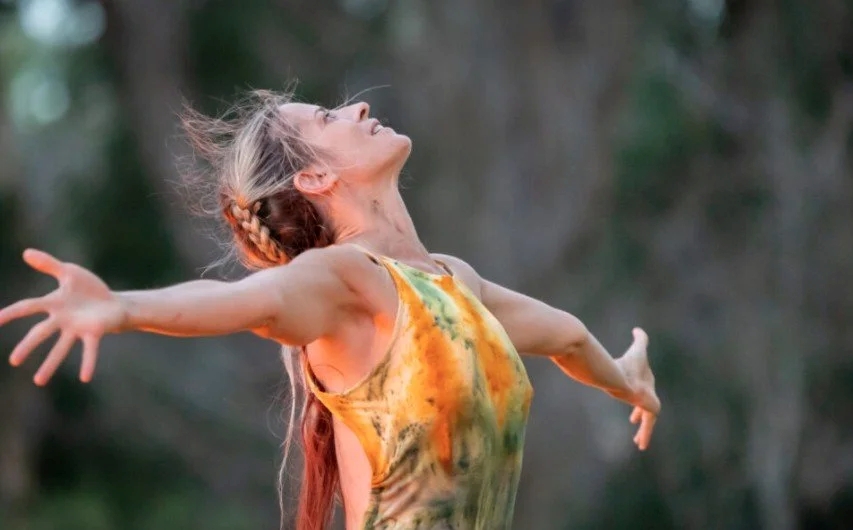
Addressing themes of trauma and resilience, Pointe: Dancing on a Knife’s Edge is a deeply personal and emotionally charged Australian documentary exploring Floeur Alder’s journey of catharsis through dance.
Produced and directed by Dawn Jackson, the documentary has a family focus that delves deeply into legacy and promise. It begins with a reference to a terrifying act of violence suffered by Floeur. Just as she was about to embark upon a promising European dance career, Floeur was brutally and randomly stabbed by a stranger outside her Perth home. The life-altering and senseless attack left her with physical and emotional scars.
The story flashes back to June 2000, to what Floeur refers to as “the incident.” We see how the savage attack is reported in the press: A 22-y-old ballet dancer stabbed in the face and out through her neck by a man in Highgate, at around 8pm.
The story then flashes back even further to trace the early lives and subsequent illustrious careers of her parents, described as celebrities in the ‘60s and ‘70s in the ballet world. Both had won scholarships to train at the Royal Ballet School in London during the 1950s. Floeur’s father, Alan Alder, had tremendous “ballon” which is the ability to leap high and land softly.
Her mother Lucette was noticed very early on for her star quality, technique and tenacity. In the late ‘50s/early ‘60s, she danced alongside (Dame) Margot Fonteyn – the greatest ballerina of her era – and often partnered with Rudolf Nureyev, also an icon and a legend. Her father Alan joined newly formed Australian Ballet in its early years, in 1963. Although they had both studied ballet in London, the parents met in Perth when Rudolf Nureyev brought Lucette with him to perform in Don Quixote for the Australian Ballet.
The documentary then traces a new phase for their careers. Floeur’s parents accept appointments teaching at Western Australian Academy of Performing Arts (WAAPA). Alan becomes the Head of the Dance Department, with Lucette taking the role of Head of Classical Ballet. Floeur describes their ambition to create a small scale Royal Ballet/Russian Kirov-style school for dancers there that was unique to Australia. Naturally, the studios became Floeur’s second home.
There’s plenty of archival footage and photographs to illustrate this excitingly cultural development. We see Floeur training with her mum from an early age, progressing to professional training, with an eye on a career in dance. By the time she turns 19, Floeur commits to full-time elite training at WAAPA, investing a solid three years of hard work.
Floeur sets out on a fellowship – ostensibly an audition tour with some of the major ballet companies in Europe. She is “adopted” by one of her mother’s main former partners (after Nureyev), Chevalier Robert Bestonso, a former star with the Paris Opera Ballet. He fondly recalls his heyday, describing Lucette as the “perfect partner” and a passionate collaborator on stage.
In May 2000, photographed one month before the incident, we see Floeur training with him in his studio in Paris. He describes her as a “real dancer”, born with grace and talent and hard-earned technique. She’s poised to embark upon a professional European career…
We return to Perth, to the incident. The story’s timeline jumps around a lot and could use slightly clearer title cards to help keep track of which year the flashback is referring to. We learn more details, how she was stabbed 1cm from her carotid artery and nearly died from blood loss. Initially, Floeur lost full mobility of her left arm. 12 months later, after grueling rehabilitation, she’s rehearsing and tentatively performing once again.
“I struggled after that. They say the joy of dancing is therapeutic, but it wasn’t. I was angry. This was rage,” recalls Floeur. We see some impressionistic and staged footage of Floeur dancing her rage, and her nightmares.
Floeur films some outdoor footage of her parents dancing together in a piece that she choreographs. This leads to the three of them giving a stage performance called Rare Earth, the concept being that this was a rare instance of intergenerational performers dancing together, performing as a family. The trio rehearse for months, exploring modern dance and steps that are not purely classical, which is challenging for her aged parents.
Alan remarks, “It was a first for us. Firstly, visualization. Secondly, improvisation – two terms that are not part of the vocabulary of a classically trained ballet. I found it very, very difficult. I guess I was resenting it.” Floeur acknowledges that this was “outside of their comfort zone. It was a massive act of kindness and love to put themselves out there.”
Rare Earth won an award for Outstanding Choreography and elevated Floeur from dancer to choreographer. “The process was really healing for everybody, especially me, and really brought us together as a family.”
As the daughter of iconic ballet figures, Floeur navigates the weight of legacy and expectation. Acknowledging that she still needed to make her own mark in the dance world, Floeur heads for Europe. Bestonso invites her to France to perform. “I also wanted to connect with my parents’ past in London.” Her parents’ old friends embrace her like fairy godparents.
At 39, she works with Robert Bestonso and his life partner on grueling, unfamiliar techniques and training. Her plan was to create a solo dance based on the ballet Carmen, and realise a long-held dream to finally perform in Europe. But Robert turns it into something else, Ne Poussez Pas (Don’t Push), a solo show about her life.
One hour into the documentary, we get a more detailed recollection of the attack. “I felt him punch me. It was literally a split second. I looked down and I was covered in blood and I didn’t understand why. He didn’t say anything or take anything, he just walked off.” She realises that there’s a 25-centimeter steak knife minus its handle embedded in her face and neck. We also hear an account from owner of the Greek Restaurant where she ran for help.
She expresses the incident in her movements. It proves a deeply emotional and cathartic experience for Floeur to get through the solo, with rehearsals often reducing her to a sobbing heap. The solo dancework becomes a process of letting go to something that she has held onto for a very long time. “I had to find my own closure.”
The performance of her barefooted solo is set for Perth, at His Majesty’s Theatre. We get to see filmed footage of the dance, as well as audience reactions, in the final minutes of the documentary. Floeur says that “Dance has become healing.”
More than a ballet documentary, Pointe: Dancing on a Knife’s Edge is a poetic portrait of survival, artistic reclamation, as well as family legacy. Dawn Jackson’s sensitive approach to the real-life drama captures a woman’s journey of grappling with trauma, legacy, and how she refuses to let it shape her destiny. Ultimately, we see the artist using dance as both vulnerability and armour.
