



by Julian Wood
Worth: $15.00
FilmInk rates movies out of $20 — the score indicates the amount we believe a ticket to the movie to be worth
Cast:
Hiran Abeysekera, Francesca Mills, Alistair Petri, Geoffrey Streatfeild, Ayesha Dharker, Tessa Wong
Intro:
… worth a visit (NT stuff almost always is), and it has some fine fresh takes, but somehow it doesn’t score a hit, a palpable hit.
Hamlet is a very long and complex play, and it is open to a myriad of interpretations and artistic reinventions. So, there is always room for one more it seems. This production, fresh from the Lyttleton Theatre at the National in London, is put out under the auspices of Robert Hastie, now the deputy artistic director of the company. However, as the long credits show, there is a large collaborative team behind it.
The staging is quite bold and simple, with most of it taking place in one large mural-decorated state room presumed to be in the un-named Elsinore castle. The fact that it is in this type of room signals that this is a ‘modern dress’ production without the period ever being really specified.
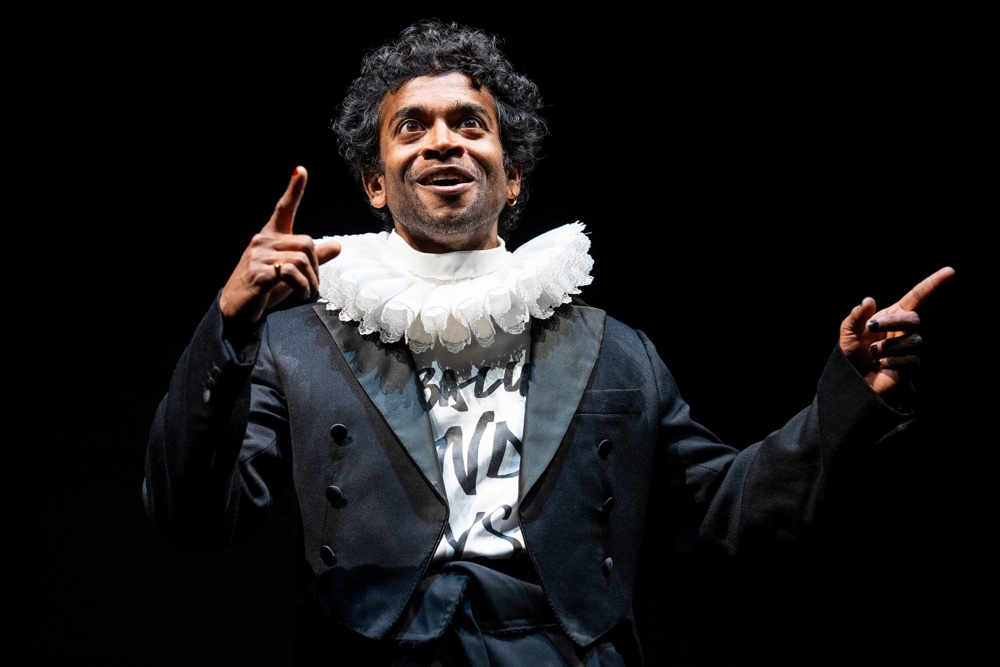
The costumes could anchor us, but here too things are sliding around a bit. Hamlet (Hiran Abeysekera, more on him later) pops up wearing anything from a casual hoodie to, at one point, a Blockbuster video shop T-shirt. Not sure whose idea that was. All this deconstructs both the character and parts of the play – are we in the play proper or in a dress rehearsal? – and it coaxes us to let go of the idea of one unform framing. After all, it shouldn’t matter too much, should it? The play’s the thing.
Here too there are some mixed results. This production goes with the now standard approach of staying with the original long version of the text but speaking it as everyday speech. The large cast throws themselves into this approach with gusto, but some are more able to bring it off than others. Some go so fast that they come close to garbling their lines.
The other element is that it is cast in a race-blind, disability-blind way and sometimes switches the normal gendering of the characters. Again, we have seen this a lot in recent years, and we should be used to it. Let’s recall that Shakespeare was no purist. He played with gender fluidity long before there was a name for it. So, with this sort of approach too, the whole point is that this is no longer a ‘thing’.
As noted, some of the scenes seem a little thrown away or are hard to hear, but that is nothing to do with any statement casting; each player has to be judged on their ability to fulfil their role and support the production.
Of course, its success falls on Hamlet’s shoulders. Everyone wants to play ‘the Dane’, but you have to be careful what you wish for too. Further, the role comes freighted with the interpretations of greats, ancient and recent.
Abeysekera has opted for a cheeky Hamlet; nimble, verbally dexterous, quick-witted but not especially ‘deep’. There is something traded off here surely. There is every reason to play him a little darker. He must be in some sort of young life crisis. He certainly is dangerous to know at this point in his life. He murders his future father-in-law (ok, that could have been an accident). He drives his girlfriend to suicide, he wants to murder his stepfather, and he is more or less responsible for the deaths of his two best friends, about which he doesn’t show much remorse. Yet here he is playing it most of the time as a semi-comedy, all with a nod and a wink to the audience as if it’s all a bit of a lark. Hamlet is quite misanthropic too, so why would he try to please us so?
Then there are famous soliloquies. This guy feigns distrust of philosophy and yet he has to say some of the profoundest meditations on human nature ever put in a play. OK, you don’t want Hamlet always walking to the front of the stage and virtually ‘conducting the word-perfect audience’ (as Gielgud once complained), but there has to be a happy medium where the incredibly moving and universal thoughts are given space for us to pause.
This production is worth a visit (NT stuff almost always is), and it has some fine fresh takes, but somehow it doesn’t score a hit, a palpable hit.
