


by Christine Westwood
They’re back. Forget Marie Kondo, Backyard Blitz, What Not to Wear – these reality shows only transform one part of your life. Queer Eye does it all, targeting every aspect of their subject’s life in just one week, culminating in a Cinderella moment when they are revealed as a new person to their family and friends. Too good to be true? Of course it is, but the makeover process is undertaken in such a warm, funny and entertaining way that you can’t help enjoying the ride.
The original concept was the 2003 Emmy winning Queer eye for the Straight Guy, created as a ‘make better’ form of storytelling by producer David Collins. The 2018 reboot is about to air its third series, so the formula is getting something right as far as viewers are concerned.
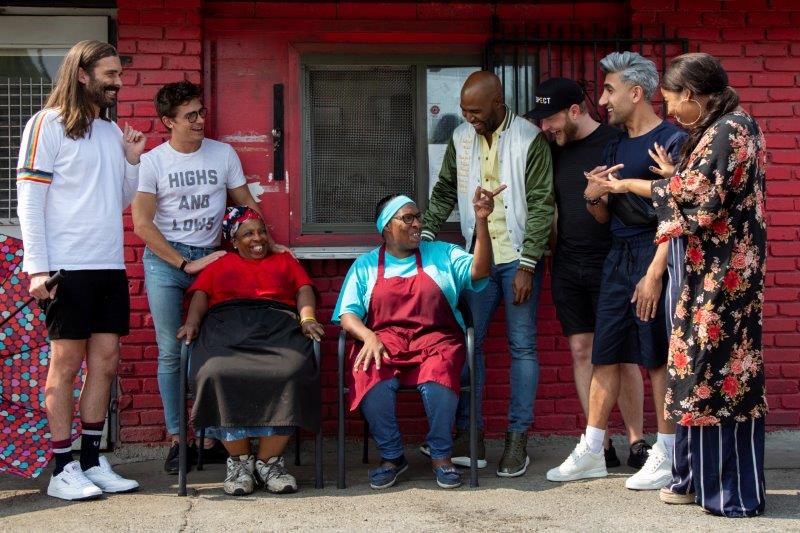
Having dropped the ‘Straight Guy’ limitation, life transformation is open to anyone, straight, gay, male or female. The Fab Five themselves also reflect the updated theme of diversity. Tan France (fashion expert) is Muslim Pakistani, Karamo Brown (‘culture’) is black American.
Collins has also taken the series out of metro-centric New York to Georgia. “I’m from Cincinnati, Ohio, born and raised,” he says in a press release. “The corn-fed midwestern folk are where I’m from.”
In an interview with the Sydney Morning Herald, Collins describes the original series, where the makeover all happened in one day, as the glossier, more surface of the two. “When I created the show, I was in my 30s and now I’m a dad of twin girls and I have a whole different life and experience. These guys get to be authentically really themselves, while the original Fab Five had to be more glossy and not as deep.”
The obvious chemistry between the Fab Five didn’t happen by accident. The first sweep of auditions was huge in scope, narrowing candidates down to a 300-person, three-day Intensive that included group exercises, interviews, and screen tests.
“The timing of the show I think couldn’t be better,” Collins says. “Obviously, the political climate is one thing, but we’re realising that we need to evolve as humans, and we’re all trying, whether it’s race and gender and all of the things that we realised, we’re still stuck in the muck of it in a very deep way. But when I go back home to Ohio, you realise that there’s still a lot of work, there’s still a lot of acceptance and tolerance issues. I hope this show brings that to the table.”
This is why in series two Bobby Berk (design) opened up about his struggle with homophobia in the Christian community he grew up in; and Brown, who previously worked as a psychotherapist and a social worker, was visibly disturbed at being pulled over by armed police after his own experiences as a targeted black teenager. The new series follows the same personal reveals with Antoni Porowski (food) sharing his own addiction issues with a scruffy, soon to be transformed, summer camp manager.
Political issues aside, the structure of the show remains unchanged. The Fab Five are upbeat, ‘can do’ guys. They look good but approachable and there is plenty of interwoven studio footage of them dancing and playing up for the camera. The idea is for them to come across as a breath of fresh air, and fun. Their sense of play is well utilised as they step into their subjects’ lives, kitchens and closets, putting on odd items of clothing, and making good-natured fun of some of the stranger belongings they come across.
Who knows what some of the neighbours make of Jonathan Van Ness (a hairdresser since he was 17 and an Emmy nominee for his Web series Gay of Thrones), turning up with a unique moustache and hair braids, but the atmosphere by the end of the makeover week is celebratory and affectionate. And emotional.
The premise is that when you take a person who is stuck in some area of life, they are going to have to fess up what made them stuck in the first place, and that usually involves loss, trauma, neglect. This is where the boys’ playfulness slides easily to frankness and acceptance, an excellent recipe for confidence boosting.
In Glamour magazine, Porowski gives credit to the casting people who find the subjects for the show. “They really picked people who are super vulnerable. They were people who were ready for change. They may have been stuck in certain ways, but were very receptive to what we came in with.”
“They’re not in there to tear someone down or to tear them apart, but to figure out how to lift them up,” Collins says. “And it is a fine line of saying, all of our bodies, shapes and sizes are different, and all of our frames and skin colours, and all that play into this.”
In this third season, camp manager Joey, one of the most neglected of their subjects so far, was tearfully grateful that “you met me where I was” rather than forcing him into some objective standard of normal. Season 2 featured a young gay man coming out to his mum, backed by the Fab Five’s support and empathy. Series 3 kicks off with a married woman of 49 who has lost her self-esteem and femininity. Her life in camouflage pants is challenged by France while Berk, who does the most behind the scenes work on the show with his complete home makeovers, finds a style of interior design that steers away from feminine cliche.
Bobby Berk (also in Glamour magazine) says, “One of the things we wanted to bring that the original show wasn’t able to do was a look into our lives. Back in 2003, it was ground breaking and controversial at the same time for gays to be on TV, but it was accepted because they kind of stayed in their lane. They were designers and hairdressers and cooks and it was kind of like ‘Oh that’s fine’, but to be husbands and fathers – that wasn’t. One of the things we wanted people to know is that we’re just like other people.”
“I think it’s probably still a hell of a life,” Collins says, referring to the teen-aged life of a young gay person, particularly one who lives outside a capital city.
It’s a hell of a life for many of us, so it’s reassuring when your makeover artist has gone through their own dark times. A French tuck and a group hug may not be the cure-all, but, hey it’s a start.
Queer Eye Season 3 launches on Netflix March 15, 2019
