



by FilmInk Staff
Bringing a small story to the big screen with dark comedy and large format storytelling.
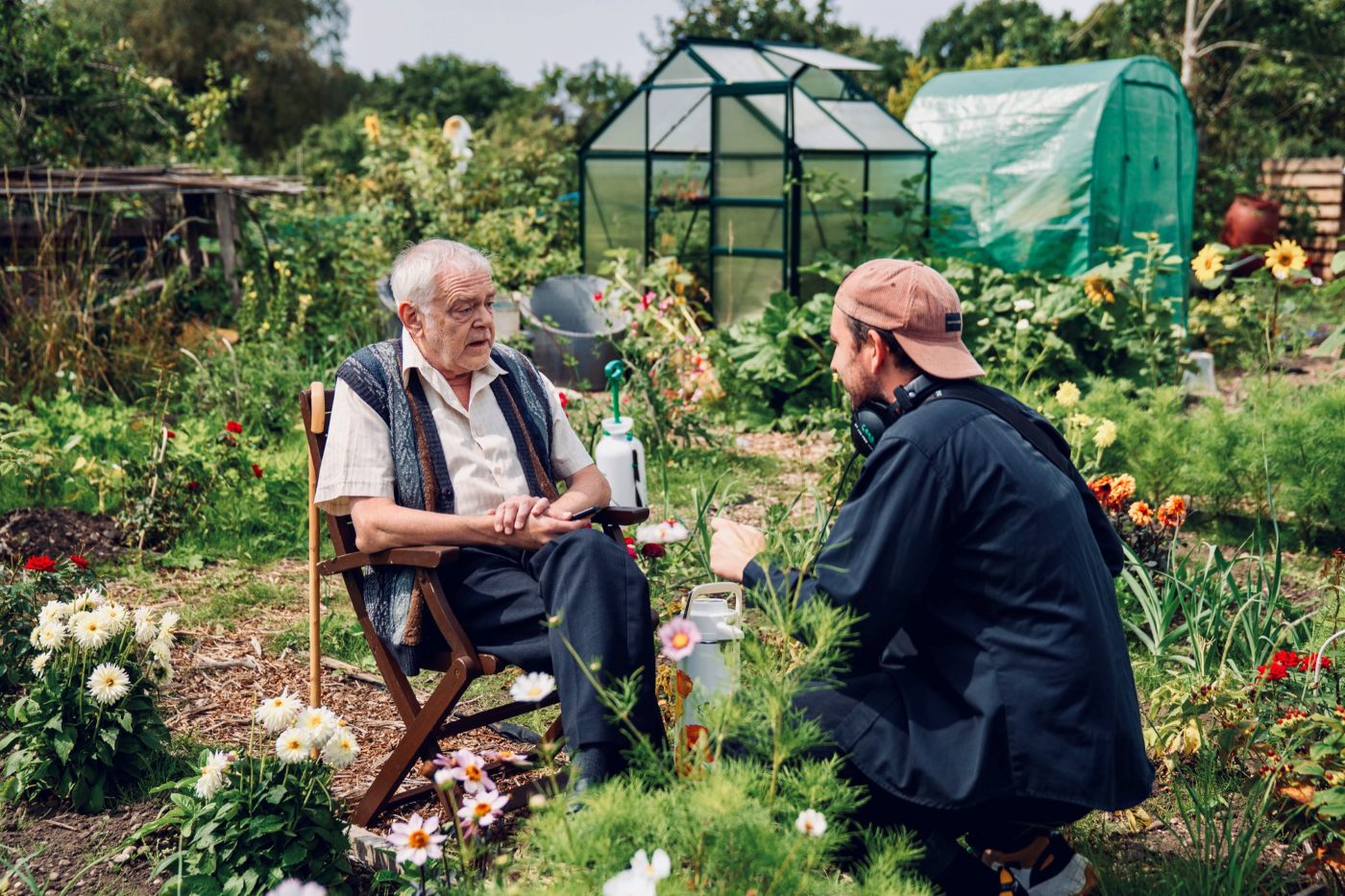
Deadheading won the Fiction prize at this year’s Sony Future Filmmaker Awards. Directed by Jack Hughes and shot by DP Ash Connaughton, the short film follows Doreen, an elderly woman trying to fulfil her terminally ill husband’s dream of owning an allotment garden by increasingly extreme means.
Produced on a modest budget and an ambitious production schedule, Deadheading is a testament to careful planning, creative collaboration and ensuring technical decisions served the narrative.
From the early conversations about tone down to the color grade, Hughes and Connaughton worked together to create a short that felt far larger than its small corner of British culture. For principal photography, the Blackmagic URSA Cine 12K LF digital film camera, paired with TLS Vega lenses, was chosen. That combination allowed the production to realise a distinctive visual language without compromising the practical realities of an independent film production.
“The idea came from an article I had read about British allotments disappearing,” Hughes explained. “Many have been lost to housing developments and people spend years on waiting lists. That became the premise for what is now Deadheading.”
At its core, Deadheading is less about murder and more so about motivation. Hughes wanted to ensure that while crafting inventive deaths, the audience could still empathize with the protagonist Doreen. “The tone was always going to be the hardest thing to get right,” Hughes noted. “She’s simply trying to fulfil the final wish of the love of her life, but she’s also killing people.”
That balance shaped how the murders were handled. The production avoided excessive gore, keeping the comedy in the absurdity of Doreen’s methods while staying close to her motivations.
Connaughton recognised the challenge immediately after reading the script. “Jack described it as a ‘granny slasher,’” he laughed. “It’s actually quite an intimate story set within a very small world, but the narrative itself is huge, bizarre and wonderfully outlandish.”
From the outset, the duo purposefully avoided following the visual trends they were witnessing across the festival circuit. “We were seeing lots of beautiful films embracing grain, vintage lenses and quite moody imagery,” Hughes noted. “We wanted to go the other way.”
Instead, they found inspiration in Douglas Hickox’s Theatre of Blood, embracing rich colour and a close up wide aesthetic, paired with their choice to shoot large format, to make a small story that feels large. “We wanted something clean, but not clinical,” Connaughton explained. “The Vega lenses have plenty of character and combined with the large format sensor and the URSA Cine’s color science, it became a really magical combination.
“We were often very close to the actors on wider lenses. That gave us the shape Jack wanted in the frame, without making the image feel flat. On the larger sensor, we could stay wide and close but still hold some depth behind the characters.”
Connaughton continued, “We wanted those exaggerated perspectives while still maintaining depth between the characters and the background. Large format gave us that.”
One sequence demonstrates that philosophy particularly well. The film’s first murder begins with carefully matched compositions between Doreen and her victim, subtly placing Doreen in a weaker position before the visual balance gradually shifts as she commits to her decision.
“Wide lenses introduce just enough distortion to make the audience feel uneasy long before anything actually happens,” explained Connaughton. “Even during the murders, audiences experience everything from Doreen’s perspective. We’re much more interested in her reaction than the violence itself.”
Although the URSA Cine 12K LF is capable of recording at extremely high resolutions, Deadheading was primarily captured in 4K Blackmagic RAW at 5:1 constant bit rate using the camera’s full sensor due to the camera’s in sensor scaling.
“People see the ‘12K’ and immediately think about enormous workflows,” Connaughton said. “The reality is we were benefiting from the large format sensor while shooting a really manageable 4K workflow.”
That proved particularly valuable on a production completed across numerous locations, in just a handful of shooting days and with variable lighting conditions.
“The large format sensor naturally gives you an advantage in low light situations. They gather more light and that’s simply physics,” Connaughton explained. “There were sequences where this was a big help.”
“We had a very tight schedule without the luxury to spend hours on lighting. Even our larger more complex setups had to be completed quickly and with less equipment than we would have ideally wanted. The image produced with the camera’s large format sensor and excellent color science gave us confidence that even our lighter touches would still look polished,” said Hughes. “The flexibility of Blackmagic RAW and the Generation 6 Color Science gave us power to recover detail in highlights during some of our brighter exteriors, subtly lift shadows, finesse and balance aspects of the image further in post production.”
Even some of the film’s most ambitious moments reflected that flexibility. For example, the exploding shed sequence had to sit alongside footage captured months earlier explained Connaughton. “I shot the miniature explosion on my own URSA Mini Pro 4.6K G2, then matched it back to the URSA Cine 12K LF material in the grade, using DaVinci Resolve, which was all helped by the shared Blackmagic color science,” he noted.
Hughes says the lesson he took from Deadheading was the value of preparation. “Every sequence was meticulously planned and storyboarded,” he explained. “We built whole montages as animatics before production, timed to music, so we knew the rhythm before we got to set. It sounds obvious, but the more work you do in preproduction, the easier production becomes.”
About Blackmagic Design
Blackmagic Design creates the world’s highest quality video editing products, digital film cameras, colour correctors, video converters, video monitoring, routers, live production switchers, disk recorders, waveform monitors and real time film scanners for the feature film, postproduction and television broadcast industries. Blackmagic Design’s DeckLink capture cards launched a revolution in quality and affordability in postproduction, while the company’s Emmy™ award winning DaVinci colour correction products have dominated the television and film industry since 1984. Blackmagic Design continues ground breaking innovations including 6G-SDI and 12G-SDI products and stereoscopic 3D and Ultra HD workflows. Founded by world leading postproduction editors and engineers, Blackmagic Design has offices in the USA, UK, Japan, Singapore and Australia. For more information, please go to www.blackmagicdesign.com/au.
