



by Shahran Morshed
Worth: $16.00
FilmInk rates movies out of $20 — the score indicates the amount we believe a ticket to the movie to be worth
Cast:
Isaach de Bankolé, Matt Dillon, Mia McKenna-Bruce, Tom Blyth
Intro:
There is a particular quality to the filmmaking that makes it difficult to look away, even when the material does not entirely come together.
Alboury comes to a construction site in the middle of the night looking for his dead brother’s body. He wants to take him home, but the people in charge have other plans. Horn, the site’s manager, refuses to hand over the body, offering explanations that become increasingly difficult to believe. Alboury, however, has no intention of leaving without his brother.
This simple but deeply unsettling situation forms the basis of Claire Denis’ The Fence, a film in which a dispute over a dead body gradually opens up a much larger conflict about power, race and the legacy of colonialism.
Set at a construction site in West Africa, the film unfolds largely around the compound where Horn and his colleagues live and work. The fence separating them from the outside world is more than a physical boundary. It reflects the distance between those who possess authority and those whose lives are controlled by it.
As Alboury waits outside, Horn becomes increasingly anxious about the situation. His younger colleague Cal is also caught up in the tension, while the arrival of Horn’s wife, Leone, brings another perspective into this already uncomfortable environment. Having recently arrived from London, she finds herself surrounded by people and circumstances she barely understands.
As the night progresses, conversations become confrontations, and the carefully maintained order inside the compound begins to fall apart.
Denis gradually reveals the uneasiness, dishonesty and dependencies that hold these relationships together.
What makes the film interesting is how little Denis needs to do to sustain the tension. She allows the situation to develop through conversations, gestures and long stretches of waiting. Alboury’s presence alone is enough to unsettle everyone around him. He does not need to raise his voice or constantly explain his position. His determination becomes a quiet challenge to the authority of the people behind the fence.
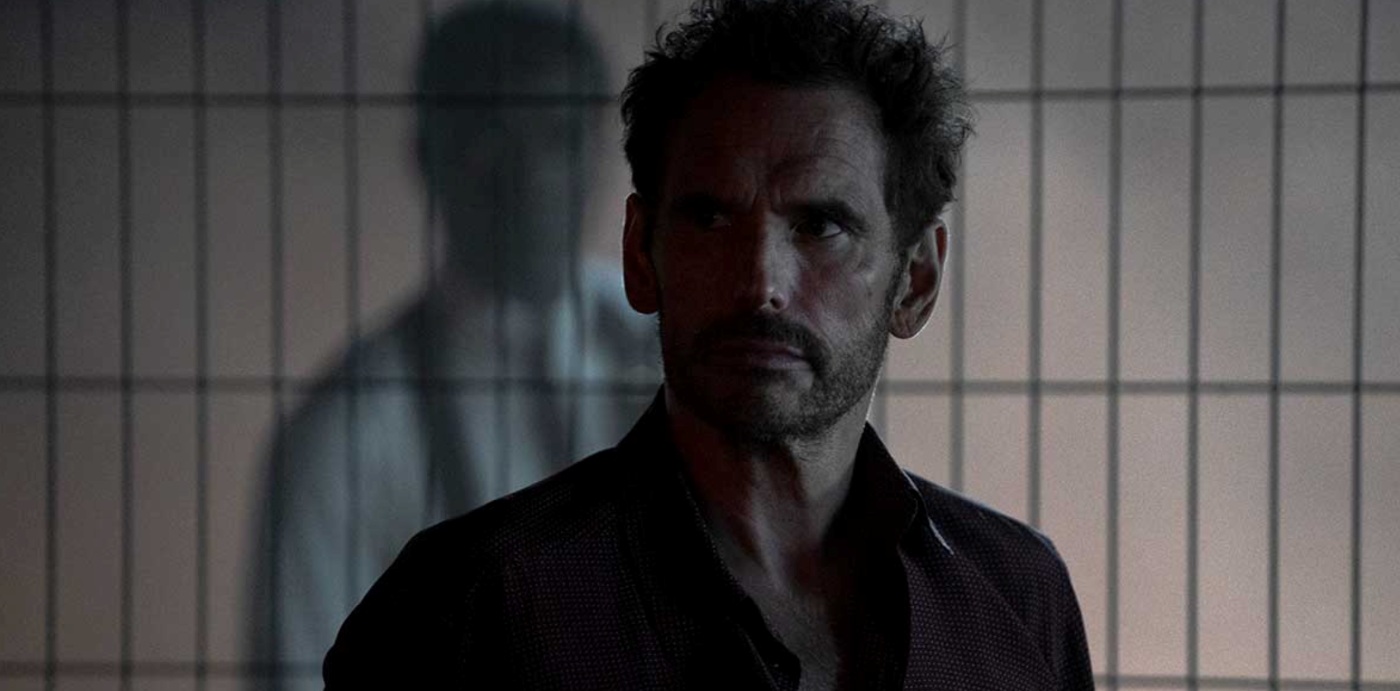
Isaach de Bankolé brings an extraordinary stillness to the character, while Matt Dillon gives Horn a mixture of confidence and desperation. The contrast between them is one of the film’s strongest elements.
Denis also finds beautiful images within this rather confined setting. Éric Gautier’s cinematography makes good use of the darkness and the surrounding landscape, giving the construction site an almost isolated existence. The music by Tindersticks adds another layer to the atmosphere without taking away from its uneasiness. There are moments when the film seems to move beyond the immediate conflict, allowing the landscape, the sounds and the faces to communicate what the characters cannot.
Still, The Fence does not quite reach the heights of Denis’ finest work. Something feels missing, particularly in the way the drama develops. Some conversations go on longer than necessary, and the film occasionally struggles to turn its ideas into a fully satisfying cinematic experience. Its theatrical origins are sometimes too visible, and certain character relationships could have been explored further. You will be wanting more from a film that holds so much potential.
But even with these reservations, Denis keeps us engaged throughout. There is a particular quality to the filmmaking that makes it difficult to look away, even when the material does not entirely come together. The film’s strongest image is also its simplest: a man standing outside a fence, refusing to leave until he receives the body of his brother. Behind that fence, people continue to talk, argue and make excuses. Outside it, someone is still waiting for the most basic form of dignity. Denis leaves us with that uncomfortable distance, and it is perhaps where the film finds its greatest strength.
