



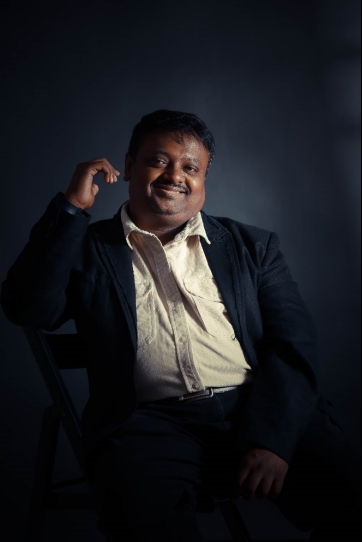
by FilmInk Staff
Julian Karikalan arrived in Australia from India as an international student in 2003, working in a spice shop and IKEA to survive while also teaching himself filmmaking at a Tamil television station. More than two decades later, the Australian citizen is turning the skills he learnt out of necessity into ‘prudent filmmaking’, a radical micro filmmaking methodology he believes could position Australia at the forefront of a new global era of independent cinema.
When Julian Karikalan arrived in Australia from India in 2003, Hollywood could not have seemed further away. He was an international student with a Bachelor in computer engineering who had come to Sydney to study a Master of Science in Computing at the University of Technology Sydney. Money was tight. He worked in a spice shop to feed and clothe himself and spent weekends working on the floor at IKEA.
Between studying and working to survive, Karikalan found another job that would ultimately change the direction of his life, working at a Tamil satellite television news station in Sydney.
There was no enormous production team and no opportunity to specialise in a single role. If something needed to be filmed, edited or put to air, Karikalan had to learn how to do it. He operated the camera, he learnt how to use the editing equipment and other technology and he learnt production by doing it.
More importantly, he learnt how much one person could achieve when they were willing to master the tools around them.
“I didn’t have the luxury of saying that’s not my job. If something had to be done, I had to learn how to do it,” Karikalan said.
“At the time, I thought I was simply working, studying and trying to build a life in Australia. Looking back, those years taught me the philosophy that would eventually shape the way I make films today.”
Having no money became his greatest filmmaking lesson
While many aspiring filmmakers dream of securing a large production budget, Karikalan’s financial circumstances forced him in precisely the opposite direction. He had the ambition to make films, but not the money to build traditional production crews around him.
“Not having much money forced me to become resourceful,” Karikalan said.
“When you can’t afford to employ somebody for every part of the process, you either give up or you learn and I learnt.
“I had to understand the camera, editing, computers, workflows, technology, storytelling and how all those pieces could work together.
“What looked like a disadvantage at the time became one of the greatest advantages of my filmmaking career.”
The computer engineer becomes a filmmaker
Karikalan never imagined his technology education would become so important to his filmmaking. His computer engineering background and postgraduate computing studies gave him an understanding of technology that would become increasingly valuable as cameras, editing systems and digital distribution transformed the film industry.
“The irony is that I came to Australia to study computing, while what I really wanted was to make films,” he said.
“Now I realise the two were never separate. Technology has become one of the great democratising forces in filmmaking. The tools that once required enormous infrastructure are becoming smaller, smarter and more accessible.
“My technology background helped me understand that you don’t have to use innovation to make filmmaking more complicated. You can use it to make filmmaking more efficient.”
Introducing ‘prudent filmmaking’
More than two decades after arriving in Australia, Karikalan has turned the lessons of those early years into a filmmaking methodology he calls prudent filmmaking.
It is his approach to micro filmmaking: combining multidisciplinary skills, technology, disciplined spending and every available resource to create high-quality feature films without the enormous budgets and production structures traditionally associated with cinema.
The philosophy is not about making films cheaply for the sake of being cheap, it is about being extraordinarily deliberate with every resource.
“Prudent filmmaking means asking what the film genuinely needs and then finding the smartest way to deliver it,” Karikalan said.
“Money matters, but resourcefulness matters too, as does technology, skills, preparation and knowing where every dollar goes. Most importantly, the audience matters.
“What I have learned is that having a micro budget should never become an excuse for having a micro ambition.”
The $24,000 experiment that changed everything
Karikalan has already tested the philosophy on his own films. His feature Love and Love Only, made during 2013-2014 for approximately $100,000 with fewer than 10 crew members, ultimately recovered its investment.
He then pushed his methodology much further with Let’s Go Below The Rainbow, producing the feature for approximately AUD $24,000 and operating effectively as a one-person filmmaking crew outside of the actors.
Karikalan managed the filmmaking process from script through production and post-production and self-funded the project without financial support from film funding bodies or private investors.
The film subsequently generated more than 10 times its production budget in gross OTT revenue organically, with much of its audience coming from the United States.
“For me, that was the proof. I wasn’t sitting in a room theorising about whether micro filmmaking could work. I had made the film and audiences thousands of kilometres away were watching it. That changes your understanding of what is possible,” Karikalan said.
Why Australia could lead the micro filmmaking revolution
Karikalan now wants to take prudent filmmaking beyond his own productions and establish it as an Australian-born methodology for a new generation of filmmakers around the world.
He believes Australia has an opportunity to become a global leader in high-quality micro filmmaking by combining creativity, technology, practical skills and a willingness to rethink traditional production models.
“Some of the biggest changes in industries come when somebody asks why things have always been done a certain way,” he said.
“I’m not arguing that traditional filmmaking should disappear. Large films need large teams and extraordinary specialists. However, what I’m saying is, there is another pathway.
“A person with a compelling story, technical knowledge, discipline and access to today’s technology may be capable of far more than they realise. I want prudent filmmaking to become something Australia is known for around the world.”
Karikalan is now exploring the development of a broader prudent filmmaking community, educational resources, training and a potential book to share the methodology with emerging filmmakers.
‘Australia gave me the opportunity to become who I am’
For Karikalan, however, the story is about more than filmmaking. Australia is the country he arrived in as an international student, the place where he worked the jobs he needed to survive, developed his skills, made his films and eventually became a citizen.
He said those experiences have created a deep sense of responsibility to contribute to the country he now calls home.
“I came here from India as a student trying to build a future. I worked in a spice shop, worked weekends at IKEA, studied and worked in television. I learnt every skill I could and slowly built a life,” Karikalan said.
“Eventually I became an Australian citizen and that means an enormous amount to me.
“I want to be the best Australian I can be. For me, that means contributing something, creating something and hopefully developing an idea here that can have an impact internationally.
“My journey taught me that you don’t have to start with everything. You start with what you have, learn what you don’t know and use every resource available to you as intelligently as possible.
“That is how I built my life here and ultimately, that is what prudent filmmaking is all about.”
From surviving to creating
Karikalan believes his story could resonate with other migrants, international students and aspiring creatives who are working ordinary jobs while privately pursuing much bigger ambitions.
He knows what it is like to have the dream before having the money, connections or resources to realise it.
“The young man working in that spice shop couldn’t afford to make films in the traditional way, so he had to find another way,” Karikalan said.
“Twenty-three years later, that necessity has become a filmmaking methodology that I now want to take from Western Sydney to the world.
“I came to Australia to study technology. Australia gave me the opportunity to build a life and now I want to use everything I’ve learnt here to help pioneer a new way of making films.
“Prudent filmmaking was born from having less, but its ambition is enormous.”
About Julian Karikalan
Julian Karikalan is a Western Sydney-based independent filmmaker, writer, founder of JUVI Films and creator of the concept, prudent filmmaking, a microbudget filmmaking methodology combining technology, multidisciplinary skills, minimal crews and carefully targeted resources to create films for everyday audiences. His feature Let’s Go Below The Rainbow was produced for approximately AUD $24,000 using an effective one-person-crew model outside of the actors and subsequently generated more than 10 times its production budget in gross OTT revenue organically.
Julian’s films have received recognition at independent international film festivals including the Amsterdam International Film Festival, Tiete International Film Festival and Anatolia International Film Festival. He is now developing prudent filmmaking into a broader movement to help independent storytellers turn their ideas into completed films without waiting for traditional budgets, crews or industry permission. More information can be found at: Juvifilms.com
