

by FilmInk Staff
Director Tristan Seniuk premieres immersive short film at Venice International Film Festival.
While many immersive projects transport viewers to otherworldly locations, such as the summit of a snowy peak or the deepest depths of the ocean, the immersive short film Desert Palms seeks to do the opposite.
According to Director Tristan Seniuk, the idea for the film stemmed from a weekend filmmaking retreat with friends. “We rented an Apple Vision Pro and consumed as much immersive content as we could,” he began. “While much of the content is based upon spectacle, transporting you to exotic lands, we thought about universally common, mundane places. We came up with a location that we all begrudgingly must visit from time to time, a place that no one is excited by: a waiting room.”
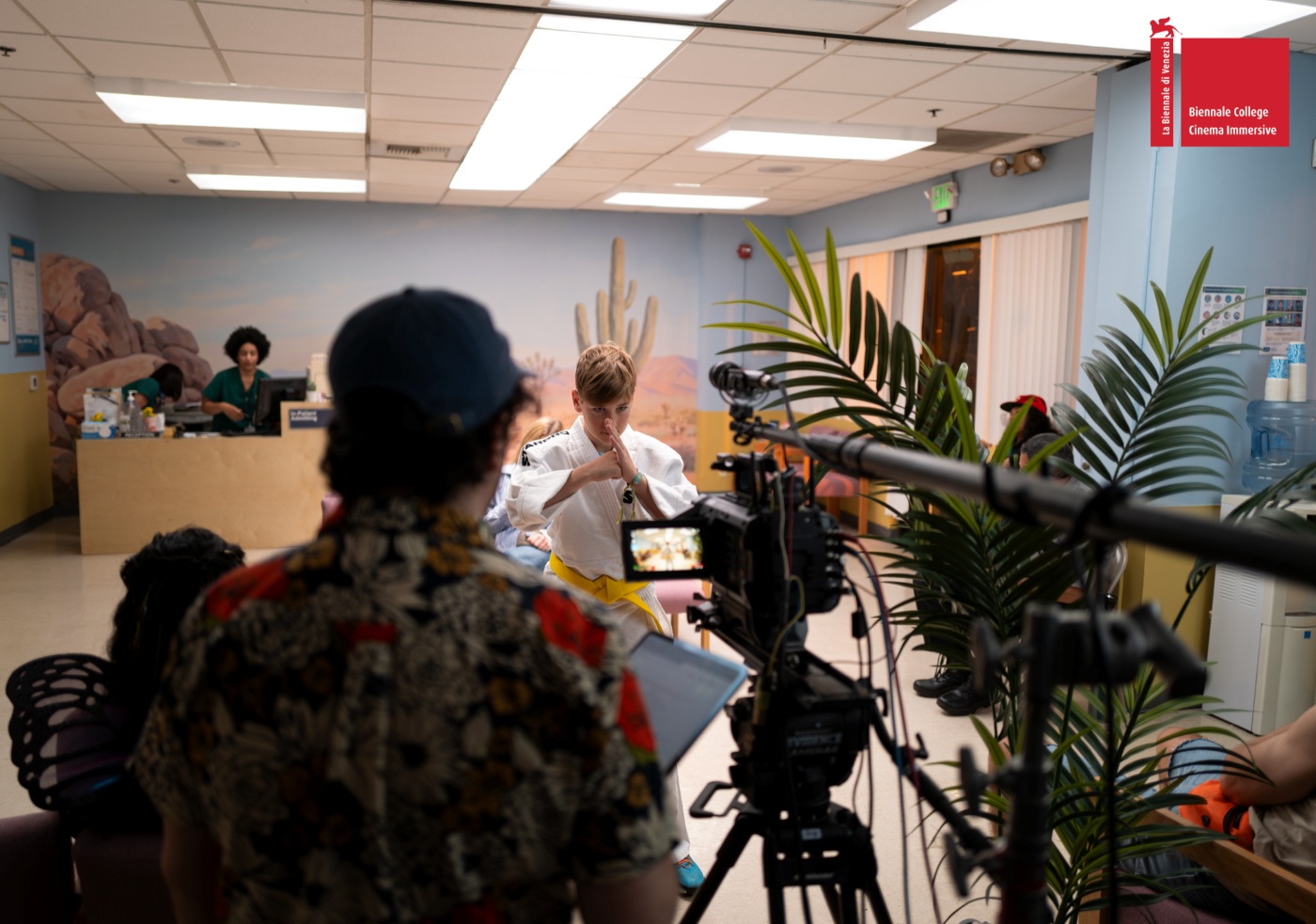
Set inside Desert Palms Emergency Care waiting room, and just across the street from a large music festival, Desert Palms follows a throng of injured characters as they get increasingly upset about having to wait to be seen in an extremely slow and overwhelmed ER facility.
The novel premise captured the attention of the Venice International Film Festival’s Biennale College-Cinema Immersive program, which explores immersive media as a new art form. Armed with a grant from the program, along with the Blackmagic URSA Cine Immersive digital film camera and DaVinci Resolve Studio post production software, Seniuk had seven months to bring the film from concept to completion, in time for the premiere at the 2026 festival.
“I wouldn’t have attempted to make an immersive project without the URSA Cine Immersive. Its streamlined design and the ability for Blackmagic RAW files to store camera metadata made its workflow extremely appealing to me. The fact that there is no stitching needed, it’s essentially dragging and dropping the footage into a timeline, and then exporting, makes it an essential filmmaking tool for immersive projects,” explained Seniuk.
Total Immersion
According to Seniuk, Desert Palms is a film meant to invite you to look up and engage with the physical world. “The entire conceit of the film hinges on placing a viewer in a physical (albeit virtual) space, so every aspect of the story and staging needed to service the idea of total immersion and the mechanics therein. To maximise this sense of total immersion, I chose to shoot the film from one vantage point and as one long, single uninterrupted take that parallels the way we as humans interface with the world. There are no edits or curatorial decisions made for the viewer by an omniscient filmmaker or guide; the viewer themselves must choose where to direct their attention within the frame and which mini substory to zero in on, mirroring the way we experience real, ordinary life,” he said.
“We all get sick, injured or need care at some point in our lives and need to visit a hospital,” added Seniuk. “We are also capturing a wide breadth of character types, from local townspeople to music festival attendees to out of towners. But there is one unifying theme connecting all of characters: none of them want to be there, and they are all becoming increasingly more impatient about the wait to receive care. Due to the structure of the waiting room’s confined space, interactivity with one another is inevitable.”
Facing New Challenges
From casting to scouting locations to production to post, there were no shortage of challenges for Seniuk and his team as they dove headfirst into immersive filmmaking for the first time.
“Everything about ‘Desert Palms’ was extremely difficult, starting with how to even write and format a script featuring 24 characters who all have their own mini concurrent storylines,” Seniuk explained.
For the cast, Seniuk sought out actors with ample theatre experience due to the nature of the long one take format, as there was no room for cutting around delivery errors. Location presented another challenge as even though the room is essentially a rectangle, Seniuk needed it to be a very specific length and width to maximize the sweet spots for focus with the URSA Cine Immersive.
“The room needed to accommodate our large cast but still have the feeling of personal space being invaded as people move about. The room also needed to have two doors: one to the outside and one that would lead back into the hospital. We never see out of either of these doors, but they are the main mechanics for how people enter and exit the space, so their placements in the room were crucial. Finally, we needed a place where we could hide a large amount of light in the ceiling in an integrated way,” noted Seniuk.
The lighting was one of Seniuk’s biggest hurdles since the team was shooting 90 fps at 400 ISO to keep noise as low as possible. “We knew that we were going to have to really blast the set to get the right exposure, so we did a lot of research and consulted several DPs. Preproduction research and test shoots were invaluable for us in planning how to incorporate the lighting into the design of the room in a seamless and invisible way, since it’s impossible to hide rigs and production design within the immersive space,” he said.
In the middle of the film, there is a power outage causing all the lights to cut out. “We choose to include this scene not only for visual variation, dynamic storytelling and a genre shakeup, but also as a clever cut point for our actors. Before the lights fully come back on, we have a blinking red emergency light illuminating a very dramatic moment,” explained Seniuk. “We were worried about this moment from a lighting perspective because the room is quite dark, and we only have one red source light. And with red light further cutting our exposure down, we weren’t sure how bad the noise floor was going to be from the underexposure. Turns out, it was totally fine and we had no noise at all even at 400 ISO. That was a real test to how well the URSA Cine Immersive does with low light.”
Rethinking Not Relinking
Lastly came the post challenges. “Fortunately, the film is just two long takes stitched together in a hidden cut during the power outage, as well as a post credit button shot, so it was a simple edit,” said Seniuk.
“Sound design, on the other hand, was very challenging. The film has more than 100 unique tracks of audio between the cast, foley, sounds from the festival, ambience and more, and all of it had to be meticulously spatialized to the exact dimensions of the room,” he continued. “I’m well versed with DaVinci Resolve but had only used Fairlight for very minor mixing. Sound Designer Jon Hansen had never used Fairlight, but what he was able to do with it is masterful. He noted how intuitive Fairlight is and easy to pick up compared to other DAWs, and he also was a big fan of being able to easily send the .DRT files back and forth without any reconnection issues and all the bussing and routing staying the same.”
“While I initially used a more familiar setup, persistent technical issues prompted me to try Fairlight,” noted Hansen. “It was remarkably easy to adopt, and its seamless integration into the post production pipeline made collaborating vastly more efficient. Fairlight’s Apple Spatial Audio Format support was essential, and the other thing that stood out to me was how we could iterate by sending each other .DRT files, removing the need to bounce/import/place audio files as we iterated.
“We used DaVinci Resolve Studio for the edit and colour, Fairlight for the spatial mix, and Fusion to convert 2D alpha assets into the Apple Immersive Video space for the graphics placement,” said Seniuk. “I’ve had to relearn so much of what I was familiar with about the post process to meet the demands of this project and to deliver it at the caliber and spec I wanted it to be. Thankfully DaVinci Resolve Studio was there to support us.
“Having everything under one hood is the best part of working with DaVinci Resolve Studio. I’ve been a fan for many years for this reason. Knowing that all the features talk to each other, and you don’t have to round trip to different applications and relink to finish a job is just so nice. Also, the integrated pipeline for working with immersive clips end to end, from camera to post, is a huge benefit.”
“When it comes to immersive filmmaking, you really need to rethink every aspect of traditional filmmaking top to bottom,” Seniuk concluded. “Wrapping my brain around immersive storytelling has really unlocked so much creativity in me. Where immersive really shines is in its intimacy and subtle emotion. By placing a viewer within the story itself, with nowhere to look beyond that world, we move from merely passive viewer to active witness.”
Desert Palms was selected, developed and produced within the program Biennale College-Cinema Immersive with the support of a production grant of 75.000€ by La Biennale di Venezia.
Image by Riley Sterns
About Blackmagic Design
Blackmagic Design creates the world’s highest quality video editing products, digital film cameras, color correctors, video converters, video monitoring, routers, live production switchers, disk recorders, waveform monitors and real time film scanners for the feature film, post production and television broadcast industries. Blackmagic Design’s DeckLink capture cards launched a revolution in quality and affordability in post production, while the company’s Emmy™ award winning DaVinci color correction products have dominated the television and film industry since 1984. Blackmagic Design continues ground breaking innovations including 6G-SDI and 12G-SDI products and stereoscopic 3D and Ultra HD workflows. Founded by world leading post production editors and engineers, Blackmagic Design has offices in the USA, UK, Japan, Singapore and Australia. For more information, please go to www.blackmagicdesign.com/au.
