


by Stephen Vagg
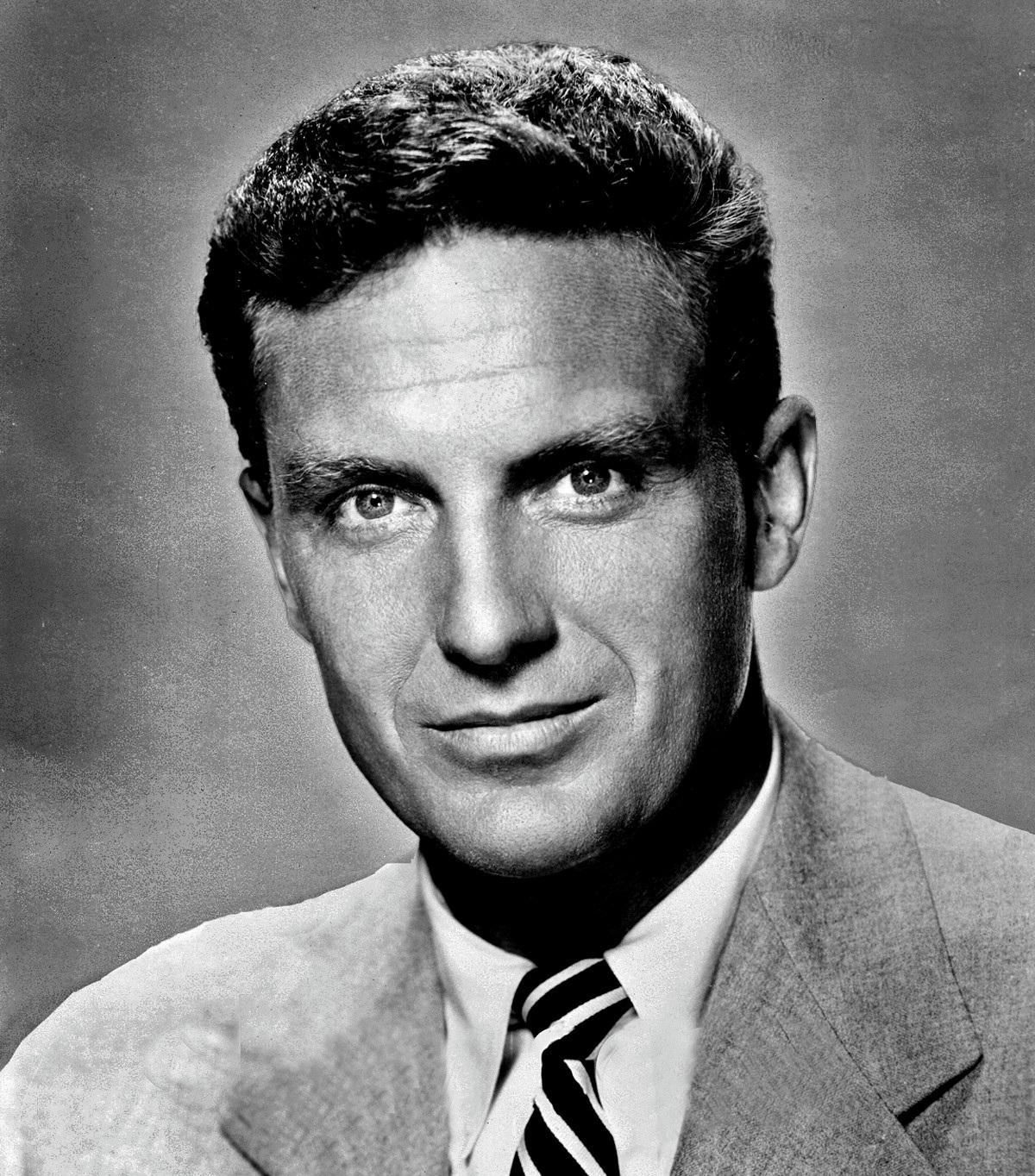
Few actors had an easier path to stardom than Robert Stack. He was born handsome, white and male, with a deep speaking voice and nice head of hair, had presence and sporting ability. His first film role was one of the most eagerly sought in the country, he played leads for over four decades, worked with some of the greatest directors in history, pops up in several classics, earned an Oscar nomination, won an Emmy, became internationally famous and wealthy. Was he a movie star? Not quite. Why do we think that is? Read on…
Stack was born Charles Langford Modini Stack in Los Angeles in 1919. His parents divorced when he was one year old; dad was in advertising and died when Stack was ten, and he was raised by his mother. Stack had a fairly affluent upbringing and displayed particular skill for polo and skeet shooting.
Stack was taking drama courses at college when he visited the lot of Universal Studios. He was spotted by producer Joseph Pasternak, looking for a handsome man to give Deanna Durbin her first kiss in First Love (1939), an adaptation of Cinderella. This was a huge deal at the time as Durbin was Universal’s biggest star – execs, press and fans were constantly getting their knickers in a twist about protecting Durbin and making sure that she “grew up correctly” on screen (in fairness, this attitude probably did more good than harm: Durbin went on to become a happy, content adult, unlike many child stars, even if it took her a few marriages, quitting the industry and relocating to France to get there). Stack got the role as her Prince Charming and became nationally famous – it’s not hard to see why, he’s relaxed, handsome and charming, a lot less self-conscious than he would be in later years.
Universal was delighted, and signed Stack to a long-term contract. The studio was not over-endowed in young male talent at the time; it’s other young leading man was Bob Cummings, whose career would parallel Stack’s in interesting ways, including playing a lot of pilots, romancing Deanna Durbin and becoming a TV star in the 1950s. Stack was a less natural performer but had a far longer career, mostly because his personal life was more stable (only one marriage, no drug addiction, no criminal scams).
Universal loaned Stack to MGM to play a young Nazi in The Moral Storm (1940), a classy credit and pretty decent movie, then Pasternak used him to replace Cummings on A Little Bit of Heaven (1940), starring Universal’s back up Deanna Durbin, Gloria Jean. Stack was teamed with Durbin again in the entertaining, Andy Hardy-ish Nice Girl? (1941) – through she spends most of the running time trying to shag Franchot Tone because Stack’s too dopey and into cars.
Stack was given a leading role a Western, Badlands of Dakota (1941), then Ernst Lubitsch cast him as a Polish flyer who adores Carole Lombard in To Be or Not to Be (1942), which quickly established itself as a classic – and Stack’s contribution was not insignificant, playing it straight and naïve, as required, in a sea of hams. He was the lead in Universal’s war tale Eagle Squadron (1942), a massive hit at the box office (due more to timing and subject matter than quality), and Men of Texas (1942), another Western. He also appeared with some of the studio’s contract players in a war propaganda film, Keeping Fit (1942) directed by Arthur Lubin.
Stack’s luck had been incredible – right out of the gate he’d been in two Deanna Durbin hits, some decent Westerns, an MGM prestige picture and one of the greatest comedies of all time. If he’d been declared 4F, who knows what else Stack might have done – but just as he was set to star in a war film produced by Howard Hawks, Corvette K-225 (1943), Stack joined the navy and was out of action until 1946.
When Stack got out of the services, he was free of Universal and was offered a contract by Liberty Pictures, the new company of William Wyler, George Stevens and Frank Capra; Stack was meant to be in Stevens’ One Big Happy Family but Liberty folded after making only one movie, It’s a Wonderful Life – the Stevens picture was never made. Stack was meant to make his comeback in The Other Love (1947) with Barbara Stanwyck, but according to press reports, had to drop out after he “fell ill” and Richard Conte stepped in; producer David Lewis wrote in his memoirs that Stack was fired from the film because the actor struggled to remember his lines, which sounds unlike everything we’ve read about Stack, but maybe he was rusty/nervous after the war.
The momentum of Stack’s film career had thus been completely disrupted, and when he finally returned to the screen, it was in support parts: Fighter Squadron (1948), a war drama, and A Date with Judy (1948), as a love interest for Elizabeth Taylor. Both were big hits, but Stack was down the cast list, as he was in the less popular Miss Tatlock’s Millions (1949), and Mr Music (1950). He was meant to star in a British war movie, The Gift Horse (1951), but was refused a work permit.
Stack’s luck started to turn. Director Budd Boetticher cast him in The Bullfighter and The Lady (1951), a strong movie and cult classic. If it wasn’t a huge hit, it firmly re-established Stack as a leading man, albeit one stuck in medium budget programmers: My Outlaw Brother (1951), Bwana Devil (1952), War Paint (1953), Conquest of Cochise (1953), Sabre Jet (1953), The Iron Glove (1954). The most notable of these historically was Bwana Devil, the first 3-D movie – as we shall see, Stack found a way to pop up in significant films throughout his career.
Stack’s career was further revived when asked to support John Wayne in The High and the Mighty (1954) as a pilot who cracks up (a role intended at one stage for Bob Cummings). Stack proved effective when both having something meaty to play and paired with a warmer, more effusive actor; the film, directed by William Wellman, was a hit, and Stack signed a long-term contract with 20th Century Fox.
Stack was back in leads of studio “A” pictures: Sam Fuller’s House of Bamboo (1955), going under cover in a crime gang led by Robert Ryan who crushes on Stack; Good Morning Miss Dove (1955), romancing Jennifer Jones; Great Day in the Morning (1956), a Western. He also worked steadily on television, including a musical, The Lord Don’t Play Favorites, and a 1955 version of Laura, in the Dana Andrews part; Stack had a similar “solid American citizen” vibe to Andrews.
Universal borrowed Stack to play the juicy role of the poor little rich boy in Written on the Wind (1956), another flyer, and was nominated for an Oscar. This was a huge hit, though the actual star was Rock Hudson. Stack whined in his memoir that he lost the Oscar because Fox was unhappy that he made the movie for another studio; look, maybe there’s something to it but also maybe people thought the actual winner of that category, Anthony Quinn, gave the better performance. Stack was reunited with the same cast, writer, producer and director of Written on the Wind in The Tarnished Angels (1957); it was less popular, but its critical reception today is probably higher than Wind.
For all Stack’s success, he did lack warmth and empathy on screen. When teamed with a male actor who could provide that (John Wayne, Rock Hudson), it didn’t matter, but on his own, he tended to flounder, as proved by the poor reception to the dull romance that he made for Fox, The Gift of Love (1958) with Lauren Bacall, and most of all, the biopic John Paul Jones (1959), a long-standing passion project of Australia’s own John Farrow – Stack was front and centre for this epic, and to be blunt, he sinks to the occasion.
However, Stack had luck on his side. Van Johnson turned down an offer to play crime fighter Eliot Ness in a TV play called The Untouchables; Stack stepped in instead, and the result was a sensation that branched into a highly successful series (1959-63). Stack was, again, a little stiff and dull but this suited the part and was a useful contrast against an array of colourful gangster villains. The show became iconic and Stack won an Emmy for Outstanding Lead Actor in a Drama Series.
Stack was a leading man in a disaster film with Malone, The Last Voyage (1960), and did The Caretakers (1963) with Joan Crawford. However, by now, he was mostly typed as a TV star in Hollywood – on the small screen, he appeared in Memorandum for a Spy (1965) and the infamous 1967 version of Laura (in the Dana Andrews part again, written by Truman Capote and starring Lee Radziwill).
Stack had to go to Europe to get film roles: Is Paris Burning? (1966), The Peking Medallion (1967), Action Man (1967), and Story of a Woman (1970). The latter was a real change of pace, a romance with Bibi Andersson, but no one cared.
Universal financed Story of a Woman so that Stack would make a TV series, The Name of the Game (1968-71). Ben Murphy, who appeared on the series opposite Stack, recalled “I would look into his face. As an actor you do that, play off of someone’s expressions, emotions. And I remember looking at him and thinking, ‘This guy is not going to give me anything to work with.’” People far preferred the acting and artistry of co-star Tony Franciosca – but Franciosca would also punch people and suffered huge mood swings whereas Stack was dependable, likeable and professional. These things count, even in Hollywood.
Stack was mostly a TV star for the 1970s: Most Wanted (1976), Strike Force (1981-82), or TV movies like Adventures of the Queen (1975), Murder on Flight 502 (1975) (with his wife and daughter). He did another feature film drama that no one cared about, Second Chance (1978), but showed a flair for comedy as General Stilwell in 1941 (1979). Actually, to be fair, he’d shown a flair for comedy back in To Be or Not to Be, provided he played it straight and didn’t try to be funny, only this hadn’t been accessed in more than three decades.
Stack’s performance in 1941 was one of the best things about the movie, but what really established him in comedy was Airplane! (1980) with his legendary performance as Ted Stryker. Most of Stack’s feature films from then on were comedies, with the actor typically playing a straight bat authority figure: Big Trouble (1986), Plain Clothes (1988), Dangerous Curves (1988), Caddyshack II (1988), Joe Versus the Volcano (1990), Beavis and Butt-Head Do America (1996), and BASEketball (1998). There were limits to his comic flair, as proved when he was hired to do La Cage Aux Follies on Broadway. Director Arthur Laurents called Stack’s work “staggering and stumbling through rehearsals that were painful and embarrassing” and fired the actor before he reached the paying public.
Still, Stack guest starred on a lot of TV (including the inevitable guest appearance on Murder She Wrote) and had a long running gig hosting Unsolved Mysteries (1987-2002). He died in 2003.
Robert Stack had an amazing career littered with iconic credits. He was Deanna Durbin’s first screen kiss (First Love) and MGM’s first Nazi (The Mortal Storm), featured in Carole Lombard’s last movie (To Be or Not To Be), the first 3D film (Bwana Devil), a top class Sam Fuller (House of Bamboo), Budd Boetticher’s most personal Hollywood film (The Bullfighter and the Lady), two Douglas Sirk masterpieces (Written on the Wind, The Tarnished Angels), a legendary TV series (The Untouchables), pioneering disaster epics (The High and Mighty, The Last Voyage) landmark comedies (1941, Airplane!). The directors he worked with included Steven Spielberg, Sam Fuller, John Cassavetes, Douglas Sirk, Budd Boetticher, Ernst Lubitsch, John Farrow and William Wellman.
We would argue though that he wasn’t a movie star. A leading man, yes, a TV star, absolutely, hugely effective in comedy, affirmative. People who worked with Stack are unanimous in praising his professionalism, work ethic and self-deprecating self of humour. But a movie star? No, not quite. This does not diminish his career or legacy. His filmography is always worth revisiting.
