


by Stephen Vagg
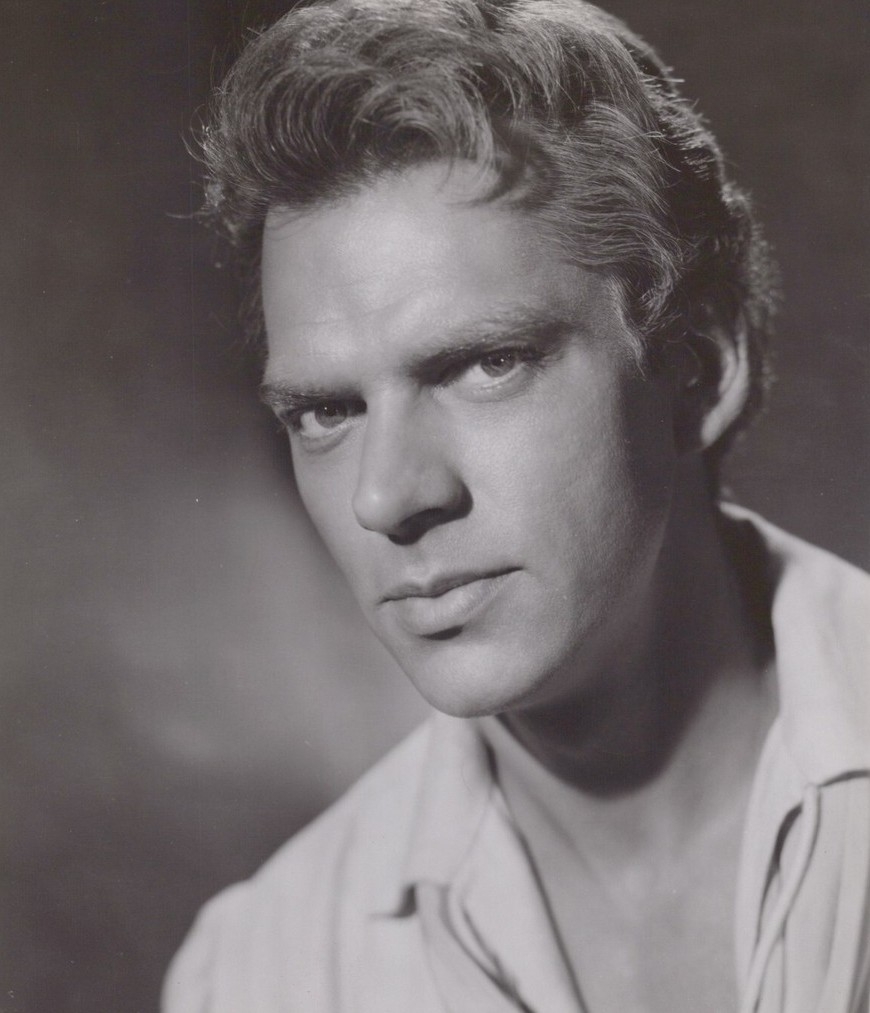
Keith Andes was a slab of 1950s beefcake who co-starred opposite Marilyn Monroe, Lucille Ball and Linda Darnell, appeared several times on Broadway, was given a big push by RKO, and had his own TV series. He never became a star, or indeed anything close to one, but he had an interesting career and life.
Andes was born in 1920, and while he did some acting in college, his original plan was to be a schoolteacher. Then came the war, and Andes wound up singing and performing in USO shows (he was a baritone), which led to being cast in Moss Hart’s morale-boosting play Winged Victory. Andes understudied for the three leads and when one fell ill, he got to play the lead for a stint. This resulted in offers from 20th Century Fox and David O. Selznick – Andes accepted the latter.
When Andes got out of the services, Selznick cast him as one of Loretta Young’s meathead brothers in The Farmer’s Daughter (1947), which was released through RKO. That was a decent credit to start (Lex Barker and James Arness played other brothers) and the film was popular. However, Selznick did not make that many movies and released the actor from his contract. Andes headed to New York and nabbed a key role in a Broadway revival of the operetta The Chocolate Soldier.
Andes was given a film lead, albeit in a low, low-budget thriller shot in New York: Project X (1949). The movie people didn’t seem that excited, so it was back to Broadway where Andes replaced Alfred Drake in Kiss Me Kate (1950) for about a year, in New York and on the road. His performance impressed executives at RKO, who signed Andes to a long-term contract.
By this stage, RKO had been bought by Howard Hughes, who would kill the studio, but in 1950 that was still some time off. Andes’ first movie for RKO was a classy production, Clash by Night – based on a play by Clifford Odets, directed by Fritz Lang, a cast including Barbara Stanwyck and Marilyn Monroe. Andes played Stanwyck’s brother and Monroe’s boyfriend. The image of him shirtless holding Monroe who is just wearing a bra remains probably the best-known picture of Andes.
RKO gave Andes the heroic lead in Blackbeard the Pirate (1952), playing the real-life Lt Maynard, although he was billed beneath Robert Newton (Blackbeard), Linda Darnell (love interest), and William Bendix (first mate); Raoul Walsh directed. The studio then used him as the hero in a thriller directed by Dick Powell, Split Second (1953), outshone by villain Stephen McNally.
In late 1952, columnist Sheilah Graham listed Andes among a dozen names of people she thought were most likely to achieve stardom the following year (the others were Rosemary Clooney, Audrey Hepburn, Susan Ball, Mari Blanchard, Phyllis Kirk, Ursula Thiess, Dewey Martin, Elliot Reid, Keefe Brasselle, Richard Anderson and Robert Wagner).
None of Andes’ RKO films did well, not even Clash by Night, and he was proving to be a little, let’s be blunt, dull on screen. RKO adjusted its contract with Andes to one film a year for five years. He returned to Broadway for a musical, Maggie (1953) but it only had a short run. He co-starred opposite Angela Lansbury in a noir, A Life is at Stake (1955), from Lansbury’s “obscure credits everyone forgets” period in the mid-1950s.
Universal Studios, always keen to use virile, manly types, offered Andes a deal at two films a year. He was cast as one of the men in The Second Greatest Sex (1955), a western musical comedy based on Lysistrata – his co-stars included people like Jeanne Crain, George Nader and Mamie Van Doren. Universal then used Andes in Away All Boats (1956) (a war story with Jeff Chandler and Nader), Pillars of the Sky (1956) (a western with Chandler and Dorothy Malone), and Interlude (1957) (a Douglas Sirk melodrama with June Allyson).
Andes went back to RKO for two more films, both remakes: Back to Eternity (1956), John Farrow’s re-do of Five Came Back, in the boring role of the pilot; and The Girl Most Likely (1958), a musical remake of Tom, Dick and Harry. The latter was the last film produced by RKO Radio Pictures, although it was distributed by Universal.
Throughout this time, Andes regularly appeared on television, notably starring in TV versions of musicals such as The Great Waltz (Neil Simon worked on the book!), Holiday and Bloomer Girl. He had the lead in two films based on true stories shot on location: Damn Citizen (1958), written by Stirling Silliphant, about a soldier who fights against corruption in New Orleans; and Surrender – Hell! (1959) playing the real-life WW2 guerrilla leader Donald Blackburn who fought in the Philippines. He did a thriller in Britain, Model for Murder (1959); starred in a TV series, This Man Dawson (1959-60) and returned to Broadway at the request of Lucille Ball to be her leading man in Wildcat.
None of these were that successful. The Universal films did so-so, the RKO films disappointed, no one cared about the biopics or the TV series. Even Lucille Ball on Broadway couldn’t consistently pull them in.
And Andes never broke through. He was handsome, could sing, move, act well enough, all that stuff… but whatever it was that made a star, the ability to connect with audiences, he didn’t have it. Maybe a few more film musicals would have changed things but that genre went into sharp decline from the mid-‘50s onwards.
Andes never lacked for work on television as a guest star and he was Glynis Johns’ leading man in a sitcom, Glynis (1963). He did musicals, voiceover work and even appeared in the odd feature film such as Tora! Tora! Tora! (1970) and And Justice for All (1979). After the TV movie Blinded by the Light (1980), Andes retired, bought a boat, and lived on it, running charters. He married twice and one of his sons became a rock musician, a member of the band Canned Heat.
The story has a downer ending, which happens. Andes liked working out but he also liked his smokes. He developed bladder cancer, which caused him great physical pain – so much so he committed suicide in 2005. (Jon Hall did the same thing after being diagnosed with the same cancer.)
When starting to research this piece, we were unaware of all that Keith Andes did in his career. Not only did he put in serious yards on Broadway, he worked with directors such as John Farrow, Mitchell Leisen, Fritz Lang, Dick Powell, Raoul Walsh, Norman Jewison and Douglas Sirk. He was championed by Lucille Ball and Howard Hughes. If he never became as big a star as Audrey Hepburn or Robert Wagner, he certainly matched Elliot Reid and Keefe Brasselle.
