



by Stephen Vagg
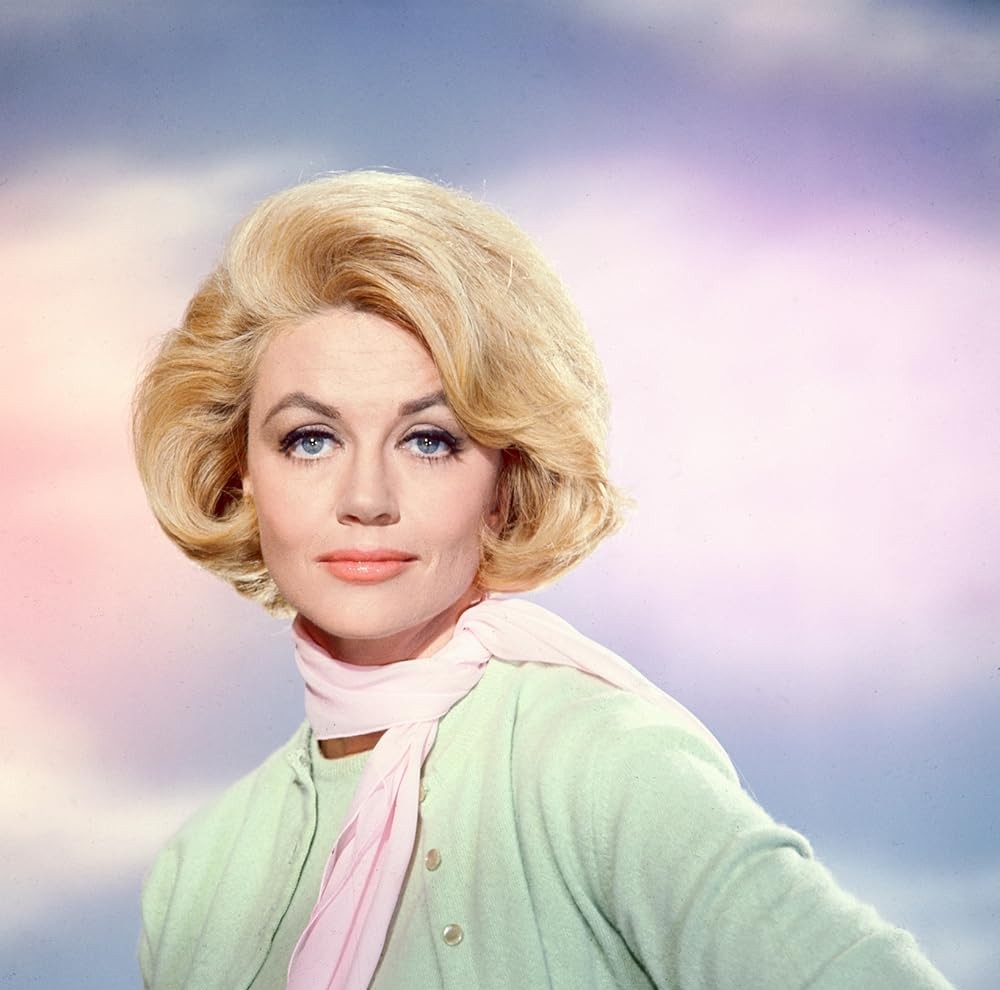
Dorthy Malone had an unusual career. She played leading roles for over two decades, featured in some big hits/classics, won an Oscar, had starring vehicles, was acknowledged as being stunning, hard-working and talented… and yet never became a star, not really. It is/was admittedly more difficult for women, especially in Malone’s heyday (the 1950s-‘60s) as the previous bread and butter genres for female stars – melodrama, screwball comedy – migrated to television. But even considering that, it’s a mystery how someone so good never quite clambered on to the A-list. Was there anything else going on?
Malone, real name Mary Dorothy Maloney, was born in 1924 and grew up in Texas. She was one of five children to an accountant and his wife: two of her sisters died of polio, a brother was killed when struck by lightning while playing golf, her surviving brother became a judge.
Dorothy was born with what actress Edith Evans called “the primitive passport” (i.e. she was hot) and did a little modelling, but as with so many women of her age and class at the time, she was basically raised to get married and have kids; she attended college, preparing for a something-to-do-before-marriage job like nursing or teaching (accounts vary) when fate intervened – Dorothy was spotted in a play by a talent scout from Hollywood studio RKO; he arranged a screen test, which led to a contract.
This was a decent enough break, though studios did put a lot of pretty girls under contract; Dorothy, who was only 18, accepted it as a lark more than anything, fully expecting to soon return home, get married and have children, etc. RKO did use her, but mostly just to smile in the background, unbilled – she pops up in films like Gildersleeve on Broadway (1943), The Falcon and the Co-eds (1943), Higher and Higher (1943), and Youth Runs Wild (1944). Blink and you will miss her.
RKO dropped her, and Dorothy might have gone back to Texas had Warner Bros not stepped in. They changed her surname to Malone and put her in some pretty girl parts like Too Young to Know (1945), Frontier Days (1945) and Janie Got Married (1945). Then came a big break – she was cast as the bespectacled book shop clerk who shags Humphrey Bogart after two minutes of chat in Howard Hawks’ The Big Sleep (1946). She only had two scenes (one, really), but they were a highlight of the film: book-loving girls with glasses never came across so sexily on screen (her character’s not interested in Bogart until he displays some basic literacy, then she wants to hump him then and there). It’s amazing that she rarely played this type again.
Warners started giving Malone bigger parts in films like Night and Day (1946), To the Victor (1946), Two Guys from Texas (1948), One Sunday Afternoon (1948), Flaxy Martin (1949), South of St Louis (1949) and Colorado Territory (1949). The problem was, most of these movies weren’t that crash hot – they were fine, but they tended to be remakes and/or Westerns and/or Dennis Morgan vehicles, and Malone was typically wasted in them, playing The Girl.
Warners had a track record of devising fantastic parts for women (Bette Davis, Ida Lupino, Anne Sheridan, etc), but the studio didn’t seem to consider Malone worthy of such treatment, giving juicier roles during this period to its other contract stars like Viveca Lindfords, Virginia Mayo and Alexis Smith. None of Malone’s movies did much business, so despite decent reviews (especially for One Sunday Afternoon), Warners dropped her.
Malone was unsure what to do next. She was established, but not firmly, and shelf life for ingenues in Hollywood was/is traditionally short. From everything we have read, she didn’t have a burning desire to perform, but she was clearly good at it, and she wasn’t trained to do anything else, so… she kept acting. Only not full time. She seemed to kind of… drift.
Malone made a few movies at Columbia, including Convicted (1950), as The Girl. She went home to Texas for a bit. She did public relations for an insurance company. She studied acting in New York, travelled to South America, enjoyed her many hobbies, dated but didn’t get married. She took acting roles when she needed the money – in particular, Malone made a lot of low/medium budget Westerns (some for Allied Artists), romancing everyone from Randolph Scott, Tim Holt, and Ronald Reagan, to Mark Stevens and Fred MacMurray. Very few actresses got any career bump from being in a Western, but Texan-raised Malone enjoyed them, later saying “I loved to get all dusty and ride horses and plant potatoes and cotton. My stand in and I would be the only women on the set.”
At one stage, she was even set to go to Australia to make The Kangaroo Kid but fell ill and was unable to. She also began appearing on television, though not in fantastic roles. A 1952 profile declared that Dorothy Malone “just acts on whims or sudden urges.” She didn’t seem to have the hunger/ambition/confidence to seek out better roles/films/directors.
Malone’s professionalism, skill and beauty were not ignored and, gradually, she began to get better credits again. These included two strong Lewis and Martin films, Scared Stiff (1953) and Artists and Models (1956); Pushover (1954) with Kim Novak; Young at Heart (1954) with Frank Sinatra and Doris Day; Sincerely Yours (1954) with Liberace; and Private Hell 36 (1954) for Don Siegel, with Ida Lupino. Even in these, though, Malone tended to be the second female lead – for instance, Anita Ekberg got the juicy close ups in Artists and Models, and it was Novak not Malone launched to stardom in Pushover, while Joanne Dru wound up with Liberace in Sincerely Yours.
Malone starred in the first two features produced by Roger Corman, both for ARC which became AIP: The Fast and the Furious (1955) and Five Guns West (1955) (Corman’s directorial debut). Corman said around this time: “I think this girl is the best actress in Hollywood. she was the most sporting and willing worker I’d ever seen” The two of them dated (Corman routinely dated his leading ladies, mostly to save time.) It must be admitted though, that working with Corman back then, was not an indication that your career was going well.
Malone’s brother died tragically after being struck by lightning in 1954 and this coincided with her career being re-energised – possibly, she took her career more seriously, or people felt sorry for her, or it could have been just a coincidence.
Raoul Walsh, who’d directed Malone in One Sunday Afternoon and Colorado Territory, cast her in a juicy part in Battle Cry (1955), playing a married woman who has an affair with a young soldier (Tab Hunter) during World War II. Malone won the role over Phyllis Thaxter and Meg Myles; in his memoirs, Hunter praised Malone’s support for helping him deliver his best part to date. The movie was a big hit and the penny dropped in Hollywood how Malone could be used other than as a Girl in Westerns – namely, as a sexually active temptress who was still sympathetic, a sort of minor league Lana Turner (she could play other roles, of course, we are talking about how the major studios could envision her).
Thus, she was cast in Written on the Wind (1956) as a hot mess, sex positive, poor little rich girl in love with Rock Hudson who loves Lauren Bacall who’s married to Malone’s brother Robert Stack, under the direction of Douglas Sirk. Malone went all out in the movie, drinking, rooting, dancing and stroking miniature oil wells with phallic aplomb, and wound up winning the Academy Award for Best Supporting Actress. Among those she beat were Patty McCormack in The Bad Seed and Mercedes McCambridge in Giant, so that was decent competition. “I think people voted for me because they liked me and were surprised when I actually won,” said Malone later.
With the Oscar, Malone’s parts did improve, kind of: she played Mrs Lon Chaney in the biopic Man of a Thousand Faces (1957); while The Tarnished Angels (1957) reunited her with Hudson, Sirk, Stack, and producer Albert Zugsmith (and is Sirk’s favourite of his own movies). But she couldn’t escape Westerns – Tension at Table Rock (1955), Pillars of the Sky (1956), Quantez (1957) – or Girl parts in dramas like Tip on a Dead Jockey (1957). She was cast as another poor little rich girl hot mess, Diana Barrymore, in the biopic Too Much, Too Soon (1958), but the film was not a success, commercially or critically (unfairly, we think it’s splendid) – any good reviews went to Errol Flynn who played John Barrymore. The Diana Barrymore part had been turned down by Carrol Baker, who played a part that Malone desperately wanted in The Big Country (1958)… but Malone had been too shy to pester director William Wyler for an audition. Baker went on to play a whole series of roles that might’ve gone to Malone. Likewise, despite having worked with Douglas Sirk twice, she missed out on the juicy lead in Sirk’s Imitation of Life (1959) to Lana Turner; Turner was a bigger star but who knows what Malone might’ve done in a big old Ross Hunter produced vehicle?
Any post-Oscar boost did not last very long, and Malone soon resorted exclusively to The Girl parts – Warlock (1959), The Last Voyage (1960), The Last Sunset (1961), Beach Party (1963) – or guest starring on episodic television. She later said, “instead of better movies, I got awful ones. My salary went up, so a lot of producers couldn’t afford me. I took every lousy third rate movie just to keep me going.”
It seems that Malone never reached the top rank not so much due to lack of talent or popularity, but absence of self-belief. In 1958, she admitted that “I have never thought of myself as a star. Perhaps I should. I’ve been told it makes others respond accordingly… I’ve always thought my job was acting and that I was expected to act instead of making an impression. Many actresses start out with one particular goal and never allow themselves to be deterred. In essence, this must be an ideal means to an end, but I had no all-over plan. There was no money to hire a press agent. I just had to earn my way and was in no position to be selective. After I won my Academy Award, practically everyone advised me to now hold off. They enumerated the reasons why it was so important to go from one award picture to another, but how can you bank on a myth? And how could I forget that every picture looked like my last picture for quite a few years. Naturally, I wish I could do more pictures that are considered tops in Hollywood, but the whole truth is: The smaller ones have given me the breaks! Maybe it’s because I came up the hard way, but I can’t turn my back on the people who had faith in me and put me in those pictures.”
To compound the issue, her 1959 marriage to actor Jacques Bergerac did not last – they had two daughters, but things went south very quicky and various court/custody battles followed, forcing Malone to take jobs for money instead of being choosy. She later cracked, “I waited so long to make sure the right man came along and then I couldn’t have made a worse choice.” A second marriage was to banker Robert Tamarkin who later went to gaol for swindling, while a third marriage to a model chain executive also failed. She later declared, “I really have very bad judgement in men. I’m very gullible and romantic and easily swept off my feet. I have much better luck sizing up women.”
In 1963, Malone accepted an offer to star as Constance McKenzie in the TV version of Peyton Place, the role played by Lana Turner in the film. It was appropriate casting in a way, since you could easily imagine Malone in many Turner parts (blonde, ‘50s sexy, etc); the series was a big hit, and Malone stayed with it for four years, although she took a few weeks off in 1965 when she almost died during an operation to remove a blood clot (Lola Albright replaced her). In 1968, she was fired off the show after which she sued the studio; they settled out of court.
Exhausted from Hollywood, Malone moved back to Dallas in the early ‘70s to raise her daughters and look after her parents. She would fly back to Los Angeles to work, mostly guest shows and TV movies, plus the odd feature like Good Luck, Miss Wyckoff (1979), and The Day Time Ended (1980); she also did some theatre. In 1981, it was reported that she was suffering financial troubles at the time due to expensive divorces and medical bills. She inspired John Waters’ Dorothy Malone’s Collar and kept working until her last performance, in Basic Instinct (1992), playing the family-murdering friend of Catherine Tramell (Sharon Stone). She died in 2018.
What to make of Dorothy Malone’s career? She clearly had a great work ethic and complete lack of pretention, and was someone who could be relied on to turn up and do her job without too much fuss. Whenever she was teamed with a really first-rate director – Howard Hawks, Douglas Sirk, Raoul Walsh, Frank Tashlin – she always rose to the occasion. But most of her directors were journeymen – for instance, Pillars of the Sky, which she made with Jeff Chandler, cries out for John Ford (who was meant to make it) but she wound up with George Marshall instead. A little bit more gumption and better luck in her collaborators, and who knows what Dorothy Malone might have achieved?
Still, it was an incredible career. There were some bonafide classics (Big Sleep, Written on the Wind, Artists and Models), hidden gems (Too Much Too Soon), an iconic show (Peyton Place), cult efforts (The Tarnished Angels, Beach Party), enjoyable trash (Battle Cry), several decent programmers (One Sunday Afternoon). She made numerous movies/TV series, which launched other people as stars: Mia Farrow, Ryan O’Neal, Kim Novak, Tab Hunter. She had two daughters and from all accounts was a lovely person. A life well lived.
