




by Gill Pringle in LA
Natasha Lyonne’s human bullshit detector Charlie Cale is still on the run from mob-bosses, with Season 2 seeing her continue to deal with strange crimes and shifting relationships – this time with a plethora of notable guest stars.
A mystery-of-the-week series, Poker Face is an entertaining crime comedy caper that embraces the detective story format popularised by 1970s series, Columbo among others.
“She’s not exactly the same Charlie from Season 1, who maybe thought of herself as a lone wolf. Now, she genuinely is,” offers executive producer/star Lyonne when she sits down with creator/writer/director Rian Johnson for our interview.
Like her shambolic artistic predecessor Peter Falk, Lyonne brings a huge dose of likability to her alter-ego. “We always try to be mindful of removing any sort of cynicism or streetwise New York-type thing – that’s not this character,” she says of Charlie, who has an uncanny ability to determine when someone is lying. “We make sure that Charlie is ultimately an optimist.”
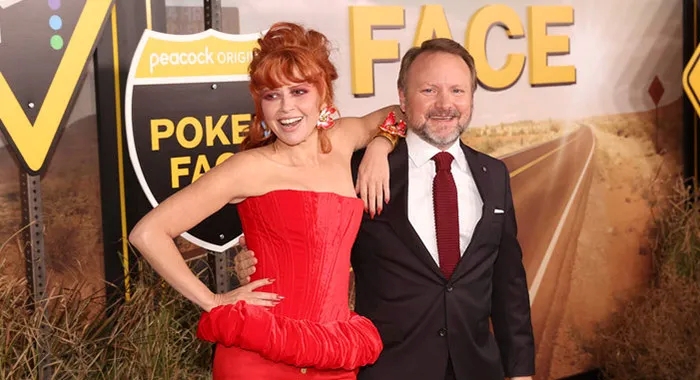
“There’s obviously a lot of Columbo and Peter Falk in Natasha, and then in Charlie,” acknowledges Rian Johnson, who created the Knives Out franchise. “And then, when you have somebody as talented and singular and iconic as Natasha Lyonne, that’s what makes a show like this work; she is the sun at the centre of this little solar system, and she can hold it all together gravity-wise.
“One of the things about the show is that, on one hand, it has a Columbo style structure to it, but one of the tweaks to the structure is this flashback thing where Charlie has to meet and get to know either the victim or the killer and form a relationship with them.
“And that’s what draws her into solving the crime. That’s important, because she’s not a cop. It’s not her job to solve the crime, so she needs an emotional way in with every single episode. We needed to open up the season in a way that makes Charlie come to each episode, trying to find her place in the world, and it gives us more ammunition, specifically for what makes each episode tick, finding an emotional way in – whether it’s the killer or the killee…
“So, it’s not just sprinkling more existential stuff on top of it, it actually feeds into what the writers have to find in each episode for it to work,” he says.
 For Lyonne’s part, she says, “Whatever show I’ve been a part of creating or world-building, I am always trying to imbue a female lead with non-traditional qualities. I’ve really made it my business to try and flip those tropes on their heads.”
In person, it’s hard to separate Lyonne from Charlie, both tending to express existential philosophies, the actress even quoting Nietzsche during our rambling conversation.
“Is life a planned improvisation? I think for each of us – none of us know our fate – so it could come at any moment. I’m real logistics, OCD-obsessed. I always think of it as, like, you’ve got to really know the scene and really prep or whatever. As a director, you’ve got to know everything and storyboard.
“And Rian is a serious person, if you can’t tell, so I think the joy of it is in that heavy preparation, whether it’s for life or for filmmaking, and you can have some space to improvise, right?”
For Poker Face’s second, Lyonne and Johnson also looked at influences beyond Columbo. “Part of the intention of the show is to come back to the pleasures of, sort of what I think of as ‘TV TV’, the stuff that I grew up sitting down in front of the TV watching, like Quantum Leap, The A-Team or Magnum PI, episodic shows,” says Johnson.
“But it’s almost like the persistence of vision illusion with cinema, where you see 24 frames a second very quickly, and your mind creates motion. I think there is a thing where, if in each episode, Charlie herself, like in a little movie, does some level of development from the beginning to the end of the episode… it kind of doesn’t matter what order you watch them in, you’re going to create the persistence of vision and feel that she’s taking a journey.
 “Because when I was watching those shows, I was watching reruns in the afternoon, and they weren’t playing them in order. It’s not like I was watching season two and bingeing it. I was seeing them kind of on mix, but I still had the sense that I didn’t feel like the characters were repeating themselves. It felt like the character was constantly growing.
“So, we focus on each individual little episode as a movie: what is Charlie’s journey within that episode? More so, even then, what is her journey over the course of Season One or Season Two?” he asks.
Both Johnson and Lyonne can talk endlessly about their inspirations. Reflecting on their original conversations for Season 2, Lyonne recalls that “we had a bunch of meetings. But then he sent me this gorgeous puzzle box, very Rian Johnson script, and it’s beautiful. I mean, it’s so funny and so tightly wound and it was a building of beauty, and it extended that character out of that interpretation of an Elliott Gould/Philip Marlowe, kind of hipster Altman ‘70s [a reference to The Long Goodbye], into someone who had the desert at her back, flavours of Jeff Bridges as the dude in Big Lebowski…
“It was just somebody who had lost interest in themselves and gained interest in their fellows. And it moved from being on their own case into being interested in other people’s cases. And I think that that’s really special, like it’s a real gift,” she muses.
Season 2 also features several drug-themed episodes, much to the amusement of the long-time sober Lyonne. “LSD – I did too much, I would say, as a teenager. . . and these are the effects that you’re seeing,” she quips.
“Yes, it stays in spinal fluid, they’ve told me, for a lifetime, and appears at any moment. I’m so, so sorry. But it does give a lasting impression, I think, and changes your point of view.
“In terms of specifically this season – it’s used in forming connections, I think, with people. And I guess altered substances can provide that. I haven’t had a drink in 20 years, but I remember there was a time when it did forge a sense of a false sense of connection in that moment or allowed you to drop down your guard.
“Or sometimes, you’re sleeping with a weirdo, you would regret, but, you know, it’s a funny thing… People do tend to open up when their defences are down and are on altered substances.

“But, yeah, funny thing about life is, I think that can even occur in surprising moments of, you know, a shared reality of some other kind – high stakes, maybe like running from Rhea Perlman is probably its own altered state, I guess is what I mean in its own way. You know, if you’re in a state of paranoia that they’re out to get you all the time, it’ll be easier to form a connection with Cynthia Erivo, because you have that vulnerability or that desperation … so it’s a funny thing to think that we reach all kinds of altered states all the time in a weird way,” she says.
Showrunner Tony Tost has the last word, describing the show as capturing the “lightning-in-a-bottle” magic sparked by the unlikely pairing of Lyonne and Johnson. “I see the show as the marriage of Rian and Natasha’s aesthetics,” says Tost. “Rian is your Paul McCartney – very good at making hooks and intricate pieces that come together that have this playfulness. Then Natasha comes in with this Lou Reed kind of swagger.
“They almost have their own language, on their own wavelength. I’m just the rhythm section helping to fuse them together,” he says.
Poker Face Season 2 is streaming now.
