


by FilmInk Staff
Jackie Collins was a literary hit factory. There were thirty-two books and half a billion readers. She was famous for writing novels about the international jet-set and dubbed ‘the Queen of Trash and Flash’. The novels had titles like The Bitch, The Stud, and Hollywood Wives (the first two here were filmed as low budget soft-core quickies.)
Collins became just as famous, perhaps more so, as her older sister, movie/TV star Joan Collins. Jackie claimed the glamourous style of the ‘80s as her own (and maybe even influenced Dynasty): big hair, big earrings, and aircraft carrier shoulder pads.
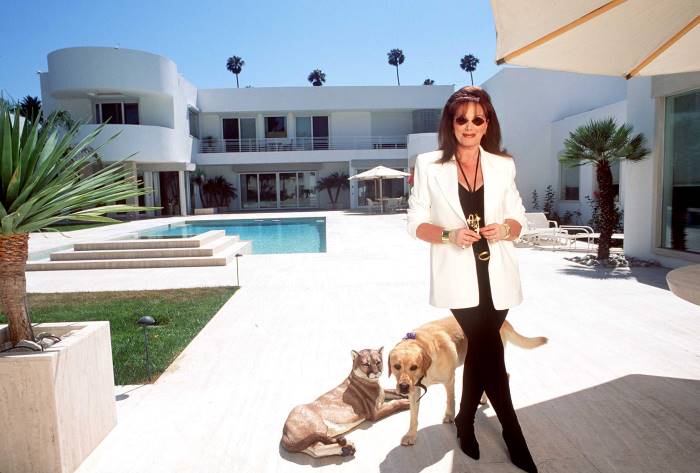
But as a new and excellent feature documentary about her life argues, it was the fact that she put female sexuality at the centre of the world in her novels that was the significant factor in her pop culture success. “People lost their minds over it”, an eyewitness to Collins’ influence says in Lady Boss. They certainly did in Australia. Collins’ 1968 debut novel The World is Full of Married Men was ‘dirty’ enough to be banned here (it was filmed in ’79).
For Collins, says director Laura Fairrie (Taking on the Tabloids), her female centred fiction was more than fantasy.
Her heroines, the tough, beautiful women who always get what they want and put one over exploitative men, was both fantasy and biography.
Collins died in 2015 at 77 of breast cancer (she bravely worked through her illness). But says Fairrie, her contribution to feminist fiction has never been recognised, “I wanted to celebrate her.”
It was gratifying to the filmmakers to find an international cast of talking heads to back up for Collins, but Fairrie and co. were fighting a very British kind of snobbery. Collins is still, even in feminists’ circles, simply thought of as ‘exploitative, smutty, and disgusting’.
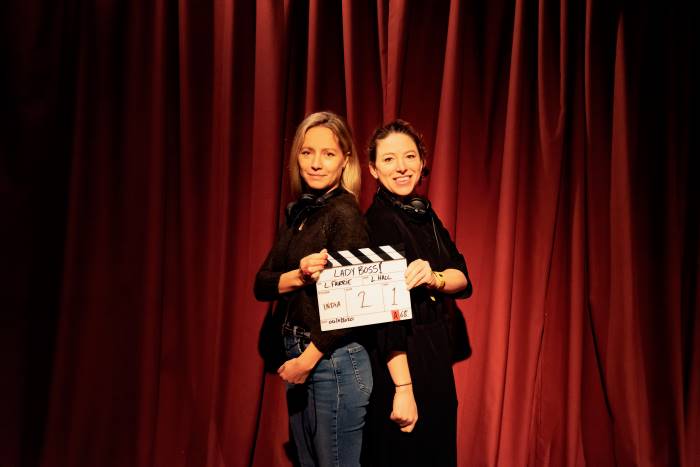
Lady Boss is superbly produced on several continents by Lizzie Gillett (One Day in September) and John Battsek (One Day…), made with the co-operation of Collins’ family and is an unabashed fans’ film. But underneath the fun, the schmooze, and yes, the bedroom bouncing, is a serious tale of body-shaming, family tragedy, sexism and controlling men…
FilmInk spoke to Fairrie and Gillett, both based in the UK, where they are prepping new projects, via Zoom.
In the film, quite a few talking heads recall how Jackie Collins novels offered her audience – sometimes teenage girls – not only saucy thrills…but a sex education. Was that your life?
LAURA FAIRRIE [Laughs] Yes! She was my sex education. I read her at school and hid the books under the desk.
As a young person, did you even then make the leap that the film makes… that what was at play here in these sexy books was more than sex, that there was something there about female empowerment?
LF No, I did not make those connections as a kid. But it did feel radical. I did know that I was reading something I was not supposed to be reading. Especially in maths class. [Laughs]. I think I understood there was something powerful in what she was doing.
LIZZIE GILLETT I had not heard of Jackie Collins before I was asked to consider this as a film [to produce.]
I literally Googled her, though I think I had this vague perception… and [then I saw] that she sold 500 million books and I thought wow! What a powerful successful British woman.
The archive used – including excerpts from Collins’ teen diaries and Hollywood home videos – offer a great insight into a life from modest beginnings to jet-set leopard-skin-poolside celebrity gatherings with Roger Moore, Michael Caine, Warren Beatty… she was underage and had a thing with Marlon Brando…
LG We ended up ingesting four and a half thousand pieces of archive – a lot of it from the Collins Estate – that includes stills, faxes, manuscripts, lists… we only had eighteen shooting days but [the key to that] was Laura’s preparation.
The visuals are very witty. They look like paperback covers. You seem to get a really strong connection to all the cast in the interviews.
LF I researched it to death. There was no script. But I went into the interviews with a comprehensive story beat document almost like a script. I was quite targeted about what I wanted from each interview because I knew the relationships… It was important to me to peel back the layers and find the human story.
Was there anything the interviewees wanted to avoid?
LF They didn’t want to talk about her [last major relationship] with a man called Frank. People were worried. Jackie was in this abusive relationship. They felt it would undermine this woman who wrote these kick arse characters.
Collins was hardly a critics favourite.
LF Yes. What really interested me was that she was always looked down upon through her life, especially in the United Kingdom. People sneered at her. No one respected her. It was almost like an embarrassing dirty secret that you read Jackie Collins. So, the idea of reframing her as a feminist for her times and celebrating what she did [was a major motive behind the film.] I love the fact that she made feminism accessible.
LG There have been so many films about older men, so that was the starting point for me. Of course, the look of it was incredible and Laura had this incredible concept of doing it as a sort of an I, Tonya…
Yes, the talking heads contradict and obsess over their own part in the main character’s story…
LG Yes, and when we pitched I, Tonya [as a reference] that would baffle financiers… they’d say, ‘but that’s a drama’…
LF But we had discovered all these bat-shit characters surrounding Jackie Collins and were a part of her story.
Collins was part of the tradition of bestsellers like Harold Robbins, Arthur Hailey, Mario Puzo, where real-life private lives are inserted into fictional adventures. In the film, you have some of the talking heads read directly from Collins’ novels… and what they are reading are fictional versions of themselves! What was the idea there?
LF I wanted to feed on the idea of fact and fiction and how Jackie would get lost in her fictional world. Those boundaries would intertwine. She drew from her life and put that into her books. She used her fictional worlds to help her in her own life. That was the place she was happiest; with her imaginary friends. She dreamt up the life she wanted and then chased after it.
Famous Australian writer Clive James is in your film. Usually, a fan of pop fiction, James really savages her.
He says: “Collins’ books start off as nothing and end as nothing and they are never going to become ‘classic’…no matter how long you wait.”
But your film argues that this is more than literary snobbery. It was sexism.
LF We faced that when we tried to finance the film.
LG People told us ‘why would you bother making a film about Jackie Collins?’ Even now, a well-known art-house film director told me ‘I had to watch the film as part of the BAFTA Awards… it’s really good and I didn’t expect that at all.’
LF Just recently, Hilary Mantel (of Wolf Hall fame) said that Collins was not a feminist…
There are clips included in the film where Collins’ ‘brand’ has suddenly become dated.
LF That idea of her being told ‘you are not a feminist!’ How can a woman who’s saying I’m a feminist and I’m gonna write the books that I want, and I’m gonna define feminism for myself and share it with 500 million others and make a fortune and be an independent woman and build my own brand and build my own business empire’…And then she’s being told you are not are a feminist by all kinds of people: ‘that’s not feminism’ – that’s absurd!

