



by Stephen Vagg
Another Vietnam War screenplay from the author of Apocalypse Now.
Few Hollywood screenwriters had a hotter hot streak than John Milius in the 1970s. Consider these efforts: Apocalypse Now (all the great stuff in that movie originates from Milius’ original draft), The Life and Times of Judge Roy Bean, Jeremiah Johnson, his Dirty Harry rewrite, Magnum Force, Dillinger, The Wind and the Lion, the Indianapolis speech in Jaws, his original Extreme Prejudice draft (very different from the final film), Big Wednesday, his Conan the Barbarian rewrite. Milius’ output became more variable in later years as he lost his sense of humour and started taking his characters and stories far too seriously (eg Red Dawn, Farewell to the King, Flight of the Intruder) – although there were exceptions such as his highly entertaining script for Rough Riders. So, we were curious to read The Greatest Raid of Them All, his unmade screenplay about the Son Tay Raid, which he tried to make in the 2000s.
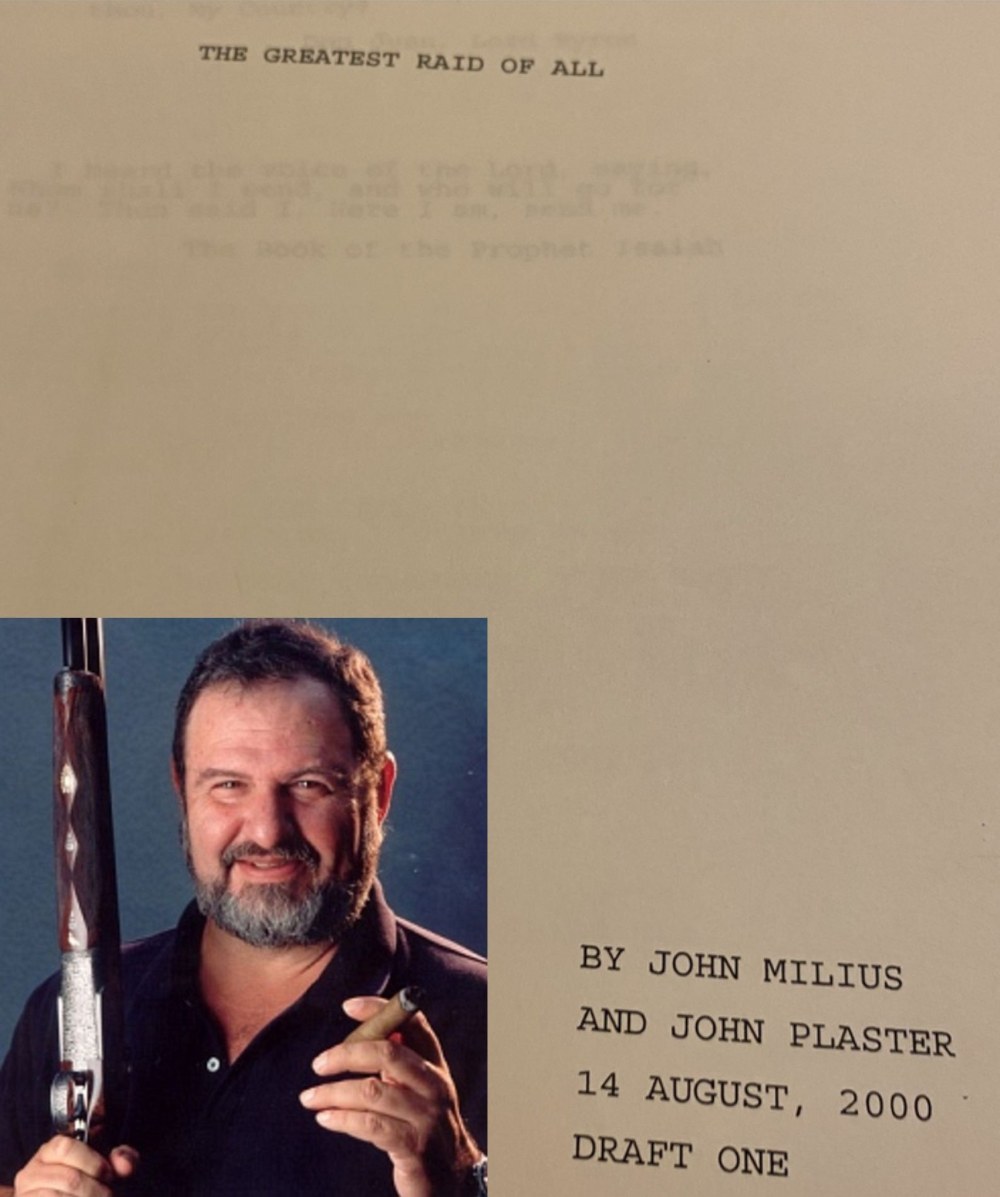
We read a copy at the Writers Guild Foundation Library in Los Angeles – a draft dated 14 August 2000 credited to Milius and John Plaster, a former US army special forces officer who has written several books on sniping.
The Son Tay Raid, aka operation Ivory Coast, was a legendary/notorious/pretty-funny-when-you-think-about-it mission in American military history, an attempt to rescue POWs behind enemy lines during the Vietnam War in November 1970. How’s this for a dramatic set up… Plucky American fliers held captive by the Vietnamese in brutal conditions; US military organise a rescue mission consisting of a team of crack troops led by gruff, tough officers; replica of the camp built for training; rescue team dropped miles behind enemy lines, close to Hanoi itself; our heroes stumble upon deadly North Vietnamese troops; major firefight ensues; team gets back safely! Hurrah!
Only… there are no prisoners.
The POWS had all been moved to another prison.
The mission rescued no one.
The Son Tay Raid was thus not an automatic choice for movie dramatisation, at least not by Hollywood. While Commonwealth countries such as Australia, New Zealand, Britain and Canada like to celebrate their military defeats and disasters through film and TV versions (Gallipoli, Dunkirk, Chunuk Bair, Dieppe, Singapore, etc), America’s historical memory tends to be more victory-focused… thus their country’s military disasters (the land-based part of The War of 1812, the 1983 Beirut bombing, the Pancho Villa expedition, Operation Eagle Claw, the Mayaguez Incident) don’t get a lot of screen time. In films set in theatres of war where America lost, we rarely see American troops be defeated on screen – for instance, the soldiers in The Alamo (1960), Bataan (1943) and Wake Island (1942) are depicted fighting to the death rather than surrendering; Pearl Harbor (2001) ends not with the disaster in Hawaii but with the successful Doolittle Raid; even Platoon (1986) shows the Americans ultimately triumphing, however haphazardly, over the North Vietnamese, while Apocalypse Now (1979) ends with Willard successfully completing his mission, however bloodily.
There are good commercial reasons for this – whenever Hollywood tries something different (eg Tora! Tora! Tora!, A Bridge Too Far, Letters from Iwo Jima, Casualties of War, Hamburger Hill), American audiences tend to steer clear. This is in contrast to English and Australian audiences who have queued up to see their side lose in films like In Which we Serve (1942), The Cruel Sea (1953), The One that Got Away (1957), A Town like Alice (1956), Oh What a Lovely War! (1969), Breaker Morant (1980), Australia (2008), and Gallipoli (1981). (NB We are aware there are exceptions to all these… but as a general rule, we feel that it holds.)
The 1980s brought a slew of popular Hollywood films about successful rescues of POWs in Vietnam that were all entirely fictitious (Uncommon Valor, Missing in Action, Rambo). So, we were curious to see how the most famous real attempt to rescue POWS during that conflict (the second most famous being the disastrous Mayaguez incident) was treated. Would Milius go the quasi-satirical route like Rough Riders/Apocalypse Now? Or serious and sombre like Red Dawn and Flight of the Intruder?
We won’t leave you in suspense. It was the latter – Milius and Plaster treat it all very straight, with most of the characters based on real people and written accordingly, i.e. in that slightly stiff style you often find in depictions of people who are still alive (eg. how Bohemian Rhapsody conveyed everyone who wasn’t Freddie Mercury.)
There is no real main hero role, but it’s an ensemble piece made up of different subplots: the adventures of a POW at Son Tay, Major Chandler; the efforts of Chandler’s wife Anne to lobby various politicians on behalf of the POWs; the organisation of the mission under General Blackburn, Captain Meadows and Bull Simons (all real people); a member of the task force, Sgt Butler, who falls in love with a stripper called Kelly (who, we think, are fictitious); another soldier, pilot Mark Conway, who sleeps around, wears a bracelet for POWS, and helps Butler’s romance with Kelly; the reaction of Vietnamese politicians. There are cameos from real life people such as Henry Kissinger and John Wayne (who pops up at the end at a party for the soldiers).
The early ‘70s version of John Milius might have made a more satirical take of this story, with its intelligence failures, military mistakes, and political skullduggery, having fun with the characters like he did with the soldiers in Apocalypse Now and The Wind and the Lion, the cowboys in Judge Roy Bean, and the gangsters in Dillinger. However, in The Greatest Raid of All, all the American characters (soldiers, wives, strippers) are, without exception, admirable professionals. The benefits of the raid are emphasised – it raised morale for the POWS and resulted in them being better treated – while any mistakes are downplayed. Indeed, in this version the General knows that the camp is empty before the troops leave on the mission, but he still considers it worthwhile. The Vietnamese guards are vicious barking caricatures (a surprise from Milius who typically wrote stories where the antagonists had honour eg. the Cuban Colonel in Red Dawn, Melvin Purvis in Dillinger – perhaps this was the influence of co-author Plaster, who served in Vietnam and might have been less inclined to do his old adversaries any favours). Less surprising are the dull female characters, always a weakness in Milius scripts; we only get two of note, the plucky stripper Kelly and devoted housewife Anne, either of whom could be easily snipped from the screenplay without losing anything.
To be fair, Milius and Plaster had to deal with the fact that the people on whom the characters were based were still alive. And by this stage, Milius probably knew a lot more military people than he did in the early ‘70s and was thus less inclined to send them up. The story still holds interest, all the details seem (to our untrained eye) authentic, and it was an interesting episode in the Vietnam War. Indeed, tales like the Son Tay Raid should be better known – if Americans were a little more familiar with their country’s military failures, maybe they wouldn’t be so gung ho to rush into wars all the time.
The Greatest Raid of All was almost made in the early 2000s for the History Channel but couldn’t get over the line, although that network did broadcast a 2005 documentary, Special Ops with John Milius, which touched on the raid.
Incidentally, 2005 also saw the release of a film based on a successful attempt to rescue POWs, The Greatest Raid, based on the Raid at Cabanatuan in World War Two (not that it helped the film at the box office). In the 19990s, Milius was supposed to direct a film adaptation of the Tom Clancy novel Without Remorse, which featured an abortive POW rescue mission inspired by the Son Tay Raid (as in, it was in the novel – we are not sure if this was in the Milius adaptation, the plug was pulled on that film shortly before shooting was to commence and Milius had nothing to do with the recent Michael B Jordan starring version).
The Son Tay Raid is still a great story that would make a compelling film – not necessarily from this script though.
