




by Stephen Vagg
This is a companion piece to our earlier one on Cinema Center Films (CCF), the short-lived feature filmmaking arm of the American TV network CBS. As mentioned in that article, CCF started in the late 1960s, when CBS decided to have a go at this filmmaking caper… around the same time as its great television rival, ABC.
ABC also went into making movies for television, where execs like Barry Diller and Michael Eisner cut their teeth – but this article isn’t talking about that. We’re discussing when ABC made movies for theatrical release.
ABC’s theatrical arm ran from around 1967 until 1972 – roughly the same time as CCF existed. Like CCF, ABC’s film operation turned out over thirty movies, most of which lost money. Also like CCF, there were a lot of gems in amongst those pictures, but not enough to make it a profitable operation. A key difference, however, was that while CBS only had one studio churning out features (CCF), ABC had three:
 a) Palomar – established in 1967 by Edgar Scherick [left], a key executive at ABC television (he helped create Wide World of Sports), who wanted to get into the movies. Palomar was originally a wholly owned subsidiary of ABC and made films for them until the end of 1969, after which Scherick went independent; he was allowed to take his company with him, and Palomar wound up making movies for other studios.
 b) Selmur – the company of Selig J. Seligman [left], a former lawyer (he was a prosecutor at Nuremberg) turned ABC television executive. Selmur was another wholly owned subsidiary of ABC, albeit one run by Seligman; it started off making TV shows for ABC (notably Combat!) before moving into films. Seligman died of a heart attack in 1969.
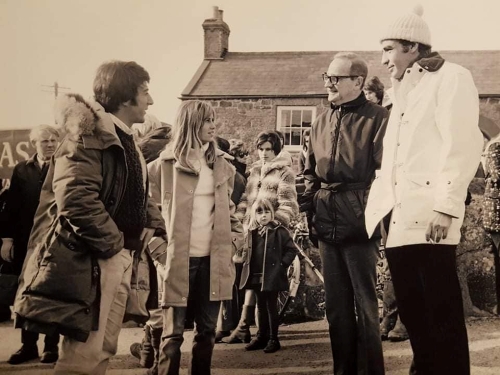 c) ABC Pictures – established in late 1968 under former agent Martin Baum [below; second from right, on the set of Straw Dogs]. This turned into ABC’s main feature-producing arm.
There was, not surprisingly, conflict and rivalry between the three companies, especially following the creation of ABC Pictures, who ranked above Palomar and Selmur. Any rivalry involving Selmur ended with the death of Seligman; Scherick/Palomar and Baum/ABC Pictures clashed, resulting in Scherick/Palomar leaving and becoming an independent company. Through 1970 and 1971, Martin Baum was basically head of production for features at ABC – however, a series of flops led to him quitting ABC Pictures in early 1972 to become an independent producer, and ABC pulled out of features soon after. This piece will discuss all three companies.
Incidentally, the actual executives at the ABC television network overseeing movie operations were Sam Clark (head of ABC Records) and Len Goldenson (ABC’s president), but the people who actually decided what got made were Baum, Seligman and Scherick.
And what did films did these three make?
Scherick said in a 1968 interview that “before I commit myself to a film, I ask myself two questions. First, does the picture have singularity? Second, will it serve? Pictures have got to be damn good these days.” Seligman said the same year that “the best talent has a going price, and they can get it with any company. But I think we can make it more attractive for the talent by offering them more freedom.” In 1969, Baum said he would like to make 11 or 12 films a year, “any more than that you lose control and miss the cream at the box office.”
Thanks to Variety, we have financial records of ABC’s films (including those from Selmur, Palomar and ABC Pictures) up until 1973, and we give a brief summary below of the their estimated costs, box office rentals and profit/losses for ABC. We should stress that the profit/loss figure isn’t simply rentals minus costs – it’s how much money ABC made from the film (as at 1973, anyway), which means it takes into account various associated costs such as overhead profit participations. And we acknowledge that Hollywood accounting is notoriously “rubbery”. Still, the figures will give you some idea of what films earned, and cost.
ABC’s feature film output fell into three main genres – comedies/musicals, action/thrillers, and dramas. No horror, sci fi or sex:
a) Comedies/musicals
– Good Times (1967) (ABC) – a Sonny and Cher musical with George Sanders directed by William Friedkin in his feature debut (cost $1,115,000, rentals $800,000, loss of $1,050,000). A fun, clunky, experimental movie, more accessible than Sonny and Cher’s second film, Chastity (1969).
– Smashing Time (1967) (Selmur) – a swinging London buddy comedy with the novelty of women as the buddies (Rita Tushingham and Lynn Redgrave) that probably came out a few years too late (cost $630,000, rentals $290,000, loss of $710,000).
– Diamonds Are For Breakfast (1968) (ABC) – a swinging London comedy with Marcello Mastrioanni and Rita Tushingham never released in the US (cost $1.3 million, loss of $1,445,000). Like Smashing Time, it came out when audiences were sick of London movies that had been all the rage in 1964.
– For Love of Ivy (1968) (Palomar) – a romantic comedy with Sidney Poitier romancing a black maid, a big hit that helped establish Poitier as a comedy lead (cost $2.5 million, rentals $7,270,000, profit of $390,000). Many of the profits went to Poitier. This film demonstrated not just Poitier’s popularity, but also a huge appetite for black themed films – something ABC did not follow up on, meaning it missed out on the blaxploitation craze which might have saved the company.
– Candy (1968) (Selmur) – an all-star adaptation of Terry Southern’s saucy novel that is very much of its time, but was popular (cost $2.7 million, rentals $7.3 million, loss $25,000). It was a hit but lost money for ABC, at least at first, due to all the profit participation.
– Take the Money and Run (1969) (Palomar) – the film debut of Woody Allen as a writer-director (What’s Up Tiger Lily? doesn’t really count) (cost $1,530,000, rentals $3,040,000, loss of $610,000…. Though this surely was profitable in the long run). This really launched the Woodman’s career, but United Artists swept in and offered him more stable, long-term finance.
– Midas Run (1969) (Selmur) – heist comedy with Richard Crenna and Fred Astaire (cost $1.1 million, rentals $500,000, loss of $1,515,000). A random movie. We wonder why they made it.
– How Do I Love Thee? (1970) (ABC) – never heard of this, right? A Jackie Gleason family comedy (cost $1,975,000, rentals $275,000, loss of $2,425,000). The last feature of director Michael Gordon.
– Song of Norway (1970) (ABC) – ABC’s attempt at getting that Sound of Music cash, a musical with Florence Henderson that was super popular in Britain (cost $3,625,000, rentals $7.9 million, loss of $1,075,000). Post-Sound of Music musicals were often accused of wrecking Hollywood – the fact is, many of them, like Song of Norway, were popular, they just didn’t recover their large costs. Florence didn’t become a movie star, but she had The Brady Bunch.
– Suppose They Gave a War and Nobody Came? (1970) (ABC) – a peacetime service comedy with Tony Curtis (cost $3.6 million, rentals $1,080,000, loss of $4,160,000). Service comedies were box office gold during the late ‘50s but not during the Vietnam War and the movie suffered in comparison with MASH – like How Do I Love Thee?, this was too old-timey.
– Lovers and Other Strangers (1970) (ABC) – an adaptation of a popular Broadway comedy play (cost $2.5 million, rentals $7.7 million, profit of $790,000). No one much remembers this. An early credit for Diane Keaton and the song “For All We Know” won an Oscar.
– Mastermind (ABC) – a comedy with Zero Mostel that was never released (cost $2.5 million, loss of $2.9 million).
– Cabaret (1972) (ABC) – legendary musical from Bob Fosse and Liza Minelli, a co pro with Allied (cost $4.6 million, rentals $23 million, profit of $4,904,000). Won 8 Oscars, became a classic, one of ABC’s last movies and a great one to go out on.
b) Action/thriller
– Stranger in the House (1967) (Selmur) – Georges Simenon thriller with James Mason and Bobby Darin set in London, that no one saw (cost $665,000, rentals $255,000, loss of $795,000).
– The Rover (1967) (Selmur) – a Joseph Conrad adaptation with Anthony Quinn that no one saw (cost $1,325,000, rentals $295,000, loss $1,595,000).
– A Minute to Pray, a Second to Die (1968) (Selmur) – spaghetti Western with Alex Cord (cost $280,000, rentals $885,000, loss of $165,000).
– Shalako (1968) (Palomar) – Western with Sean Connery and Brigitte Bardot (cost $5 million, North American rentals $1.1 million, loss for ABC of $1,275,000). A co production with ABC – it lost money because the film didn’t do well in North America, but the picture performed strongly in Europe and elsewhere, where ABC didn’t have rights.
– The High Commissioner (1968) (Selmur) – disappointing version of Jon Cleary’s novel, the first in the Scobie Malone series, with Rod Taylor (cost $1,055,000, rentals $605,000, loss of $1,185,000). The team of Ralph Thomas and Betty Box were, in hindsight, not ideal and Rod Taylor, who should have been perfect, was not on form.
– Hell in the Pacific (1968) (Selmur) – John Boorman war film with Lee Marvin and Toshiro Mifune (cost $4,150,000, rentals $3,230,000, loss of $4,115,000). We always thought this was a hit but nope…
– Krakatoa East of Java (1969) (ABC) – ABC bought an interest in this Phil Yordan epic, which we think did okay at the box office. Yes, we know the title is geographically incorrect.
– Whatever Happened to Aunt Alice? (1969) (ABC) – horror thriller produced but not directed by Robert Aldrich (who signed a multi-picture deal with ABC), perhaps hurt commercially by its talented yet B-list-in-terms-of-movies stars Geraldine Page and Ruth Gordon (cost $1.7 million, rentals $3.2 million, loss of $860,000).
– Too Late the Hero (1970) (ABC) – Aldrich guys on a mission film with Michael Caine and Cliff Robertson (cost $6,250,000, rentals $1,590,000, loss of $6,765,000). How the hell did this film cost that much money? We love it, mind you. So did the Brits. Not the Americans.
– Zachariah (1971) (ABC) – acid Western from George Englund (cost $1.2 million, gross $625,000, loss of $1,435,000). Peak New Hollywood.
– The Last Valley (1971) (ABC) – James Clavell’s epic about the Thirty Years’ War with Michael Caine (cost $6,250,000, rentals $1,280,000, loss of $7,185,000). Many things to admire here, though you can see why it didn’t do well.
– Straw Dogs (1971) (ABC) – some violence and rape with Dustin Hoffman, Susan George and Sam Peckinpah (cost $2.2 million, rentals $8 million, profit of $1,425,000). Controversial to say the least.
– The Grissom Gang (1971) (ABC) – Aldrich gangster film (cost $3 million, rentals $590,000, loss of $3,670,000). It’s got wonderful things in it, but the public stayed away in droves.
c) Drama
– Charly (1968) (Selmur) – Simple Jack tale with Cliff Robertson, who won the Oscar (cost $2,225,000, rentals $8.5 million, profit of $1,390,000). The big success of Selig Seligman’s movie career – he really championed the project.
– The Birthday Party (1968) (Palomar) – adaptation of Harold Pinter play with Robert Shaw directed by William Friedkin (cost $640,000, gross $400,000, loss $725,000).
– The Killing of Sister George (1968) (Palomar) – Bob Aldrich adapts a classic queer play (cost $2,550,000, rentals $5,325,000, loss of $750,000). Fascinating. Did quite well and became a cult hit just couldn’t recover its costs.
– They Shoot Horses Don’t They? (1969) (ABC) – marathon dancers tale with Jane Fonda, Susannah York and Gig Young for director Sydney Pollack (cost $4,860,000, rentals $9 million). The film’s production was chaotic – original director James Poe was fired, Scherick developed the film, hired producers Irwin Winkler and Bob Chartoff, then tried to fire them, they complained to Martin Baum who was installed over Scherick, Sherick was forced to resign from ABC. It resulted in a wonderful film. Young won an Oscar, and Fonda was established as a genius actor.
– Jenny (1969) (Palomar) – vehicle for Marlo Thomas of That Girl (cost $1,550,000, rentals $2,825,000, loss of $1,170,000).
– Ring of Bright Water (1969) (Palomar) – British children’s film about an otter with the duo from Born Free, Bill Travers and Virigina McKenna (cost $915,000, rentals $2.4 million, loss of $615,000).
– Kotch (1971) (ABC) – Jack Lemmon directs Walter Matthau as an old man (cost $1.5 million, rentals $5 million, profit of $330,000).
– The Touch (1971) (ABC) – Ingmar Bergman’s first English language movie, with Elliot Gould as the dud root lover of Bibi Andersson (cost $1.2 million, rentals $1.1 million, loss of $1,080,000). No one much likes this, and it’s not very good, but even flawed Bergman is interesting, and Gould possibly had the most fascinating filmography of any ‘70s stars.
– The 300 Year Weekend (ABC) – a Victor Stoloff film about a therapy session shot in 1969 that was given limited release in 1971 (lost $260,000).
– Junior Bonner (1972) (ABC) – Steve McQueen and Sam Peckinpah tell a non-violent, sensitive story about a rodeo rider that the public didn’t like anywhere near as much as their next collaboration, The Getaway, but which has devoted fans (cost $3.2 million, rentals $2.8 million, loss of $2,820,000).
Phew. Right. Well, what to make of ABC’s theatrical films?
First of all, it’s interesting that Martin Baum, Selig Seligman and Edgar Scherick all had roughly the same hit rate – a few successes and mostly flops. All aspired for quality; maybe Seligman was a little more conservative. No executive was a genius, but they were all solid. Scherick went on to a long producing career (Sleuth, The Heartbreak Kid, The Stepford Wives, lots of television); Baum produced for a bit, mostly some Sam Peckinpah films, then went back to being an agent, a key figure at CAA; Seligman, as mentioned, died relatively young.
Second, there are some great movies in there. Cabaret. They Shoot Horses Don’t They? Straw Dogs. Kotch. The Aldrich pictures. Hell in the Pacific. There were some super obscure ones as well – Diamonds Are For Breakfast, How Do I Love Thee, Mastermind, The 300 Year Weekend – but the overall record is strong. Even the misfires are interesting eg The Touch.
Thirdly, it’s amazing how “New Hollywood” ABC was, considering the television network had to be so conservative. But its theatrical arm was edgy; it backed talent and gave crucial breaks to people (Woody Allen, William Friedkin, Jane Fonda); it financed Ingmar Bergman, Harold Pinter, queer play adaptations, acid Westerns, experimental features. The movies are heavily bleak and depressing – possibly too depressing: the endings of They Shoot Horses Don’t They? and Charly made sense, but would it have been so bad to have some hope at the end of Hell in the Pacific, The Last Valley, or Too Late the Hero? We wonder if the failure of ABC’s motion picture division in part inspired the super-commercial/conservative direction of ABC television which proved so successful in the 1970s under Barry Diller and Michael Eisner.
Finally – and we think this was the main reason that ABC’s feature film division collapsed –the movies cost too much. Every studio will have its flops, it’s unavoidable. But the output of ABC Pictures/Selmur/Palomar was, overall, simply too expensive. For instance, Hell in the Pacific was a two hander and Too Late the Hero was basically a couple of actors in the jungle, but both cost millions. Furthermore, in order to attract top talent, ABC had to give away chunks of profit, so hit films like Candy actually lost money. In 1973, Variety estimated that ABC lost money on 30 of its 36 films – with stricter financial controls that mightn’t have been the case.
Our take away from reviewing the history of ABC Pictures and, earlier, Cinema Center Films, is this: if you’re establishing a new studio, don’t try to become an instant “mini major”, go exploitation first. Classy star driven films will give you instant credibility and may be hits but they are too risky and gobble up too much money, and you can’t afford that without a library. Make some cheap commercial movies, get on a firm footing, then go uptown. That’s what all the Hollywood majors did when they were starting out. A desire to become an instant major ultimately killed CCF and ABC as well as other new studios around this time (National General, Cinerama).
Still, with all the history that’s been written on New Hollywood (“BBS! Robert Evans! Roger Corman!”), it’s not fair that CBS and ABC have been so overlooked. ABC undeniably left the cinematic world a better place.
