



by Stephen Vagg
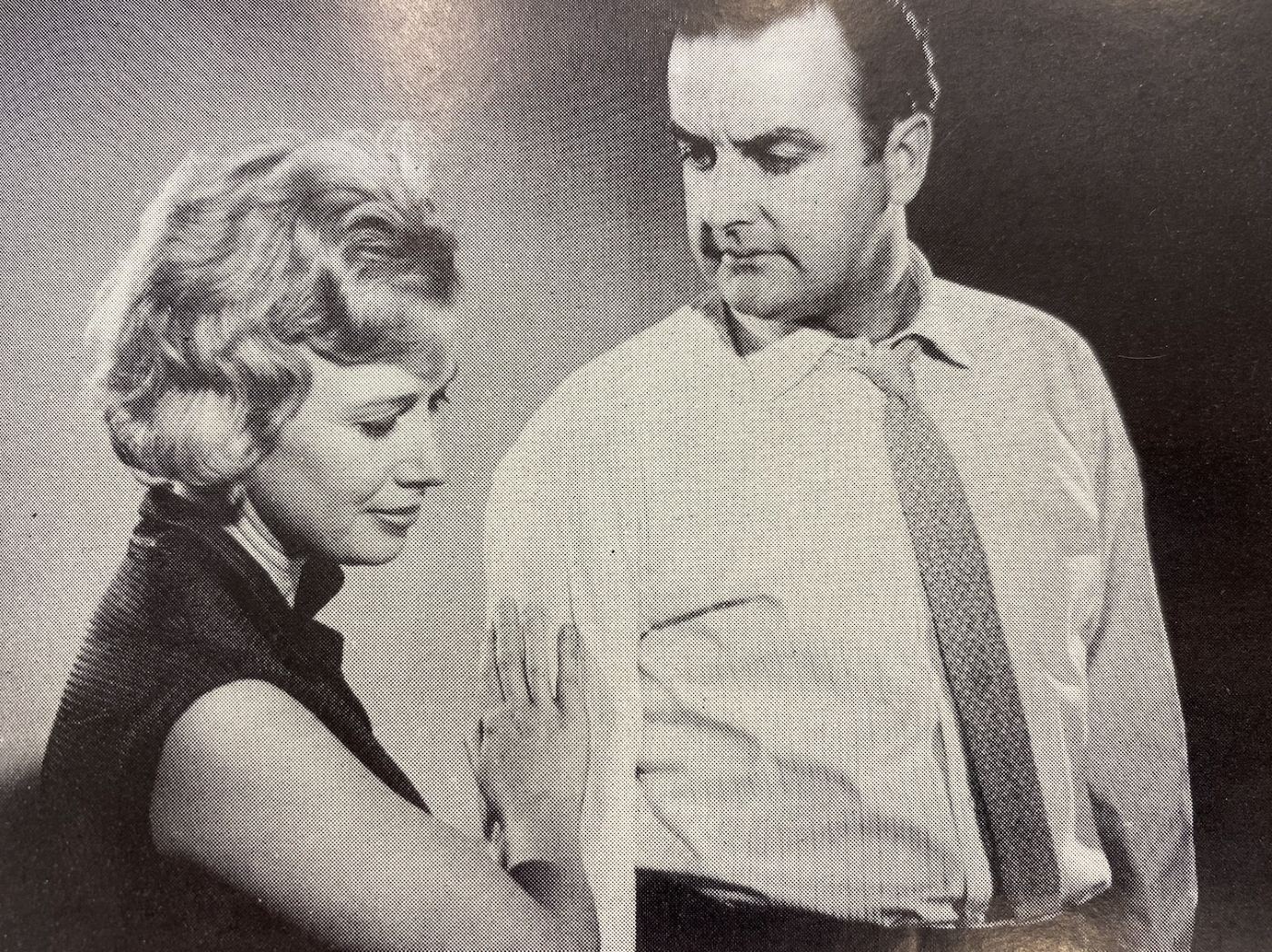
The fame of Australian writer Alan Seymour rests pretty much on one work – the stage play The One Day of the Year. That’s tended to obscure the fact that he wrote a bunch of stuff, including stage plays (such as Swamp Creatures, unproduced film scripts (including an adaptation of The Delinquents for producer Joseph Janni which sounds amazing) and lots and lots of television. The best known of the latter was his BBC version of The Lion, the Witch and the Wardrobe, but he also contributed a number of key original television plays, one of which was Lean Liberty.
By 1960, Seymour was the ABC’s leading TV scriptwriter, but his work until then had all been in adapting foreign texts, such as Murder Story and Richard II. He was keen to try an original, and was commissioned by commercial television to do The Runner, based on a Herb Elliott type athlete. As it so often was/is, the ABC was spurred into action by the commercial stations, and commissioned its own original from Seymour. This became Lean Liberty.
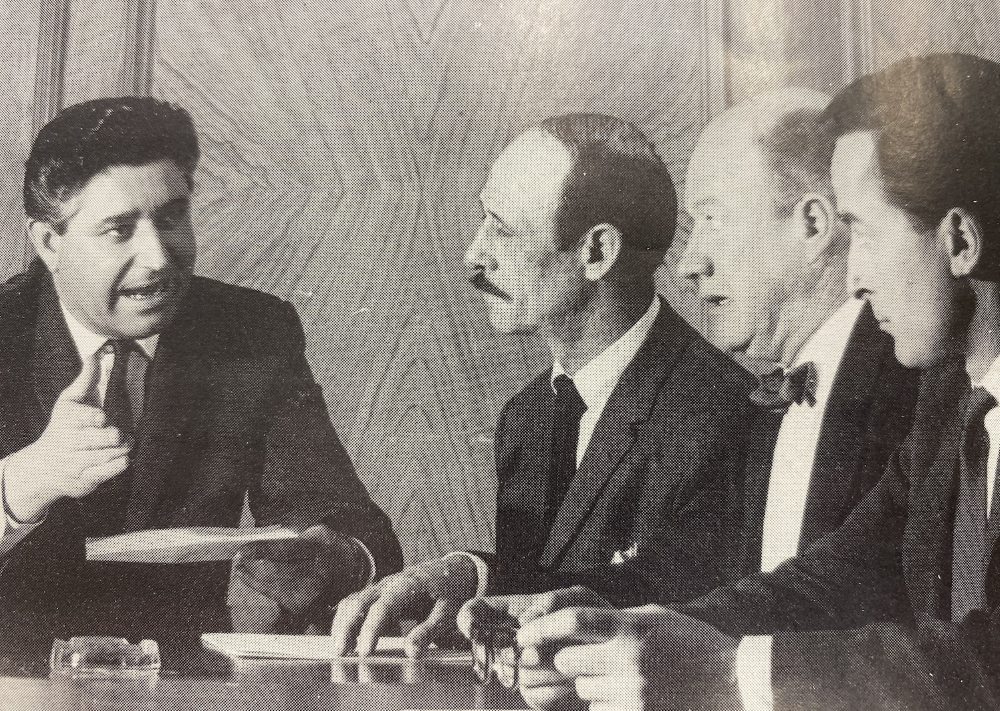
The idea behind Lean Liberty came from director Ray Menmuir, who collaborated several times with Seymour – they were Australian television’s first great writer-director team. One of their efforts had been Shadow of Doubt, an adaptation of a British play by Norman King about a scientist who is trying to rebuild his life after getting out of prison for a conviction of spying for the Russians. Menmuir suggested Seymour write something similar based on the real case of a Tasmanian engineer who got in trouble because of his membership in the Communist Party.
It’s hard to appreciate today just what a hot topic Communism was in 1960, where genuine concern was mixed up with hysteria, religion, idiocy and slogans, whipped up by unscrupulous hacks, politicians and grifters, reinforced by businessmen willing to go along with anyone who will keep taxes and wages down – imagine, say, today’s attitudes towards Palestine/Gaza, mix it up with feelings about property prices and immigration, and you might have some idea. During World War Two, Russia had been allies of Germany (everyone forgets that bit) then the Allies, and since then Australian troops had died fighting communists in Malaya, Indonesia and Korea, and would soon do so in Vietnam. Fear of communism drove much of Australia’s foreign and domestic policy, caused the ALP to split, and helped the Liberals stay in power from 1949 until 1972. Communism wasn’t illegal in Australia – despite attempts to outlaw it in 1951 – but being called a communist could be damaging to someone’s career, especially if they did work with the government. The Australian Communist Party was actually very sympathetic to the cause of Australian content on film, television, theatre and radio – this probably did more harm than good to the cause of local artists because supporting Australian work could be seen as a pro-communist act (if you think that’s stupid, we agree, but if you think it was uncommon, check Hansard and newspapers.)
Seymour was aware how sensitive 1960 Australia was about self-reflection – Swamp Creatures had been criticised as vulgar because it touched on sex, One Day of the Year’s criticism of Anzac Day led to bomb threats and the Adelaide Festival backing out of a production, The Runner would ultimately not be broadcast for several years because it dared criticise sports worship. However, he was not afraid of a challenge and had the support of Menmuir and Rex Rienits, the ABC’s drama editor. Seymour wrote the script after which it was rejected by Paul O’Loyughlin, then head of ABC drama – who, to rub salt into the wound, didn’t pay Seymour for his work. Seymour went to London for the West End debut of The One Day of the Year and was asked if he had any TV scripts – he presented Lean Liberty, it was sold to ITV, which broadcast it in 1962, Australian setting and all (and a mostly Australian cast) under the direction of Ray Menmuir. There was no controversy and the play launched the television career of both Menmuir and Seymour. Seymour returned home to live for more than three decades and honestly why should he have?
What was so “hot” about Lean Liberty?
We haven’t seen the 1962 production (it most likely was wiped) but we’ve read a copy of the script at the BFI’s archives – it was part of a collection to do with Associated Rediffusion, who produced the play.
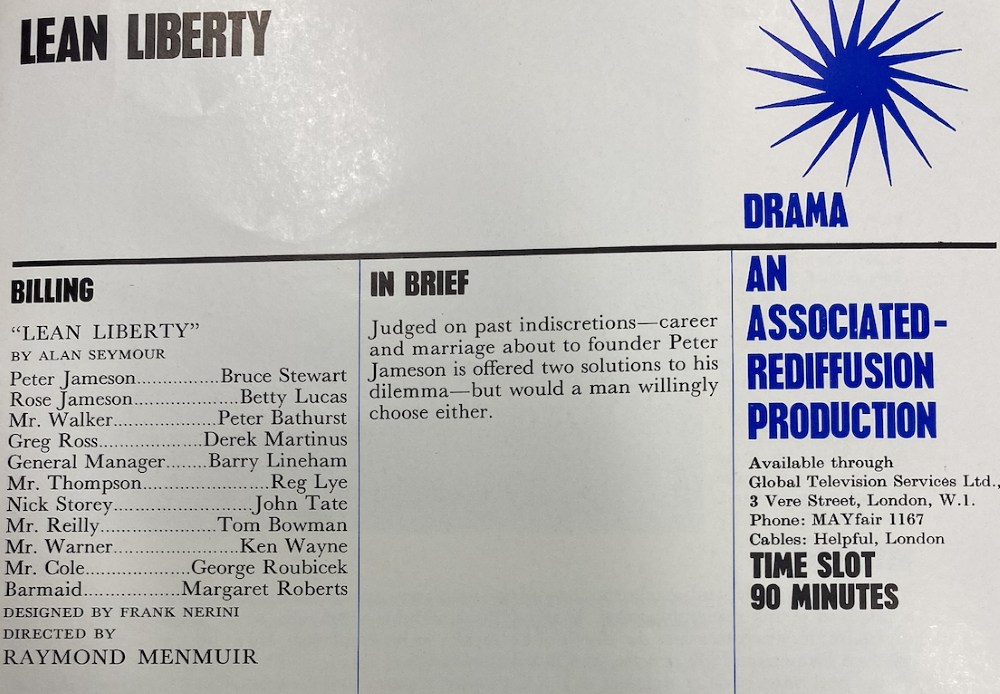
Lean Liberty is set in Australia and told the story of engineer Peter Jameson, a grumpy bore who is annoyed when his employing firm asks all its employees to fill out a questionnaire on their private life. He refuses on principle and it comes out that Jameson lost an earlier job for his association with the Communist Party. Key figures at Jameson’s firm want to fire him, others (such as his colleague, Greg) are more sympathetic as he is a good worker; the general manger (in a nice, realistic touch) wants to keep Jameson because he can hire the engineer on the cheap. Jameson is offered to keep his job on a trial basis if he’ll sign a loyalty oath, but he refuses. This upsets his born-rich wife Rose who leaves him, upset that Jameson has been keeping secrets from her. Jameson is approached by a co-worker at the firm, Warner, who is a member of the Communist Party – he offers Jameson a job at a firm in China with plenty of money. Jameson is tempted until he is told there are strings attached (basically, to follow the party line), and Jameson refuses. So [SPOILERS], he’s left alone at the end with no job, no wife, not great prospects – but he has a quote from a coaster at the pub from Jonathan Swift which says “lean liberty is better than fat slavery.”
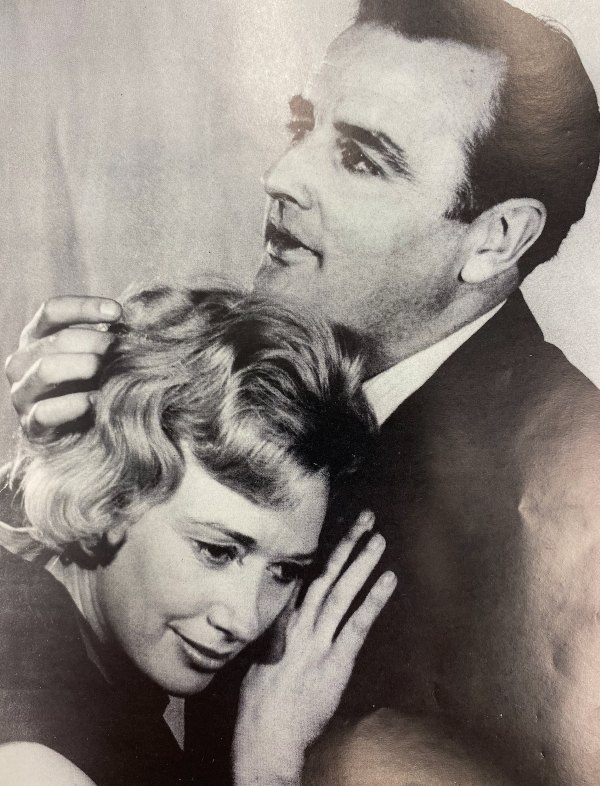 For the most part, the script of Lean Liberty is an excellent piece of work – the story proceeds logically, with decent conflict and great scenes. Jameson is not a goody-goody but a grumpy crank which makes him interesting. He admits to leaving the party after the war – but then rejoining it, being an active member until leaving it again after the Hungarian revolution. But he still retains strong left-wing sympathies, signing peace petitions, and refusing to invest in shares because it’s wealth earned off the sweat of others.
It is remarkably gutsy drama for the time. The anti-Communists at Jameson’s work are basically shown to be idiots (“that’s something a Communist would say!” “They’re all liars”) and there is pointed criticism of the anti-Communist hysteria. Even the relatively kindly General Manager is depicted to be a smug idiot completely unaware that one of his men (Warner) is a Communist agent.
The weakness is the one sizeable female role, Jameson’s wife Rose – she basically just says “I love you” and “why didn’t you tell me the truth” – but she does offer dramatic pressure for the lead. (Seymour wasn’t great at female characterisations in The One Day of the Year either).
But it’s very strong stuff. There was nothing like it on Australian radio or theatre let alone television – something set in contemporary Australia that tackled these themes.
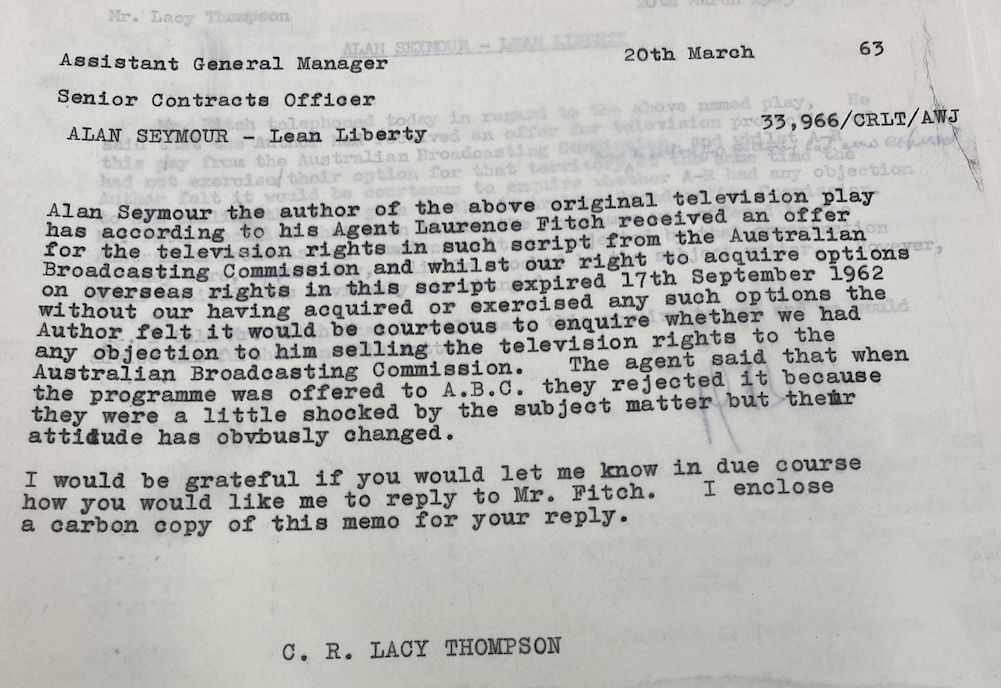
According to the records at the BFI, Seymour said the ABC was interested in buying the play in 1963 – we’re not sure how genuine this was on the ABC’s part. The ABC didn’t buy it and Seymour whinged about not being paid for the next three decades – as well he might.
After Lean Liberty, Alan Seymour still wrote occasionally on Australia (the TV play 31 Backyards, the stage play A Break in the Music) and displayed a gift for annoying the British as much as Australians – one TV play, Stockbrokers Are Smashing: But Bankers Are Better was pulled from broadcast due to its sexual content. He later wondered if he lost a little something as a writer moving away from Australia and being cut off from his culture. But Australia lost more with him not being here.
The author would like to thank the staff at the BFI Archive for their assistance with his piece. All opinions are the author’s.
