



by Stephen Vagg
Australian screenwriters have suffered a lot at the hands of directors over the years. Australian comedian-writers, however, have traditionally done a lot better – the ones who are stars, at least, because they can create their own material, and use that stardom to leverage creative control. We have a long and rich history of comics who write and perform their own material in movies/television/radio/stage – from Kitty Flanagan and the Working Dog troupe, to Paul Hogan and Barry Humphries, and back to George Wallace, Roy Rene and Pat Hanna. The latter was the auteur of Diggers.
Like many an iconic Australian, Hanna was actually a Kiwi, born in Whitianga in 1888. He was a cartoonist and songwriter when he enlisted in the New Zealand army during World War One, taking part in the invasion of Samoa (that was a thing – it was a German colony), serving in Egypt and Europe.
Hanna wound up joining the Entertainment Unit to distract the troops and formed a concert party called The Diggers, who would get up to various comic and musical shenanigans. The show was very popular and Hanna – who was the prime creative force behind it – toured with the Diggers, even after his army stint, all throughout the 1920s. There was a whole bunch of these sort of shows at the time, incidentally – digger-sploitation – but Hanna’s was probably the most popular. He would typically play a gangly, larrikin soldier who got up to scrapes with his mates; there were other components to his act, but being a digger was his bread and butter.

In the early 1930s, FW Thring, who we’ve discussed a few times in this series, was looking to move into film production and was attracted by the pre-existing IP of Hanna’s Diggers show. He offered to finance a film version and Hanna accepted, using his stage associates such as George Moon and Joe Valli.
The movie of Diggers consists of three episodes linked by a reunion dinner, where the soldiers flashback to their war time adventures. The first has Hanna and his mates trying to malinger in hospital. The second has them try to steal some rum. And then they remember a fellow Digger who romanced a waitress and died.
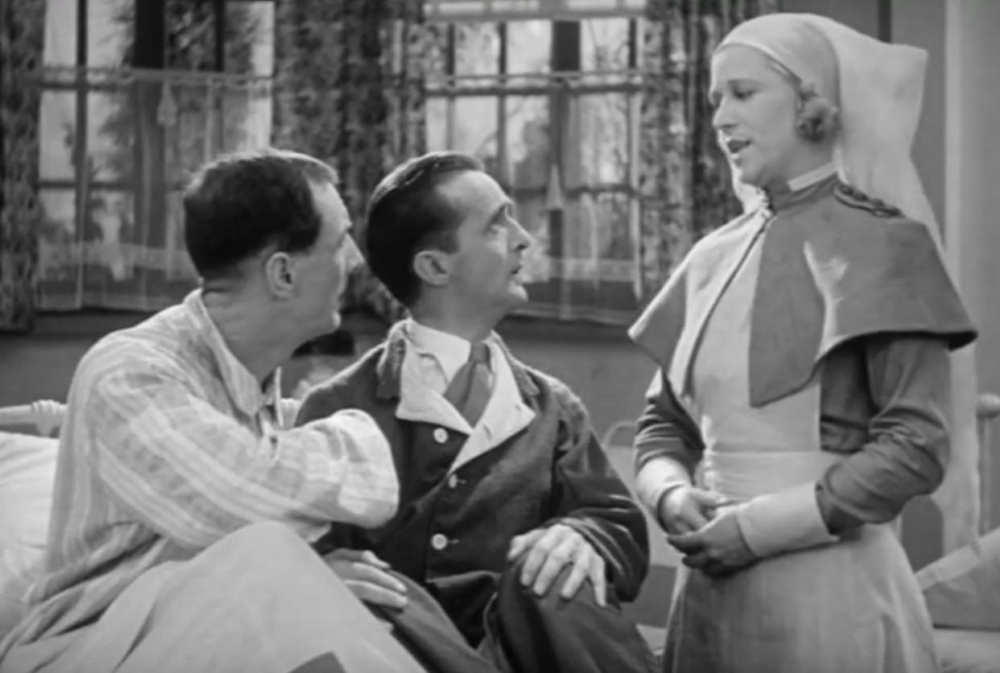
The main interest of Diggers is that it captures a piece of cultural history, particularly its depiction of soldiers in World War One: plucky, rebelling against authority, up for a drink and a good time, not keen to be shot at. It’s not a blood and guts pro-war MAGA type epic – there’s a string of melancholy and sadness through the whole film, particularly the ending. The photography is excellent, the production values are quite strong, the comic performances are memorable. The ending is quite moving with troops singing over the story of the doomed romance.
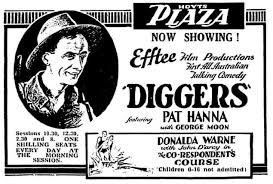 At the top of this piece, we discussed that comedian-writers often have more creative control than regular writers, but there was a limit in the case of Diggers: Hanna clashed with FW Thring during shooting over various matters including Thring’s decision to restructure the sketches (Hanna wanted to go rum-romance-hospital, Thring wanted to go hospital-rum-romance). This meant that although Diggers was quite popular at the box office, the two men made no further films together: Thring devoted his resources instead to promoting another stage comic, George Wallace, starting with His Royal Highness. Hanna raised finance to make two of his own movies – Waltzing Matilda and Diggers in Blighty. We wonder if at any stage, Ken G Hall ever considered using Pat Hanna for his films, the way he did with Wallace – maybe he figured Hanna was too old and/or independent. We can’t help wondering how Hanna would have gone with a really well-structured screenplay.
Eric Gorrick, Australia’s correspondent for Variety wrote a particularly dim review of the Diggers, saying “Real Australians do not chatter like the production leads one to believe”. Australia’s had a lot of rotten film critics over the years.
Diggers, for all its creaky moments, pleased audiences and had a long “tail”, running in rural cinemas until the 1950s. The film has an authenticity that later World War One movies can never match because it was made by and for people who’d been through the conflict. This alone makes Diggers priceless. You can see some of the film here.
