



By Erin Free
Australian director Dylan Nicholls delivers a quietly moving study of war, grief, mourning and closure with his 14-minute documentary Bringing His Spirit Home, which is set to screen at The Red Poppy Film Festival.
“I never knew about the service of Aboriginal soldiers in the First World War until only recently,” director Dylan Nicholls tells FilmInk. “I developed an interest in the topic after watching a video of my family relative, Joe Flick, visiting the graves of Aboriginal soldiers from WWI buried in France. While watching Joe visit these Commonwealth War Graves, I was very moved. Many of these Aboriginal men had never had family come and visit them, due to being so far away.”
Aboriginal Australians have played a huge, essential role in this country’s history – both before and after white settlement – with reams of extraordinary achievements, many of them either erased or merely footnoted with the passing of time. Aboriginal men and women have been involved in all of the major wars in which Australia has fought, but you wouldn’t really know it from the words and images that surround those conflicts. It’s sobering, profoundly affecting subject matter, and it hit filmmaker Dylan Nicholls – a Yuwaalaraay man who grew up in Dubbo and has worked as a psychologist in Brisbane – especially hard. Studying at The Australian Film, Television And Radio School (AFTRS), Nicholls eventually used said subject matter to shape what would eventually become his graduate film, the deeply moving 14-minute short, Bringing His Spirit Home.

“I decided that I wanted to take a descendant to France with Joe on his next trip and document it,” Nicholls explains. “The only issue was, I didn’t know about who these soldiers were. I didn’t know their names. But after doing some research, I came across Private William Allan Irwin DCM, and noticed that his great-nephew Peter Milliken had been fighting to get him recognised for quite a while. When I spent time with him and his family, I could see how much William’s recognition meant to him, and how painful it was for the family knowing that William was so far away. I asked him whether he’d ever been to France and he said ‘No, but I’ve always wanted to go.’ That was when the journey began.”
That journey was a long and sometimes difficult one, with Nicholls travelling with Peter thousands of miles away to France, where the group liaised with French officials and eventually made their way to Private William Allan Irwin DCM’s distant resting place, where they perform a traditional ceremony to bring his spirit back home to his family and Country. “It was a massive undertaking,” Nicholls explains. “We had great support from AFTRS, who backed and funded most of the project. My fellow producer Sophia Carolyn Wallace was also a big reason for why we got to France in the first place. She worked tirelessly to make sure that all the risks were accounted for and managed to convince AFTRS that this trip would go well and wouldn’t be a disaster. She comes from a military family herself, so she understood how important this story was. It’s almost unheard of for a film school project to be filmed overseas. AFTRS understood how important the story was.”

Also vital to the success of Bringing His Spirit Home – and indeed the pillar of its creation – is the aforementioned Joseph “Joe” Flick, a Gamilaroi/Yullaroi man and Churchill Fellow who has travelled to France, England, and Belgium, uncovering the stories of 91 Aboriginal soldiers who died in battle or fell victim to wounds or illness during the war. Flick has also been instrumental in uncovering the often-heartbreaking stories of how many Aboriginal war veterans were cruelly treated and ignored upon returning home from battle. “The trip to France wouldn’t have been possible if it wasn’t for Joe Flick building those relationships with the French people of the Somme for the past decade,” Nicholls explains. “He’s done such incredible work over there. If it wasn’t for Joe and the French, this film wouldn’t have been possible.”
As Joe Flick’s work demonstrates, the story of Private William Allan Irwin DCM is only one of many involving the role of Aboriginal soldiers in Australia’s wars. “There are many incredible stories out there about our Aboriginal and Torres Strait Islander WWI soldiers,” Nicholls says. “We’re starting to learn more about them thanks to researchers and historians, and also to the generosity of the soldiers’ families who have shared these stories, which is such a privilege for all Australians to hear. It’s an honour to hear about these stories that weren’t spoken about for many years. There’s been incredible work done by researchers like Michael Bell, Philippa Scarlett, Desmond Crump, Joe Flick, and people like Pastor Ray Minniecon, who has organised The Coloured Diggers March in Redfern each year on Anzac Day. These initiatives tend to be driven more by grassroots community rather than mainstream Australia. It would be great to see more non-Indigenous Australians developing an interest in learning about these soldiers’ histories. On Anzac Day and Remembrance Day, we say Lest We Forget. Sadly, these soldiers were forgotten, so as Australians we need to do all we can to remember their legacy.”

The development and now screening of Bringing His Spirit Home has been one step into shining a light on these long forgotten and ignored stories. “When I started developing Bringing His Spirit Home, I created a Facebook page called ‘Remembering the Aboriginal and Torres Strait Islander soldiers of WWI,’” Nicholls says. “On that group, which now has around 700 members, you see so many moving stories that descendants share about their ancestors who served. It’s so special to see the pride in these descendants as they share about their ancestors and it’s amazing to see how many had multiple ancestors who served.”
Like most superb cinema, Bringing His Spirit Home is ultimately a deeply personal film, despite its obvious big-picture implications and broad scope as a potential conversation starter. At the centre of Bringing His Spirit Home is Peter Milliken, a wonderfully humble, reserved, quiet man who the audience empathises with immediately. “For me, the relationship was the most important thing,” Nicholls says of working with Peter. “I wanted Peter and the whole family to trust me with their story. I spent quite a bit of time with Peter before we officially started filming. I consider Peter a good mate and we still talk every couple of days or so. What drew me to Peter was his honesty. He doesn’t know how to be fake. What you see is what you get. It doesn’t matter what context he is in – whether it’s formal, casual – he’s still the same person. That’s what resonates with audiences when they watch the film.”
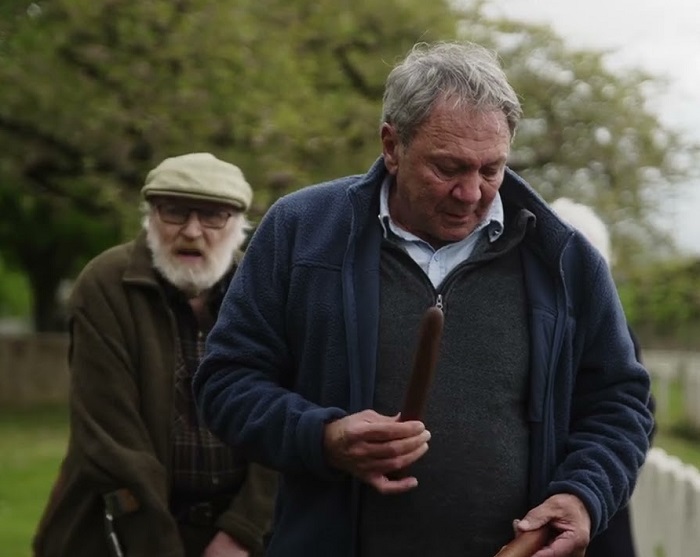
Bringing His Spirit Home has already screened at The Sydney Film Festival, where it enjoyed a very warm response. “We were nominated as a finalist for the First Nations award,” Nicholls says. “It was an honour to be a part of it. Some of the family came down for it, which was good. They also had The Travelling Film Festival which went out to Tamworth, where most of William’s family lives. For the family to be able to see the story on the big screen was so special. Most of them will never get the chance to visit William’s grave in France. But when they watch the film, they can be there with Peter. That was important for the filming, to make it as intimate as possible. Our cinematographer T. Oxford did such a great job of creating that intimacy so that when the family watch the film, they can feel like they’re there with Peter on this journey.”
Next up for Bringing His Spirit Home is a berth at this weekend’s Red Poppy Film Festival in Sydney, a platform for films made by military veterans and films with military veteran themes and subject matter. “It is a great fit screening at The Red Poppy Film Festival,” Nicholls says. “We can never thank our veterans and their families enough for the sacrifices that they’ve made. The fact that there’s a festival that honours the stories and service of veterans and their families is so important. For our film to play at this festival is truly an honour and I can’t wait to see the other films as well.”

Visually assured, emotionally mature, touching to the extreme, and beautifully made, Dylan Nicholls isn’t quite finished with Bringing His Spirit Home just yet. It looks like his AFTRS graduate film is just the first step in a greater journey. “I’ve actually just finished working on an extended version of Bringing His Spirit Home titled Yaluu (See You Again),” Nicholls says. “It goes into more of the history of William’s story and the duty of remembrance that the French people feel to honour Australia soldiers. It’s a half-hour documentary that will screen on ABC Compass on April 26th this year.”
Bringing His Spirit Home will screen at The Red Poppy Film Festival, which runs from Friday 6 March till Sunday 8 March 2026 at The Art Gallery of New South Wales in Sydney. For all ticketing and session information, head to the official website.
