



by Julian Wood
The best actors are smart people, and, in particular, they have the emotional intelligence to know how humans tick. They also need the skill to represent or embody things convincingly in such a way as to make us care. One such person is David Oyelowo. The classically-trained British actor is currently starring in the small screen adaptation of Victor Hugo’s Les Misérables for BBC First where he plays the part of the determined and obsessive Inspector Javert.
Oyelowo was in Australia for another project [Peter Rabbit 2] when were able to catch up with him. Given that his performance will be seen on the small screen, we wondered if he might shape up for it in a different kind of way than a film role?
“Well, I don’t think you should really. I think now, even more so from an audience’s point of view, small screen work has such high production values, such high standards of writing and everything that you would normally expect from a film. When I read the script for Les Mis it was a six-hour movie to me really. I didn’t think of it as television, or the sometimes put down idea of what television is. The audience screenings I have been to have made me think that it absolutely sits well as a piece of ‘cinema’ too in a way. I think the lines between TV and film and so on are blurred, and that is a good thing.”
Given that the source material has been done in so many versions, and is part of the general culture in a way, does this make it harder to make one’s own distinct interpretation of the character? What sort of Javert did Oyelowo want to create?
“Largely, people come to Javert with the word villain in mind. Even though one could see it like that in a simplistic way. But I am hopeful that my version is someone who is not easily categorisable as being a villain. You can get so much more of an understanding of why he is as he is. You may not agree with it, but at least there are moments that I hope will engender empathy. And the other characters too, they make questionable choices, but you can see why they do what they do. I like to think that Javert has those moments too.”
Oyelowo seems to have some sort of natural bearing of goodness, even nobility (his previous roles have included Martin Luther King in Selma and an African king in A United Kingdom for example). So, is it more interesting to play villains? To put it another way, would he rather play Othello or Iago for instance?
“For me it is partly a matter of where I am in my own creative exploratory journey. As you say, I have played a bunch of noble guys, and I loved doing that (he has also famously played Othello on stage) but that goodness is not the totality of humanity. That is one of things for actors like me who are blessed with the opportunities to play things. I am happy that people might think of me for any role, but you are not owed it. And when the Javert tole came along I thought this is an opportunity to explore a different side of myself. And it is a side that I don’t normally occupy. I don’t share Javert’s view of the world for example. But ultimately what I am drawn to is – and this is true for any role I do – is I want it to feel redemptive. It puts into the world that which is pointing towards the light perhaps. The source material contains that. It is about self-forgiveness and self-sacrifice. John Valjean [the protagonist played here by Dominic West) has that journey and it is juxtaposed with Javert who refuses to transform or evolve because of his own baggage. He is stuck and there is something that is interesting in playing that too. Your job is to be a student of humanity and to evoke emotions.”
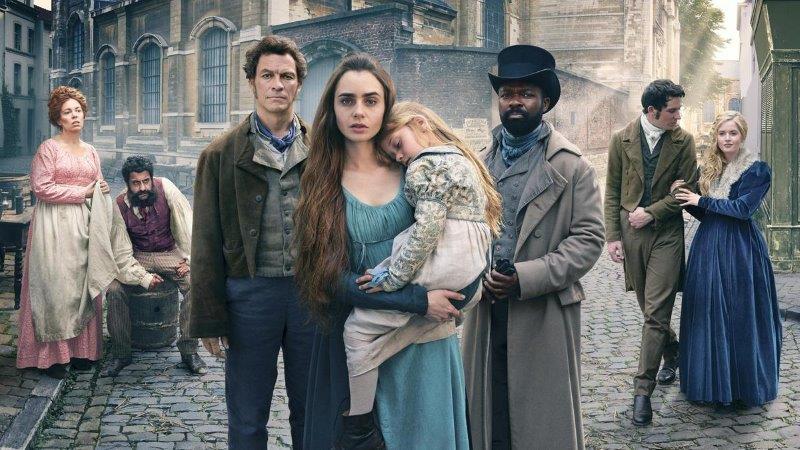
As films are not shot in sequence, it must be quite complex when you play a character who changes so much. We wondered, do actors have to think before any one scene ‘what does my character know at this point? Where is he on his journey?’
“It is a very relevant question in relation to this show in particular. Dominic was shooting another show and he couldn’t join us until two weeks in, so I had to shoot lots of my end scenes (the ones that didn’t involve him) first. The last scene of the entire series was on day two! So, you really do need to know the emotional topography of the character and the arc. Of course, it is a six month shoot but the audience isn’t there going ‘oh yeah he shot that on such and such a day’. It was worse for Lilly Collins [who plays the tragically fallen Fantine], she shot all her later scenes first. The ones where she is a prostitute and has had her teeth knocked out, and then she came back to play the ingénue falling in love. But that is the job.”
Les Miserables is available on Digital, DVD and Blu-ray from April 17, 2019
