


By Travis Johnson
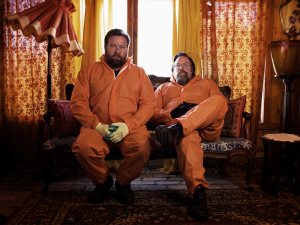
The new blackly funny Aussie thriller Brothers’ Nest sees real life brothers Shane and Clayton Jacobson as Terry and Jeff, two put upon siblings who return to their remote rural childhood home with a dark deed in mind: murder their hated stepfather (Kim Gyngell) and so ensure they will inherit the house from their mother (Lynette Curran), who is dying of cancer. Naturally, their plot doesn’t go according to plan.
It’s certainly a shift in gear for audience members who still identify the pair with 2006’s lovable and big-hearted comedy smash, Kenny. We caught up with Clayton, who directed both films, to learn how Brothers’ Nest came to be.
Where did the initial germ of an idea of Brothers’ Nest come from?
It came from Jaime Brown, the writer. Jaime’s sort of an old colleague and friend and we’ve collaborated on a number of projects. He was staying at my house. I live about 50 minutes north of Melbourne on a six acre block, and he was staying with me overnight at my house while working on a project. A lot of people when they stay at my place, they get all weirded out about the fact that the nearest neighbour is far enough away to not hear you being murdered, so unbeknownst to me he had a pretty rough nights’ sleep. Every time any of the dogs or a horse took a shit, he thought someone was trying to get in and cut him up.
And so, cut to six months later, another friend of mine, Chris Pahlo, is a writer and it turns out the two of them, they’ve collaborated on this script. Jaime said, “Look, I hope you won’t mind but I’ve written the film, and I’ve brought Chris in as well. And that’s for you and Shane. Would you like to read it?” Of course! And I read it, and I realised the characters were designed for Shane and myself, and that was a little interesting, because I did not know what the film is about until I started reading it.
What kind of shape was the script in when you got it? Did you take a pass on it?
The script was a lot darker. When I read it, both characters were pretty full on and it was really – I would have to say – savage. Some of the fundamental things that are in the script now were there, but the idea of the older brother having a bit of a foothold over his younger brother, there was a little bit of backstory, but not a lot of backstory about Roger.
When I read it, I got to the end and I thought it’s actually too full on for me. One of the characters has to be more sympathetic for me. Particularly with Shane, you’re going to get that anyway – Shane is just naturally a sympathetic kind of human being. That was the start of me kind of realising, let’s just go into the “why” rather than the “how” more.
 So it becomes more psychological than procedural?
It was the procedural that I know Jaime was more interested in off the bat, but he was more than happy for me to start bringing a few more layers in there. And, of course, that’s my want. I’m more interested in what makes people tick.
The film is shot on location and the house is incredible – it has a very tangible sense of place. Can you give me some examples of how the location and the production design influenced the script and the action of the narrative?
They wrote the film so that it would be shot in my house. My house is all white walls and kind of modern. So I knew the film was gonna be a two-hander but I thought, let’s go cinematic, let’s go really widescreen and then allow the audience to peruse the frame. So we found this great location which was built in the ’60s and ’70s, it’s all kind of pine walls and it’s very dark, the light gets absorbed in the wood and strangely enough, it naturally had most of the colour palette I wanted in it.
But it had these radios, these vintage radios. So they’re everywhere. This guy that owns the place is a radio nut, he’s a meteorologist who has been collecting these vintage radios and these cars forever and a day. We actually discounted the location because we thought we’ll have to remove all that stuff and that’s when I thought, hang on – let’s build into the script what we have available to us. You couldn’t pay for that sort of production value, and it looked beautiful, and so we went back and worked it into the story.
 You’ve directed Shane before, of course, but how did you find this experience considering the inherent darkness in material?
I really loved it. I was nervous because when we did Kenny he was quite malleable in the sense that I was his older brother making a movie and he never made a movie before, so he was all ears. Since then he has worked with some pretty amazing talent and has developed his chops, so there was a little part of me going, is he listening, are we gonna have these raging arguments where he just doesn’t see the scene that way? Which would be fair enough. But the great joy is he still trusts me and trusted the script. What was different for me was I now had a collaborator, because Shane has been on so many sets continuously that he knows the game as well as I do.

I can honestly say we are closer now because of that. It was the greatest experience, I so thoroughly loved every moment – it was a joy.
The thing I loved about this film, I said “Mate, I’m doing all the bloody talking in this movie and I’ve got quite a few of the gags. Do you want me to leave more gags in there for you?” And he goes “Don’t, please don’t. I’m in this for the character. I’m in this for the drama. I don’t give a shit about the gags, I’ve done enough comedy. I’m in this for drama.”
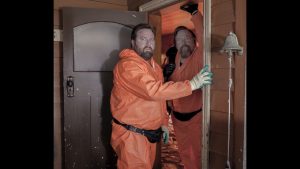 How did you find the process of directing yourself? You’ve got Shane there who can give you feedback, but what’s it like from your perspective?
I was nervous. I have a history of putting myself in acting roles, but this is big game. And honestly, I think if Jane Campion hadn’t put me in Top of the Lake, I would probably not have done it, and I was toying right up until the very end, two weeks from shooting…
But Shane just kept saying, “No, I want you to do this” and I said to Shane, it’s not going to be enough for me to look at a DOP and ask what do you think, it needed to be Shane, and he needed to look me in the eye and say I buy it, or I don’t buy it. And a brother can say that to another brother. But look, it was great fun and I had an amazing crew that were incredibly supportive.
I’ll let you know a little secret, it’s not as hard as it looks. What I discovered is when you direct all day, and you set up a shot, you get the crew and get the actors in, block everything out and you tell them what they do, and then you sit down and you get anxious. Watching them set the shot up, time’s ticking by, and there’s this continuum of anxiety that builds up as a director. But when you’re acting and directing, you walk out on the scene, you tell everyone what to do, and they say “Okay great. Leave it with us. We’ll set it up” – and then you go and you become an actor! So I go off with Shane and I rehearse the scene. I’m not getting anxious at all – in fact, I’m hoping they take their time, because I want to get it right!
It’s the way actors are treated on set versus the way a director is. I would actually go home quite pumped, because I’d actually only spend half a day directing and half a day acting. And I was surprised. I actually thought I would be completely and utterly wasted after it, but I would go home pumped!
Brothers’ Nest is in cinemas now. Read our review here.
