


by Corben Schultz
No animal has done more work for filmmakers than the wolf. It arrives on screen carrying several thousand years of accumulated meaning – predator, outcast, guardian, transformation, the wilderness pressing against the edge of the settlement – and directors have been drawing on that reservoir since the earliest days of the medium. What makes the wolf unusually useful is that its symbolism runs in opposite directions simultaneously, which means the same animal can signal threat in one film and moral clarity in the next without either reading as a mistake.
That contradiction is worth sitting with because it explains the animal’s durability. A shark means one thing. A wolf means whatever the surrounding narrative needs it to mean, and audiences accept the shift without resistance. Few visual symbols are that flexible while remaining that recognisable.
The Transformation Film and Its Peak Achievement
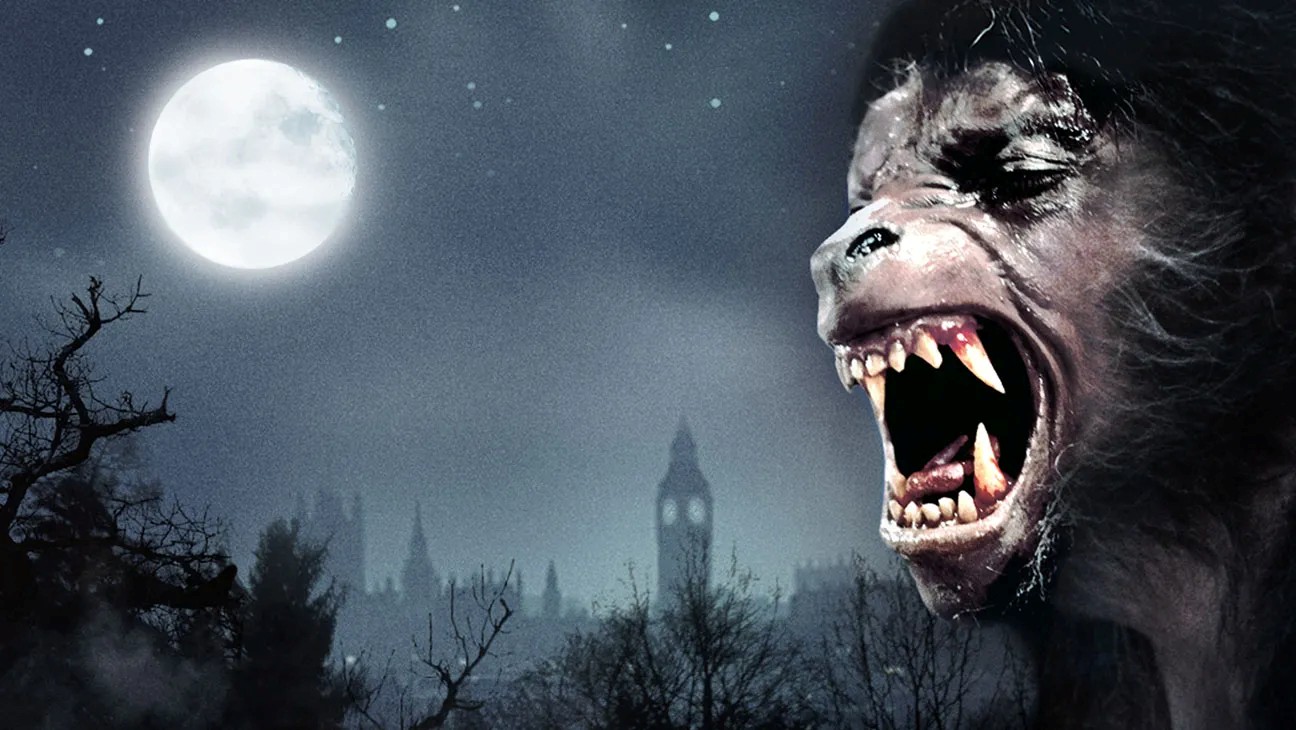
The werewolf picture occupies its own corner of horror history, and its high-water mark remains John Landis’s 1981 film, An American Werewolf in London, which did something no previous entry in the subgenre managed: it transformed itself into the centrepiece rather than a transition to be hidden.
Rick Baker’s practical effects work earned the first Academy Award ever presented for makeup, and the reason that central transformation sequence still functions decades later is its refusal to cut away. The audience watches bones lengthen and skin stretch in bright light, accompanied by screaming rather than growling, which reframes the entire subgenre. Where earlier werewolf films treated the change as a curse revealed, this one treated it as agony endured – a shift in emphasis that made everything afterward feel like a consequence rather than plot development.
Neil Jordan’s 1984 adaptation of Angela Carter’s fiction, The Company of Wolves took the opposite route into the same territory, building a dreamlike structure of nested stories that treats the wolf as a sexual metaphor and coming-of-age anxiety rather than as body horror. It’s the more literary approach and arguably the more unsettling, precisely because it refuses to explain its own symbolism.
Later entries have kept both traditions alive. The 2000 Canadian film Ginger Snaps that paired lycanthropy with adolescence and the 2002 British film Dog Soldiers that dropped soldiers into a Highland siege scenario represent the metaphorical and the visceral strands respectively, and both have aged considerably better than their modest budgets suggest.
When the Wolf Iconography Travels Beyond Cinema
The visual grammar developed across those decades – the moonlit silhouette, the amber eye, the pack emerging from a treeline – has proven so portable that it now circulates far beyond the screens that established it. Interactive entertainment has absorbed it comprehensively, and the scale is easy to underestimate. Individual themed titles built entirely around wolf imagery number in the hundreds, and examining one closely reveals how deliberately the cinematic conventions are reproduced. A release such as Wolf Treasure play from Lithuanian developer Onlyplay, published in early 2025, constructs its entire presentation from borrowed film language: a starry night backdrop with drifting cloud cover and the occasional shooting star, gemstone accents threaded through animal iconography, and a symbol hierarchy running eagle and lynx as mid-tier imagery beneath bear and wolf pack as the premium tier.
Most tellingly, its soundtrack leans deliberately ambient rather than percussive – a restraint choice that mirrors how horror cinema uses quiet to sustain dread rather than exhaust it. The design credits on work like this frequently include people who could be employed in film or games, and the art direction reflects that. For anyone studying how screen iconography propagates through contemporary visual culture, this category represents an enormous and largely uncatalogued distribution channel.
The critical question is what survives the transfer. Cinema’s wolf carries meaning because it appears in a story – someone is threatened, transformed, or redeemed, and the animal’s presence signals which. Detached from the narrative, the same imagery becomes atmosphere: recognisable, competently rendered, and meaning nothing in particular. That’s a legitimate design objective, but it’s worth noticing that what travels is the surface and what stays behind is the reason the surface existed.
Australia’s Own Vanished Predator
Local cinema has an unusual relationship with this territory, because Australia’s most cinematically potent wolf isn’t a wolf at all. The thylacine – commonly called the Tasmanian tiger or Tasmanian wolf – was a marsupial carnivore declared extinct in the twentieth century, and its absence has generated more compelling Australian screen work than any actual predator.
The 2011 film The Hunter, directed by Daniel Nettheim, starring Willem Dafoe as a mercenary sent into the Tasmanian wilderness to locate and sample the last of the species, is the clearest example. What makes it work is the way the animal functions as a structuring absence rather than a presence: the audience spends the entire film waiting for something that may not exist, and the wilderness photography does the emotional labour a creature feature would normally assign to the creature itself.
That approach is characteristically Australian – using landscape and absence where other national cinemas would use spectacle. The thylacine’s cultural position, as a species eradicated within living memory and photographic record, gives it a weight no fictional monster can replicate. Grainy archival footage of the last captive specimen remains more genuinely unsettling than most horror cinema manages with full effects budgets.
Three Ways Directors Use the Wolf
Across genres and national cinemas, the animal tends to serve one of a small number of narrative functions:
- As a threat made legible – the wolf as pure predation, giving a film an antagonist that requires no motivation or dialogue. Survival cinema depends on this reading.
- As transformation and hidden self – lycanthropy as a metaphor for adolescence, sexuality, addiction or violence a character cannot control, which is where the horror tradition concentrates.
- As moral counterweight – the wolf as the natural order against which human behaviour is measured and usually found wanting, common in ecological and animist storytelling.
The third reading produces the most interesting films because it inverts audience expectation. When a wolf represents integrity and the human characters represent encroachment, the entire genre grammar has to be rebuilt, which is why those films tend to feel formally distinctive rather than familiar.
The Animist Tradition in Animation
Japanese animation has produced the strongest examples of that third mode. Hayao Miyazaki’s 1997 feature Princess Mononoke places wolf deities in direct opposition to industrial expansion, with a human protagonist raised by them who rejects the human settlement entirely. The film refuses to resolve the conflict cleanly, and the wolf god Moro remains one of animation’s most morally complex non-human characters precisely because the narrative never asks the audience to view her as wrong.
Mamoru Hosoda’s 2012 film Wolf Children takes the material somewhere gentler, following a woman raising two children who can shift between human and wolf forms. The horror framework is absent entirely; what remains is a study of parenting, difference and the point at which children choose their own natures. It’s arguably the most emotionally sophisticated use of the transformation motif anywhere in the medium, and it achieves that by removing every trace of menace from it.
Both films demonstrate something live-action struggles with. Animation can present a wolf as a character with interiority without the audience registering it as anthropomorphism, which grants access to the animist reading that photographic cinema can only gesture toward.
Survival Cinema and the Realism Corrective
The wilderness survival picture uses the animal in its most reduced form, and the 2011 film The Grey starring Liam Neeson as an oil-rig worker stranded after a crash is the modern reference point. Its wolves are barely characterised – they function as an implacable force, closing distance, and the film’s power comes from the existential framing built around them rather than from the animal itself.
That approach has drawn criticism from wildlife specialists, and the criticism is fair. Real wolf behaviour bears little resemblance to the relentless pursuit these films depict, and the mismatch has arguably shaped public attitudes toward an animal that has been the subject of eradication campaigns across multiple continents.
The realistic tradition provides the corrective. Carroll Ballard’s 1983 film Never Cry Wolf, adapted from Farley Mowat’s account of a researcher studying wolves in the Canadian Arctic, deliberately dismantles the predatory framing – its wolves are social, playful, territorial and largely uninterested in the human observing them. The contrast between that portrayal and the horror tradition’s is instructive, and it demonstrates how much of the animal’s screen identity is constructed rather than observed.
Television’s Long-Form Advantage
Serialised drama has used the animal differently, and the structural reasons are worth noting. A film has ninety minutes to establish a symbol and pay it off. A series has years, which permits the meaning to evolve.
The direwolves in the fantasy series Game of Thrones, adapted from George R.R. Martin’s novels, illustrate this. Introduced as omens attached to individual children, they gradually became barometers of those characters’ trajectories – thriving, separating, dying or turning feral in parallel with their human counterparts. That’s a use of animal symbolism only long-form storytelling can sustain, and it’s more sophisticated than the discourse around the series generally acknowledged.
The teen-oriented werewolf drama Teen Wolf, that ran through the 2010s, itself a distant descendant of a 1985 comedy, demonstrates the opposite lesson: transformation as adolescent metaphor works best in short bursts and strains considerably when extended across multiple seasons of mythology.
The Fairy-Tale Inheritance Nobody Escapes
Every wolf on screen is arguing with a story most viewers learned before they could read. The folk tradition of the predator disguised among the household – dressed in borrowed clothes, speaking in a borrowed voice – sits underneath the entire cinematic tradition, and filmmakers either lean into it or work deliberately against it.
Adaptations of the red-hooded folk tale Red Riding Hood have appeared regularly across a century of cinema, and they tend to reveal more about the era producing them than about the source material. Mid-century versions treated the wolf as a straightforward danger. Later ones, particularly following feminist reinterpretation of the folk canon in the 1970s and 1980s, recast the encounter as one of negotiation, appetite and agency – which is precisely the reading the 1984 British adaptation was built on.
The disguise element is the part that keeps returning, because it converts the wolf from an external threat into an infiltration narrative. That structure underpins far more films than the fairy tale’s direct adaptations: any story where menace arrives wearing a familiar face owes something to it, whether the filmmakers recognise the debt or not.
Australian screen work has generally sidestepped this inheritance, which is one reason the local material feels tonally distinct. Without a native wolf in the folk imagination, the imagery arrives as import rather than as inherited nightmare – and the genuine local equivalent, a marsupial predator photographed into extinction, generates guilt where the European tradition generates fear.
Watching the Tradition in Sequence
For anyone wanting to explore how the animal’s screen identity was constructed, a reasonable viewing order exists:
- Begin with the 1981 transformation film to see the technical high point that defined the subgenre’s visual expectations.
- Follow it with the 1984 literary adaptation to observe the same material handled as metaphor rather than effects showcase.
- Watch the 1983 Arctic documentary-style feature next, which systematically contradicts the predatory framing of everything before it.
- Move to the 1997 animated feature for the animist reading in its fullest form.
- Add the 2011 Tasmanian film for the Australian variation built around absence rather than presence.
- Finish with the 2012 animated family drama, which strips the motif of menace entirely and reveals how much of the tradition’s power was cultural rather than inherent.
Step three is the one that reframes everything around it. Watching a naturalistic portrayal immediately after two horror films makes visible how much of the screen wolf is a construction, which changes how every subsequent entry reads.
What the Animal Actually Represents
Strip away the genre furniture, and the wolf’s screen career resolves into a fairly consistent function: it marks the boundary between the settled and the wild, and it dramatises what happens when that boundary fails.
Every major use follows from that. Horror places the wild inside a human body. Survival cinema places humans outside the settlement’s protection. Animist storytelling questions whether the boundary should exist at all. And the Australian variation, uniquely, mourns a predator that was pushed across the boundary and never came back – which may be why local cinema handles the material with more melancholy than menace.
The imagery now circulates in contexts with no story attached, reproduced in game design, merchandise and interactive entertainment with considerable technical skill and no narrative purpose. That’s not a decline exactly; visual conventions have always outlived their origins. But it does make the films worth returning to, because they contain the part that doesn’t reproduce: a wolf that appears at a specific moment, in a specific story, because someone has crossed a line they shouldn’t have – and the animal is what the line looks like when it finally pushes back.
