



By Dov Kornits
Although British, Neil Peplow has a long standing connection to Australia, which started when his uncle moved to Sydney in the 1960s. The first time that Peplow came here was back in 1984, which affected him so much that he’d stay up until midnight to watch The Paul Hogan Show on Channel 4 when he returned to the UK. Professionally, he visited here as a producer on two projects: John Hillcoat’s The Proposition and Vincent Ward’s River Queen.
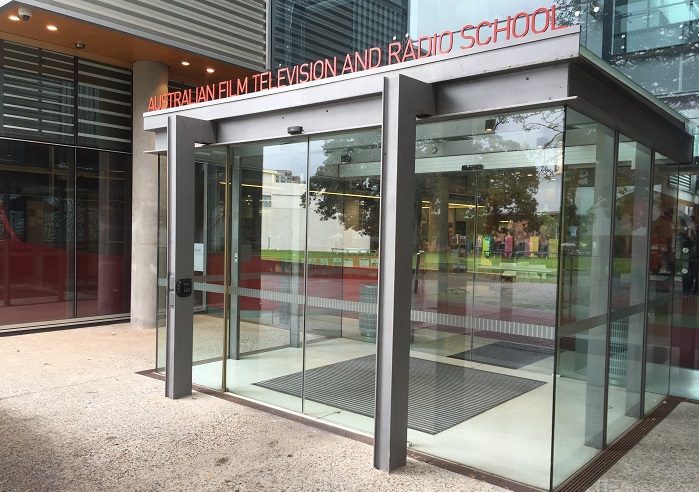
And now he’s back indefinitely as the recently appointed CEO of AFTRS, taking over from Sandra Levy. Interestingly, although he possesses a wide spectrum of industry experience, Peplow has never been a student at a film school. “It wasn’t accessible,” he tells us in his office on the AFTRS campus in Sydney’s Entertainment Quarter. “I never thought that I’d be able to get into anything like The National Film And Television School, because it felt very exclusive, so I never really even thought about applying. I didn’t even really know that it existed.”
Instead of studying film, Peplow followed up his years of practical experience in the film industry – which ranged from starting off as a cleaner at Ealing Studios to its COO – with an MBA. “What I realised is that if I’d actually read a lot of stuff, rather than just done it – especially around story and management – I would have been more effective,” he smiles.
Under Sandra Levy, AFTRS introduced a BA (Screen) to its offering, which has seen an influx of new students, in particular, younger students, which was in contrast to its reputation as only being interested in elite applicants, preferably with experience under their belt. “We’re elite, but not elitist, and that’s an important distinction,” says Peplow today. “It’s about making sure that we have this two-year MA, in which you can drill down to the specialisation that you want to focus on, where you’ll leave with professional skills. The industry looks to us to make sure that we continue to have those sound mixing teams, for instance, that can support Mad Max: Fury Road; and that we continue to produce DOPs that can light, and win awards, and bring a storytelling element to the process. So we still need to deliver on that promise because there’s no one else out there that does it, in such detail, across all those disciplines. We develop those voices that can have a cultural, and commercial impact.
“The BA’s got a different purpose behind it,” he continues. “If we get inclusion and strategy right, we get diversity right, and then we’re producing, once a year, the hottest new entrants in the industry. Then they’ll stick in their industry, and they’ll stay in their jobs. And then you’ve got people who can then become that MA cohort, if they decide to, but with a wider, diverse base. I know that there’s a big demand out there for generalists, who can understand how to make, edit, shoot, post, and understand social media. That’s because everything is moving so quickly, and you need people who can really add value to the video content that you need produced. People can’t get hold of those people.”

At a recent launch of his vision for the school until 2021, Neil Peplow cited AFTRS’ famous founding class of 1973, which included Gillian Armstrong, Phillip Noyce, and Chris Noonan. It has been a while since the school has graduated a student of such world-class feature film renown, but Peplow is quick to acknowledge that the goalposts have shifted. “Success can be measured in so many different ways now,” he asserts. “It’s not just box office, and it’s not just views on ABC or an Oscar. But there’s something about what Phillip Noyce and that first intake had, which was innovation. It was daring, and it was pushing the boundaries of what the cinema public had seen before. Then you see that with Jane Campion and Warwick Thornton, and you get that burst again, of showing something that the cinema hasn’t seen before. That daringness should be the ambition of the school, because that means that when the students go out, they’re actually more likely to capture attention. So when I said, ‘Going back to the school as it was’, my whole framing was around why the school was set up. And I think the reason that the school was set up was to promote the Australian story, the Australian take, and the Australian voice. That is what actually helps differentiate Australian cinema, TV, and new media in the market.
“You look at the Bondi Hipsters,” he continues with a surprising angle. “They’re actually known internationally because they reflect a part of Australian culture, which, although accentuated, and ridiculed, people don’t know about. And then you look at TV at the moment, and The Kettering Incident, which is something distinctively Australian, and again it captures attention. Or The Slap, Snowtown, or Animal Kingdom. All the things which capture the international attention have been very Australian in intent. That’s why the school was set up in the first place: because that didn’t exist.”
The 2016 AFTRS Open Day is on Saturday, September 10, from 10:00am-4:30pm. For more information, head to AFTRS’ official website.
