


By Cara Nash
Seemingly sneaking up out of nowhere and snagging the Grand Jury Prize at 2011’s Sundance Film Festival, Like Crazy was the latest entry in a then trend of bittersweet semi-realistic romances that also included critical darlings, Weekend and Blue Valentine. At their core, these films attempt to do something precarious: reveal both the overwhelming power of first love and its absolute fragility. From the outset, Like Crazy looked like the most lightweight of the trio, but make no mistake: it’s just as tough-minded and quietly devastatingly as its counterparts.
Like Crazy’s central pair – Anna (Felicity Jones) and Jacob (Anton Yelchin) – meet as college students at UCLA. He’s studying furniture design and she, originally from the UK, aspires to be a writer. The two fall hard and fast for one another, but Anna’s visa is only good until graduation, and when the inevitable moment comes that the two have to part, she pushes it to stay for the rest of the summer. A smitten Jacob doesn’t put up much of a fight. It’s a decision that comes back to haunt them – for the next half a decade in fact – as Anna is not allowed back in the US due to the violation, and the pair are left to embark on an often painful long distance affair marked by missed phone calls, arguments, legal struggles, and blissful but tearful reunions.
The fourth film for 28-year-old director Drake Doremus (whose previous works – 2010’s Douchebag, 2009’s Spooner, and 2005’s Moonpie – were all loosely styled comedy dramas), Like Crazy was drawn from the filmmaker’s own personal history. As with his previous films, his latest relies heavily on improvisation, with Doremus providing a fifty-page “outline” to his two young stars, and then calling upon them to fill in the dialogue. It’s a risky move that could have seen the film easily devolve into self-conscious mumblecore, but in the hands of the film’s two impressive stars, it pays major dividends.
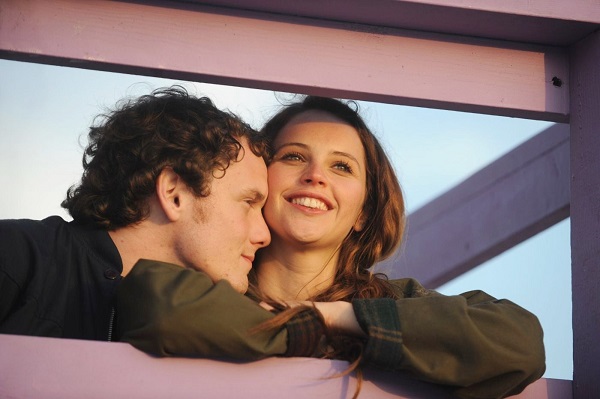
The conversation is often unsophisticated and unremarkable – a far cry from the endlessly witty Before Sunset-style dialogue that the film’s twenty-something-American-meets-twenty-something-Euro premise might suggest – but it rings awkwardly and often painfully true. And Doremus has the sense to let his camera capture these actors in broad strokes, zeroing in on who they are in a moment rather than who he could make them in the editing room. As the quietly serious Jacob, Yelchin (who had previously impressed in the Star Trek reboot, and Jodie Foster’s The Beaver) is the more understated of the two, but he finds both his character’s burrowed anguish and softness. Jones (best known then for The Tempest and Brideshead Revisited, and about to feature in Rogue One: A Star Wars Story and Ron Howard’s Inferno) is a small revelation as Anna, lacing her with a steeliness and selfishness, but also a madly loveable spirit that pulls you in and doesn’t let go.
Somewhat surprisingly given the preference for naturalism on display here, Doremus has made a polished and inventive piece of filmmaking. There’s a lyricism and seamlessness to the way that the director sashays between time and across continents, with Doremus best illustrating the alternating closeness and distance felt by the characters via smaller, intimate moments. One such is when a late night phone call leads a tearful Anna to joke that Jacob, sitting in a lonely pub on the other side of the globe, should drop by her place. It’s a poignant and irresistible moment that aims straight for the heart, seemingly without trying.
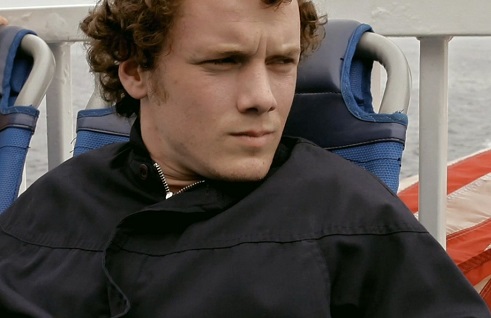
In following their romance over five years, it becomes clear that what continues to bond Anna and Jacob is their mutual infatuation with a brief period of time where they fell deeply in love, and the majority of the film sees the pair trying to navigate their way back to that moment. Always hovering above though is a handful of tough questions: Was that fleeting time enough to sustain what they have to sacrifice to be together? And in the end, is it even worth it? How much disappointment and how many setbacks can two young lovers endure before something is lost? Beautifully capturing the thrill and immediacy of first love, Doremus also reveals the way that it can stubbornly hold us back from moving forward with our lives. In the film, we watch as both parties spark promising relationships with new people – Jacob with his smitten office assistant (a lovely pre-Hunger Games Jennifer Lawrence) and Anna with her equally love-struck neighbour (Charlie Bewley) – yet neither is able to completely surrender themselves.
Passionately but tenderly portraying a young love gone right and wrong, Doremus shrouds this film and particularly its ending with the perfect level of ambiguity so that the question of whether Anna and Jacob can bridge the distance between them – in every sense of the word – becomes just as much about who we are. Are you a romantic or a realist? Like Crazy is the rare romantic drama made for both.
