




By Gill Pringle
Oliver Hermanus admits that directing Living was a daunting process. Not least because it is a reimagining of Akira Kurosawa’s revered 1952 Japanese drama Ikiru, from a script by Nobel Prize-winning novelist and screenwriter Kazuo Ishiguro. But also because, as a contemporary South African filmmaker, the film’s background of repressed 1950s post WWII Britain was not exactly in his wheelhouse. And then, throw in the prospect of directing Bill Nighy, a towering British icon beloved for his roles in Love Actually, The Bookshop, Emma and Notes On A Scandal, and some directors might have politely backed off. But not Oliver Hermanus. “The idea of doing a period piece was both scary and fun,” says the director best known for Moffie and The Endless River, with his film Beauty winning the Queer Palm Award at The 2011 Cannes Film Festival.
So, Hermanus did what he has always done. He rolled up his sleeves, and dug into the research. “That was the fun thing,” Hermanus, 39, tells FilmInk when we meet at the 18th annual Zurich Film Festival. “My previous film, Moffie, was set in South Africa in the ‘80s, and was very much about white men during apartheid; that felt equally foreign to me because I’m from a mixed race family and I’d never made a piece of work about apartheid. I always made contemporary work. So, the offer to go in that direction felt like I had to learn a lot, and that I’d have to really absorb a lot of information and generate an interest in that world. I really valued that in the end. It was a great experience. Living, in a way, was the same thing. I went to film school in the UK ten years prior, and lived there for three years, but it was still scary. I’ve learned to lean into the fear of when it seems like you know nothing about it. You can just educate yourself.”

Living is the story of an ordinary man, reduced by years of oppressive office routine to a shadow existence, who at the eleventh hour makes a supreme effort to turn his dull life into something wonderful – into one he can say has been lived to the full. Bill Nighy portrays Mr. Williams, the London counterpart to Kurosawa’s original Mr. Watanabe set in Japan. A veteran civil servant, Williams is an impotent cog within the city’s bureaucracy as it struggles to rebuild in the years following WWII. Buried beneath paperwork at the office, and lonely at home, his life has long felt empty and meaningless. Then a shattering medical diagnosis forces him to take stock…and to try and grasp fulfillment before it goes beyond his reach.
Searching to break loose from the restraints of his regimented life, Williams flirts with hedonism as a solution before finding himself drawn to the bubbly Margaret (Sex Education’s Aimee Lou Wood), a young woman who once worked under his supervision, while at the same time taking his idealistic young colleague Peter (Alex Sharp), under his wing. “The role was written for Bill,” explains Hermanus, who made his directorial debut with the 2009 drama, Shirley Adams. “Kazuo Ishiguro had the brainwave at a dinner party. He was like, ‘Oh, somebody should really make a British version of Ikiru and Bill Nighy should play Mr. Williams.’ I think a producer overheard him and forced him to do it.”
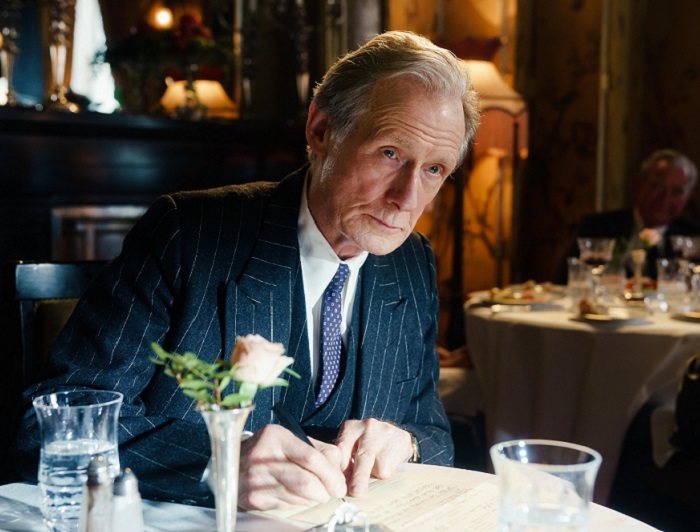
Once on set, Hermanus’s hardest task was reigning in Nighy’s expressions. “It’s hard to ask an actor to do nothing, and Bill has so many faces, and people have known him in so many different roles. He’s played pirates and vampires, and he’s a real shapeshifter. But my ask of him for Living was to do nothing.”
It was no mean feat for Nighy, whose eyebrows could hold a masterclass all on their own. “It did take a while, but we had a process,” says Hermanus. “We met every Sunday for a couple of months when I would go over to his house and slowly just bring it all down to nothing. And we did a lot of things like, for instance, Bill and I agreed that his character’s voice needed to be almost nothing as well…much deeper than Bill’s actual voice. He had to find that voice and maintain that voice. And then the rest of it was just banning him from moving his eyebrows or his shoulders…and even blinking! I mean, if you have a character called Mr. Zombie, you’ve got to find the resonance in that,” Hermanus says, referring to the nickname that Margaret calls Mr. Williams behind his back.
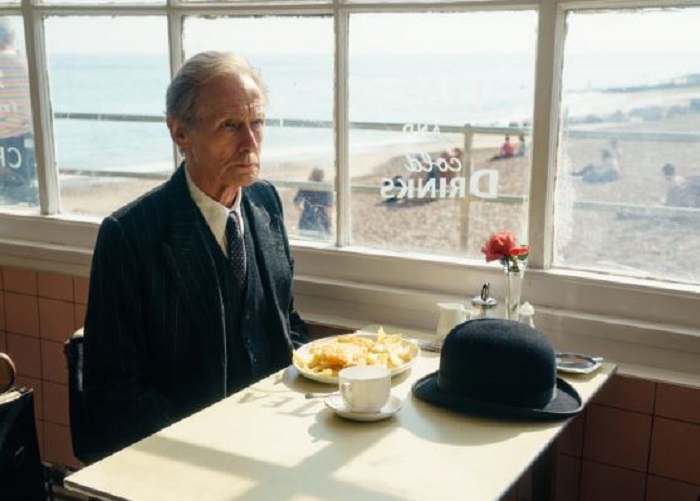
Throughout the process, Hermanus conceived of Living as being a Christmas film, despite the fact it has little seasonal reference beyond snow. “It was sort of my insistence,” Hermanus explains. “I really don’t know why. Particularly at the beginning I had to go, ‘Okay, what are the period films that I like and would watch like this?’ and one of them was It’s A Wonderful Life. And then I asked myself what do I like about It’s A Wonderful Life? And I have watched it so many times and watch it at a particular time of the year, and it gives me a certain kind of feeling. And so the egoist in me was like: ‘How do I make another film which people will want to watch during the holidays, whether it’s sad or not sad?’ Somehow the film had to operate as a warm embrace. So, by the end of it, even if you’re crying and it’s sad, it needs to feed you with something where you feel emotionally connected to your family or to your life.”
Hermanus appreciates that it’s a tall order. “My other films are not an embrace. My other films are kind of like a punch in the face or a slap across the chest,” the director laughs. “So the thing in my head was, ‘How do I make something that is inviting to an audience and for me?’ Christmas is the ultimate challenge because that’s when everyone stops and they’re looking to watch things with their families and to celebrate things. And the hope is that Living fits into that world somewhere, even though it’s about a man dying.”

The production was able to not only shoot but also set up its production offices at London’s iconic County Hall. “When you have a film that names somewhere specific, you never think you’re going to shoot it there. You always think that you’ll have to composite it together from a million other locations. But here, a lot of the time, our production designer was just dressing the spaces. We lucked out completely.
“Filming is like gladiator combat,” adds the director, who shot the film over six weeks. “You have to get to the other side. The challenge for me is always to elevate my craft in every way. I always want to make the best thing I’ve ever made, in terms of my choice of actors, collaborations, the storytelling. That’s always the big pressure that directors put on themselves.”
In describing Hermanus as “super prepared and endlessly courteous,” Nighy adds, “Oliver has a great overview, which I’m very grateful for. I tend to disappear into each day’s business, and he schedules the information very cleverly. He’s a very smart, very cool director. He has great ideas.”
Living is released in cinemas on March 16, with special preview screenings on the weekend of March 4-5. Click here to read our review.
