


by Gill Pringle in Jeddah, Saudi Arabia
At 76 years old, Oliver Stone still enjoys his role as Hollywood’s favourite disruptor. A triple Oscar winner for Midnight Express, Platoon and Born on the Fourth of July, he has never been content to sit on his laurels, his quest to uncover political truths driving him to also become a fearless documentarian, interviewing several redoubtable world leaders, including Vladimir Putin.
If some of Stone’s Hollywood contemporaries might be deterred by accusations of “art washing” attached to attending the Saudi Arabia’s Red Sea International Film Festival, now in its second year, then Stone readily welcomes the challenge of serving as President of the Red Sea: Features Competition jury.
“The power of cinema is double edged. I mean, you can become stupider watching movies,” he slyly suggests. “A lot of movies create violence or a sense of revenge – and revenge movies always make money, right? So, you go out and get revenge. What good does that do to the world? Violence and revenge don’t work. And that’s mostly what the movie diet is.
“And because the technology is much simpler now, any idiot can make a movie, frankly, so that’s what you get. You can get 3,000 movies at these festivals, which is too much. Some are very good, but we’ve seen movies that are pretty dreadful, too,” he tells FilmInk when we meet the storied writer/director in Jeddah.
While much of the world has condemned Saudi Arabia for its abuse of human rights, joining the outcry over the 2018 murder of Jamal Khashoggi, then Stone has always sung to his own tune.
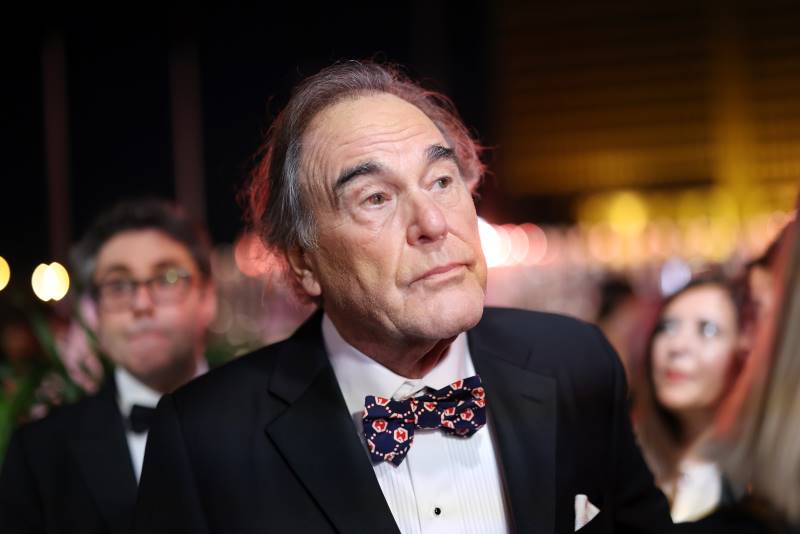
“I do feel very strongly that condemnation doesn’t work. The United States is an expert at condemnation of every country in the world when it crosses the line of the international order – what they call ‘rules’. Well, America breaks all the rules when it wants to, and there’s so many examples, and certainly one of the worst cases is the trial against Julian Assange,” he says, citing the United States’ ongoing bid to have the Wikileaks founder extradited to the US.
“So, the Khashoggi affair, yes, it’s a crime. And I’m pretty sure it goes up pretty high in the Saudi government, people get killed, that happens, like an Assange gets persecuted. So, it’s a different kind of cruelty. I mean, killing somebody and chopping them up is horrible, but put somebody in a supermax in fucking Colorado, where you’re in solitary confinement half the time, is equally suffering. It’s a cruel and unusual punishment.
“So, what’s worse? Getting chopped up, or being hounded to death in a prison for years and your health deteriorating? It’s just as bad to die one way or the other? This is worldwide, and I’m sure in Russia, there are some people in jail too, that shouldn’t be there. And in the United States, there’s tons of people that have been released from jail because they were never convicted. There’s so much wrong in the world, so once you start saying, ‘You’re the bad guy’, you have to be very careful, because it rebounds on you.
“The United States persists in this case of vengeance. So, who are we to point the finger at anybody? We’re telling the Russians what to do. It’s ridiculous considering what we’ve done to it, in my opinion.
“But this war in Ukraine is not simple at all. It’s been provoked. And who provoked it? Oh, its easy! ‘The Russians, they invaded!’ Yeah, but think about everything that happened before the invasion in those seven years between 2014 to 2021. People don’t pay attention. Ukraine used to be neutral. After 2014, it was no longer neutral. It was anti-Russian. And that’s what changed the equilibrium. That’s where the war comes from. Like everything, every war has a cause and effect, but we’re not even fucking paying attention,” argues the highly decorated Vietnam veteran, whose earlier dramatic films focused on controversial American political issues during the late 20th century, including JFK, Natural Born Killers and Nixon.
Besides his free-thinking political attitudes, Stone admits to a secondary agenda in agreeing to preside over the Red Sea Film Festival’s jury; his participation also affording him the opportunity to screen his recent documentary, Nuclear, which failed to find US distribution.
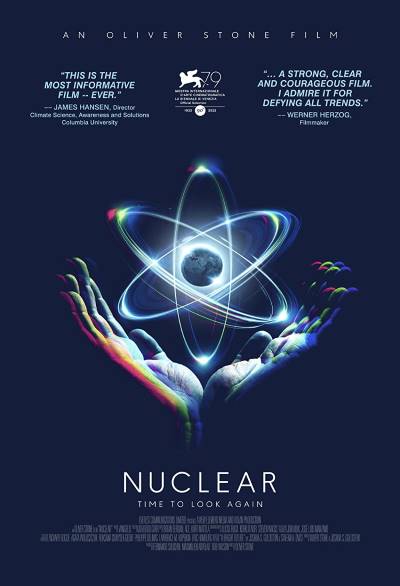 A compelling, must-see documentary, Stone makes the case that nuclear power has long been the victim of a perception/reality conundrum, one that is now in the process of being overturned. The perception is that nuclear power is too dangerous to be an essential component of providing our energy needs. The reality, insists Stone, is that nuclear power is clean, abundant, and safe, and that the ominous fact of our energy crisis is too urgent for nuclear power not to be an essential component in providing our energy needs.
Stone received unprecedented access to the nuclear industry in France, Russia and the US in his mission to de-stigmatise the fears surrounding nuclear energy.
“Look, I believed Jane Fonda and The China Syndrome was a big issue because of the timing. The 1970s were a time of supposedly great progressiveness. It’s ironic that we made one of the key decisions totally wrong, in my opinion, and this is borne out by many experts including former Greenpeace founder Dr Patrick Moore, who features in Nuclear,” he says, barely able to disguise his scorn for US distributors who he considers to be short-sighted.
“It’s a very good film, but it’s not a cliffhanger Netflix documentary, where you’re sitting on the edge of your seat with a human interest story. This is a human interest story. But this is the whole fucking humanity, right? I mean, this is a whole race. We’re concerned. I’m concerned. People who are smart are concerned. When you talk to people who know this stuff, they tell you, this is crazy – renewables are just an extravagant detour, even if we love them.
“You’re kidding yourself if you think renewables are going to work, but Americans don’t care because they only care about their own little backyard, and they’re okay, generally speaking, they can solve this thing, but the rest of the planet is going to be screaming; there’s going to be dislocations; there’s going to be migration to a huge degree.
“We’re not taking into account the global picture, we just think about ourselves. And as a result, we’re fucked; we have to think collectively now; humanity has to see the problem. And this film can help a little bit, you hope, but we can’t even get distribution in the United States with a Netflix. They say this is not human interest, but how stupid are they? What humanity will there be to give us human interest?”
He appreciates that it’s an uphill battle of changing minds and fearful anti-nuclear perceptions.
“Nuclear is one of the reasons we’re here, we may have to go on a country to country regional basis, which makes sense – when you sell to Arabic countries; you sell Middle Eastern countries; people that care. And then you work your way back to the United States via Europe.
“Every article I read, the press is against it. Because the first thing you see in the top paragraph is ‘nuclear is dangerous’, risky, risky. But it’s less risky than coal; it’s less risky than oil. And that’s our point.
“I think in America, frankly, it’s pure fear of nuclear. Also, they don’t want controversy. ‘We’re a channel, we have a lot of money, we can get sued. So, we don’t want to say that nuclear is safe for you’. And that comes from the generation that runs TV. They’re my generation, generally speaking, a little younger, maybe. But these people grew up in the 1970s influenced by all those reasons.
“But we will never ever advance as a civilization if there is not some degree of risk taking,” he says.
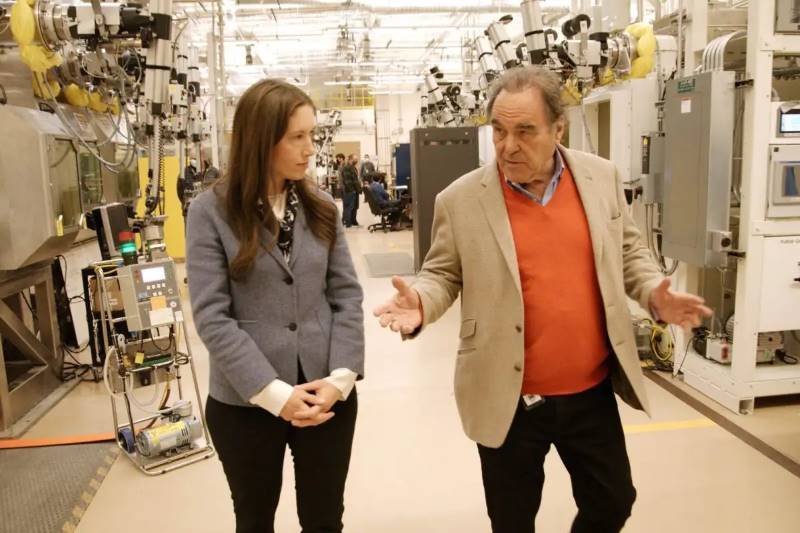
If nuclear naysayers always hark back to Chernobyl, then he says they are missing the point.
“Chernobyl was a really legitimate example because the Russians built it wrong, and they had no container – all the reasons we gave in the film – and they didn’t handle it very well at first. They didn’t have the suits on when they went in, but roughly fifty people died in the incident and, after that, we still don’t know the cancer deaths. But they’re not that big because the radiation falls off first and, on top of that, it’s low level, and we’ve lived with low level since the beginning of the planet.
“So that’s what we’re trying to do – help inform people, wake up! That’s very hard to do. All my films have been about that: wake up.”
A fixture within the industry for half a century, Stone believes he has one more important feature film to make. It’s already in the works but he won’t hint at the topic.
Stone would like to make more than one film but is realistic about his limitations. “I have plenty of problems, but I suppose the biggest problem is getting old. That’s no fun. I can’t hear as well or see as well either, and I don’t have as much energy. So that’s a problem,” he admits.
“But I prefer to live on my feet than die on my knees.”
