


by Stephen Vagg
As a broad generalisation, you’re more likely to find expat Australian writers succeed in England than America – there’s less competition of course, but also closer political and cultural connections, or at least there were in the 1940s and 1950s when Sumner Locke Elliott was making a name for himself.
Most emigrating writers of his generation, and there were a lot, tried their luck in London: Dymphna Cusack, Rex Rienits, Betty Roland, Peter Yeldham, Russell Braddon, Paul Brickhill, Michael Noonan, Bruce Stewart, Lynn Foster, and so on.
It was far less common to go to the US, for all Australia’s enthusiasm for that country’s cultural product. Still, some did try, and what’s more, some even made a go of it, albeit usually after some time in London first (Michael Plant, Ivan Goff, Alec Coppel).
Sumner Locke Elliott didn’t bother with a pre-emptive English sojourn – when he got out of Australia at age 31 (he’d had a few years in the army), he went straight to New York.
Of course, he went with considerable experience, having been a professional writer since 1934, when he was only 17 years old – mostly for radio, but also theatre (notably at the Independent Theatre in Sydney); he’d worked as an actor, too.
Elliott had an intense passion for Broadway, as can be seen from most of his Australian plays, which tended to be in the American style (Invisible Circus, Interval, The Cow Jumped Over the Moon), with the exception of Rusty Bugles, which was, ironically, his one big theatrical success. He later said Annette Kellerman advised him to go to New York as his style of writing and personality would fit in there, and he “wanted to test himself in the most difficult market of them all”.
Elliott arrived in New York in 1948 with few contacts, so had to hustle before the savings ran out (he couldn’t take his Rusty Bugles royalties out of Australia due to the currency restrictions of the time). He dreamed of Broadway, but knew he had to write other things in order to survive; radio drama, in which Elliott was hugely experienced, was on its way out due to television, but he succeeded in selling two of his Australian radio plays to TV producers – and both were filmed. They are the subjects of today’s piece, Wicked is the Vine and The Crater.
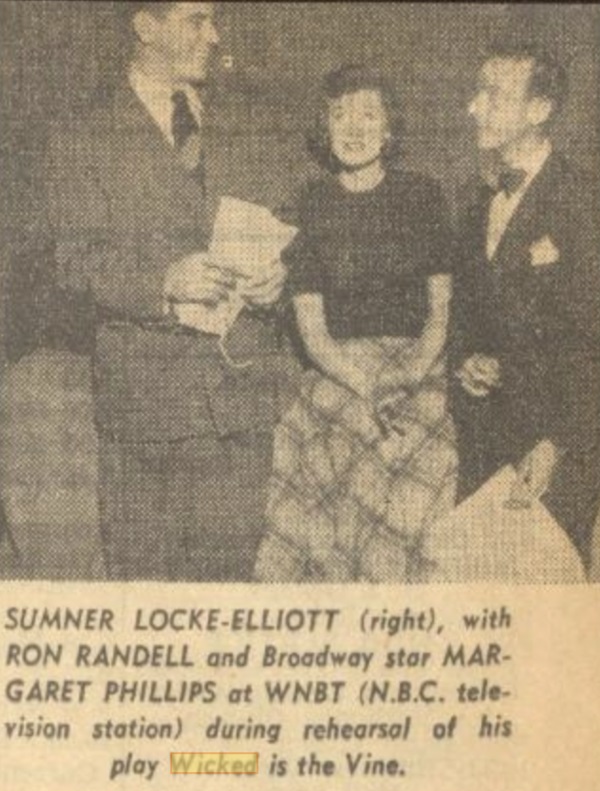
Wicked is the Vine is about two sisters who live on a farm, one harsh and the other more romantic; when their father insists on selling the property, one of the sisters murders him and tries to blame a third party. First performed in 1947, it was the first original radio play commissioned by the Lux Radio Theatre. The storyline was partly influenced by the Lizzie Borden case, and partly one assumes by the fact that Elliott had two warring aunts who fought over him (he later dramatised this in Careful He Might Hear You). I’ve read the play and it is entertaining drama, with compelling central characters. The script was bought by Kraft Television Theatre and filmed in March 1949.
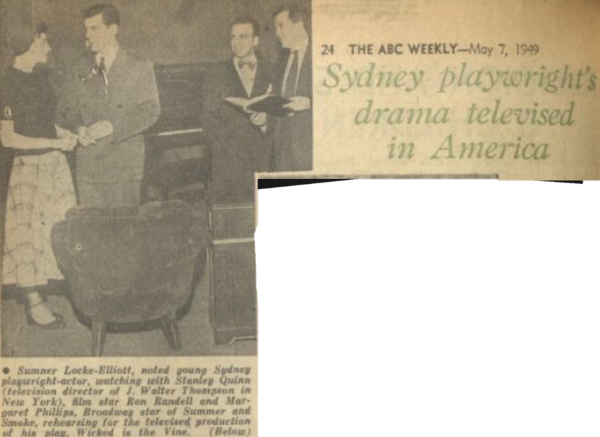 The cast included Australian expat actor Ron Randell, who had moved to Hollywood off the back of Smithy at the behest of Columbia, who thought he might be a potential star; that hadn’t worked out, but Randell would have a long career.
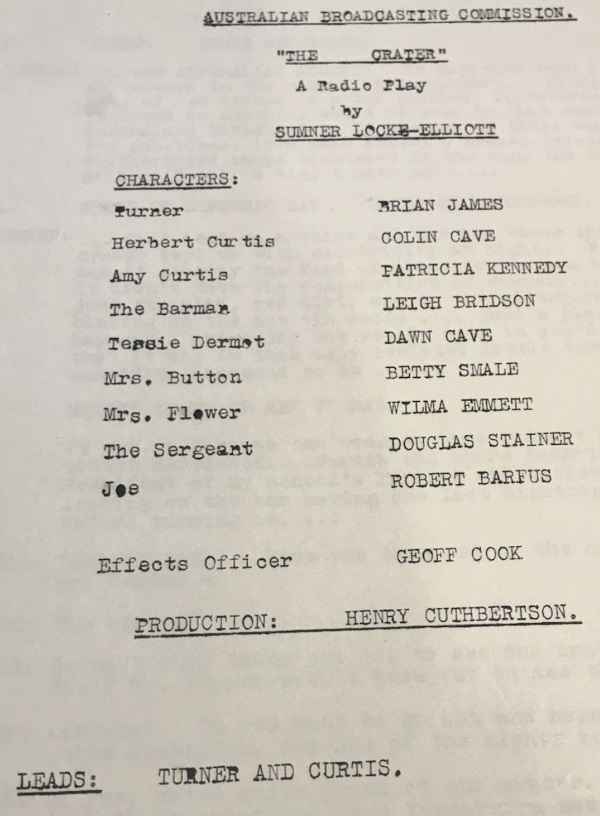
Elliott then sold another Australian-set radio play – this was 1948’s The Crater. It was adapted for Lights Out, an anthology suspense show on the NBC network, based on a radio series of the same name. The producer was Fred Coe, who went on to become a leading maker of live TV drama in America, and a champion of Elliott’s.
The Crater is set in a West Queensland town, where a visiting schoolteacher is shown a mysterious bottomless crate by a local councillor. When the unhappily married wife of the councillor goes missing, the teacher wonders if the crater has anything to do with it. I have read a radio script of this play at the Fryer Library in Brisbane; it is very atmospheric with excellent feeling for small towns, unfortunate if accurate use of racist slang to describe Aboriginal people, and plenty of twists.
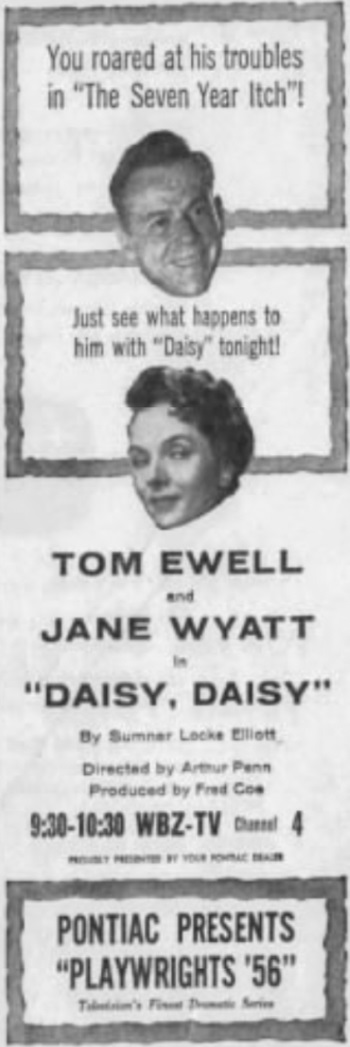 The money from these two plays enabled Elliott to keep going in New York until he received an offer to adapt Of Human Bondage for television, a version that ended up starring Charlton Heston (you can see it on line here). This job really launched Elliott in American TV and he became one of the key screenwriters in live drama at the time, particularly in the field of adaptations. He wrote several TV plays with Australian links: I’ve written about The Grey Nurse Says Nothing (1959), loosely inspired by the Shark Arm Murder Case, but there was also Daisy Daisy (1955), based on the Ern Malley affair, with Tom Ewell and Jane Wyman. He managed to get a play on Broadway, Buy Me Blue Ribbons – it flopped but it was filmed for American and British TV.
Wicked is the Vine and The Crater are, as far as I know, the first Australian radio plays to be adapted for American television and the first American small screen dramas to be set in Australia and/or come from an Australian author (now I’ve written that sentence I’ll probably discover there was an earlier one).
No copy of either production exists – indeed, I’ve been unable to find any original TV scripts or even reviews (if anyone knows of any please send them through). They are forgotten now, though they do pop up in overviews of Elliott’s career – Australian screenwriters who didn’t become best-selling novelists, like, say, Ivan Goff, are far more obscure. However, I have read the original radio scripts for both Wicked is the Vine and The Crater, and they are both first-rate stories, solidly constructed with intriguing settings and characters that build up to a satisfying climax and resolution.
Neither were ever filmed for Australian TV, even during that period when the ABC claimed it was struggling to find good scripts. (The ABC adapted The Crater for radio). During the 1950s and 1960s, when Elliott was one of the leading TV writers in the world, only two of his works were adapted for Australian television: The Grey Nurses Said Nothing and Rusty Bugles. (By way of contrast, Iain MacCormick was filmed four times and Christopher Fry five times.) Maybe the rights were too expensive. Maybe it was (as I’m more inclined to believe) a combination of anti-Americanism and tall poppy syndrome. Elliott later regained favour among financiers in the 1980s and there was a rush of adaptations of his novels – Careful He Might Hear You (1983), Eden’s Lost (1988), Water Under the Bridge (1980). He was a man of many achievements. But we shouldn’t overlook two of those were Wicked is the Vine and The Crater.
Main Photo by Lorrie Graham