


by FilmInk Staff
The Plains, a three-hour self-funded drama, filmed over twelve months, is a daring experiment in narrative and minimalist form with a lot on its mind.
It’s the first feature from thirty-something Melbourne filmmaker David Easteal.
Every evening, middle-aged Andrew (Andrew Rakowski, a non-actor) climbs into his car, pulls onto the freeway, battles the traffic, and heads home. During the trip he makes calls. He takes calls. We learn about his marriage and his ailing mother. Sometimes he gives a ride to David (Easteal), a younger colleague. Tensions and anxieties, the little tremors of life and what it might promise… these things are shared between them on the long commute.
“It covers a year in the life of these characters,” Easteal told FilmInk. “It’s about getting older, the passage of time, the impermanence of things.”
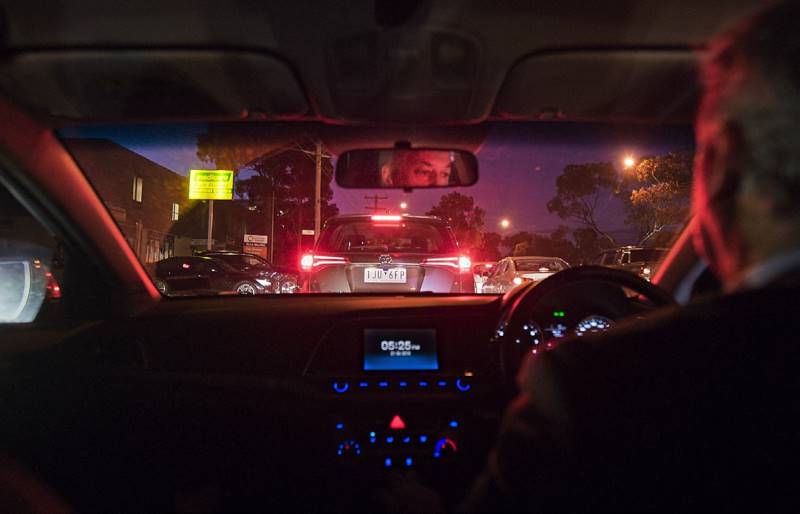
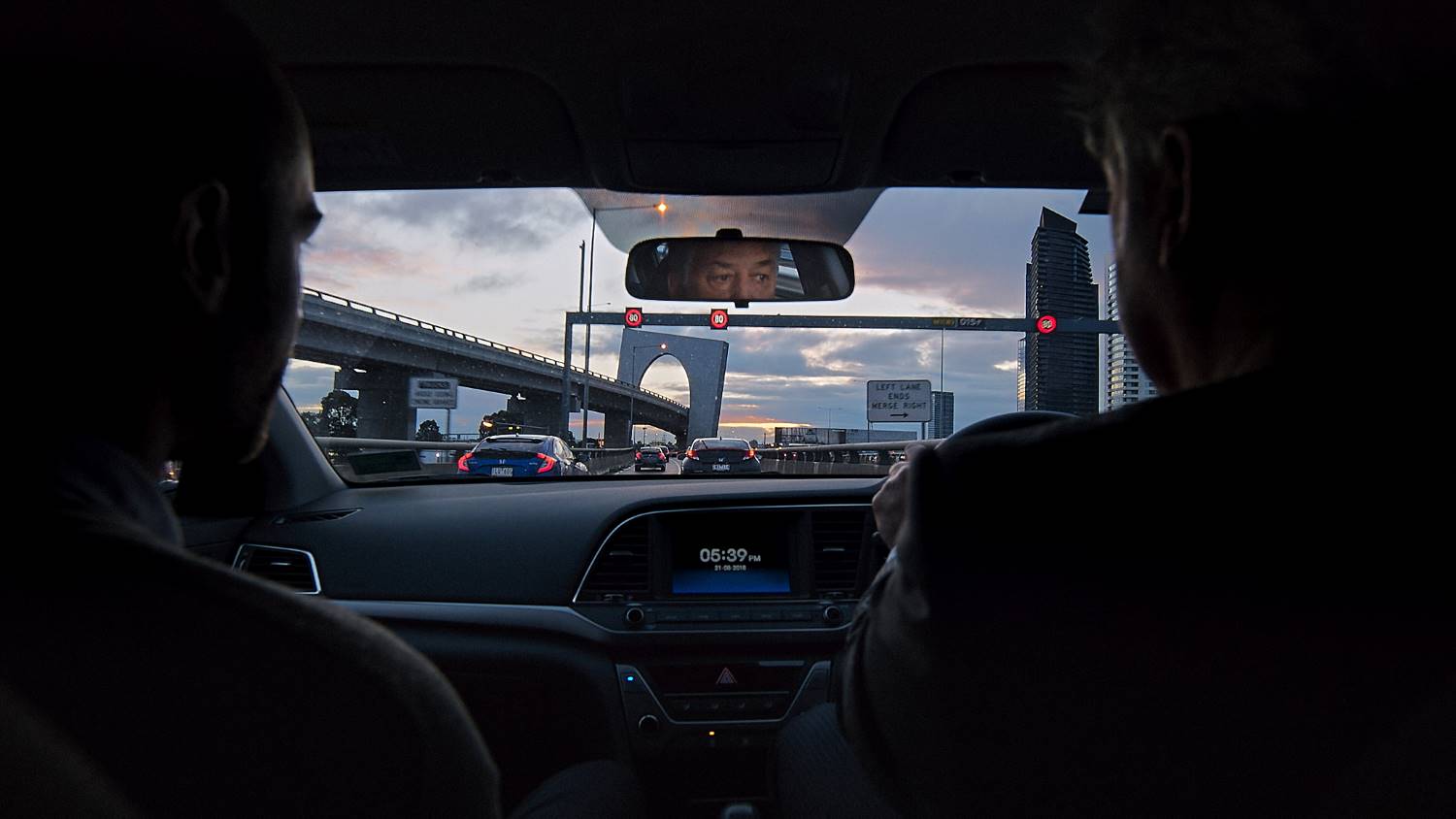
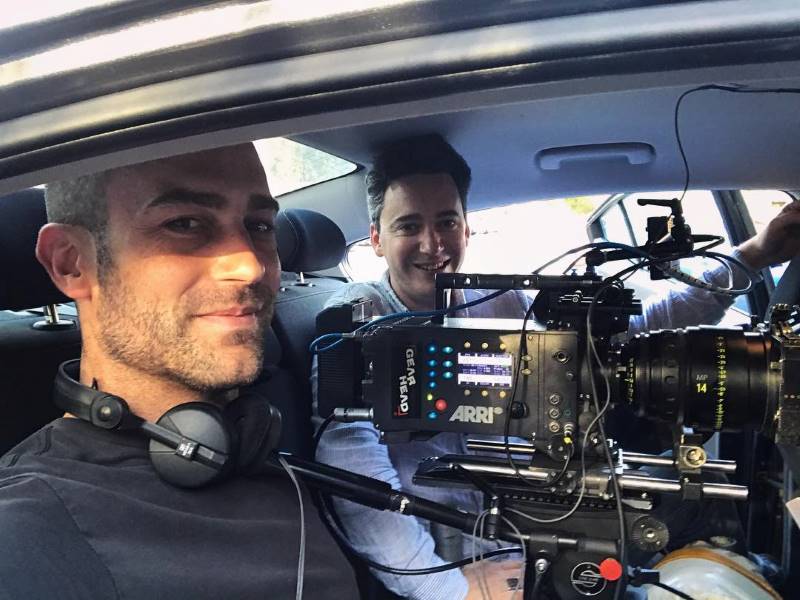
Intriguingly, most of the action is played in long scenes, with the interior of Andrew’s vehicle the principal ‘set’. Each ‘episode’, that is, each trip, is a single take from one angle. There are no close ups, or cutaways. The camera position is the back seat of the car, looking forward, perfectly centre framed, a very wide shot, the uncertain flow of traffic, and colouring sky dominating. Most of the time, we can’t even see the faces of the performers (a rear-view mirror teases a glimpse of faces.)
“I think I was trying to conceive of a film with a simplicity as to how it was constructed,” Easteal explains. The pioneer cinema, the very beginnings of movies, he says was an influence: “I was thinking about Lumiere – where a camera would just be set up in a space and record time in that space.”
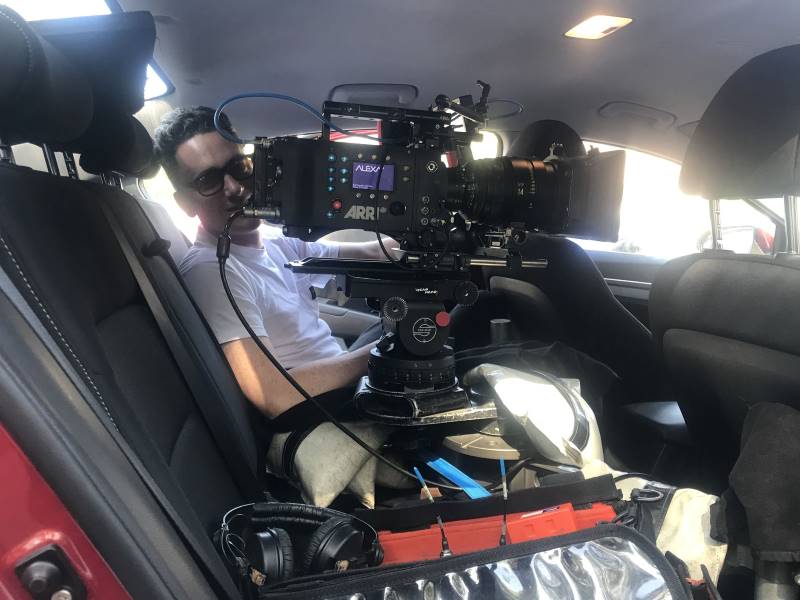
Cinematographer Simon J Walsh, shooting on the Arri Alexa Classic gives the film a sharp, crisp look and he also constructed a rock-solid camera platform for the vehicle, says Easteal.
The film derives from a shared history Easteal has with Rakowski. Some time ago, both of them were working in suburban Melbourne. Every so often, the older man would give Easteal a ride back to the city. “An unlikely friendship developed between us, given our age difference. I’d hear him call his wife; I’d hear him call his mother whose dementia was worsening over the course of a year.”
Easteal devised a production method to help shape the story. Shooting would take place only once a month, often for two days, consisting of Andrew’s commute. No dialogue was scripted (“Andrew was not about to memorise lines”) but Easteal would direct the line of action, in what amounts to structured improvisations. “There were story arcs embedded in the film, but it was not tightly scripted,” he said.
After each shoot they would meet and discuss how the story was evolving.
Complicating the process were the production contingencies involved. The route selected for Andrew’s commute only had one exit, early in the trip. If something went wrong after that point in the journey the team would be ‘trapped’ on the freeway, till they reached the city. Re-takes weren’t an option. “We were shooting in rush hour, we had to shoot at the same time of day, every time.”
In all, eleven of the twelve shoots – that is the single takes captured on the freeway – were used in the final cut. The practical necessities involved, Easteal says, became, “invigorating.”
“It added an element of chance before each day of shooting, where these external elements merged with imaginary elements.”
The Plains was completed in France after receiving the Belfort International Film Festival Entrevues Films en cours post-production support award. It was the first time an Australian film won the prize, which is given only once a year to a single production.
Editing the film, Easteal said, was about finding a “rhythm”. Some spectacular drone shots were added in post: “they weren’t part of the initial conception… the film could not be totally formal.”
A self-taught filmmaker, Easteal says he has been making movies since he was a teen. At present, he has a day job as a barrister specialising in Family Law. The Plains follows shorts The Father (2011) and Monaco (2015). Both had a long life on the international film festival circuit and in 2015, Easteal won the MIFF prize for Emerging Australian Filmmaker.
The film has been dubbed by some a ‘documentary’, a suggestion Easteal can’t quite accept. Yet, The Plains allows fact and fiction, discovery and craft to merge in an immediate kind of way. There is an unforced irony in the film’s central conceit. It is something about not allowing the daily grind to be confused with what’s important in life. Here, the routine commute becomes a space to reflect, participate, get involved. We evolve all the time Easteal reckons, and that’s reflected in his process.
“I’m not the sort of filmmaker who makes the film before the shoot,” he said.
The Australian premiere will be at the Asia Pacific Triennial of Contemporary Art at the Gallery of Modern Art Brisbane on April 10 and 22.

Wasn’t there another Aussie film recently set mostly in car or takes place in a car?