


By FilmInk Staff
When Udo Kier first appeared on screen, in the mid 1960s, one European magazine called him “the most beautiful man alive.” He’s been a cult figure ever since. He’s been in countless films. Many forgettable. Many more clearly distinguished by Kier’s strange, alluring presence. It was a screen persona that attracted some of the strongest auteurs of the last sixty years to cast him, most of the time in small but important roles, often as villains. Alexander Payne, Gus Van Sant, Werner Herzog, Rainer Werner Fassbinder, Dario Argento and Walerian Borowczyk have all used Kier to startling effect. (He even did a cameo in Ace Ventura: Pet Detective.) Still, it’s Kier’s starring role in Andy Warhol’s camp classics of the 1970s, Flesh For Frankenstein and Blood For Dracula, that brought the actor a weird fame, and a menacing-but-funny image that is hard to shake off, even if those movies happened fifty years ago.
Born in Cologne, Germany in 1944, Kier these days is philosophical about the faded beauty of youth, and remains totally dedicated to acting and the Art of movies. “Actors,” he tells FilmInk, “want to Act. I did twelve films with Lars von Trier. On Dogville (2003) we had very big names [Nicole Kidman, Lauren Bacall, Stellan Skarsgård] but everyone was treated exactly the same. It just goes to show that big movie stars, deep inside them, want to do Art!”
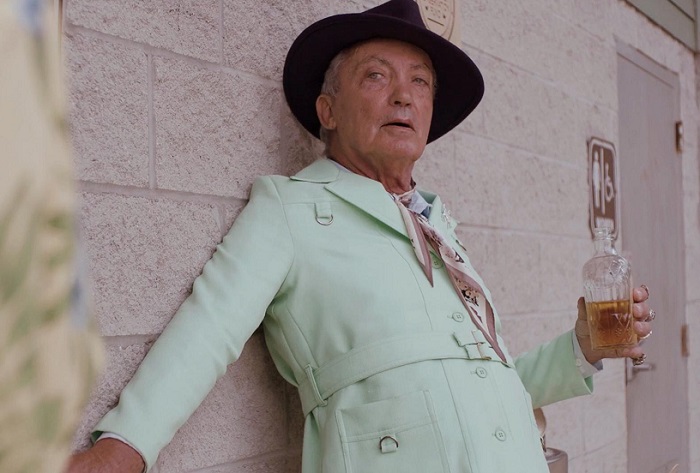
Swan Song, Kier’s new picture, he says, was the chance to play a lead role and, in a way, pay homage to old friends. Openly gay his entire life, Kier started his career in Germany and worked with Queer icon, Rainer Werner Fassbinder. When he read Todd Stephens’ (Edge Of Seventeen) script about an ageing drag queen hairdresser, Kier says that it resonated deeply. Originally, Stephens had Gene Wilder in mind for Mister Pat, a real character from his hometown of Sandusky, Ohio (pop. 24,000), and a major influence on the director’s life and work who became a local legend shopping on the high street as Lauren Bacall. This turned heads in 1967.
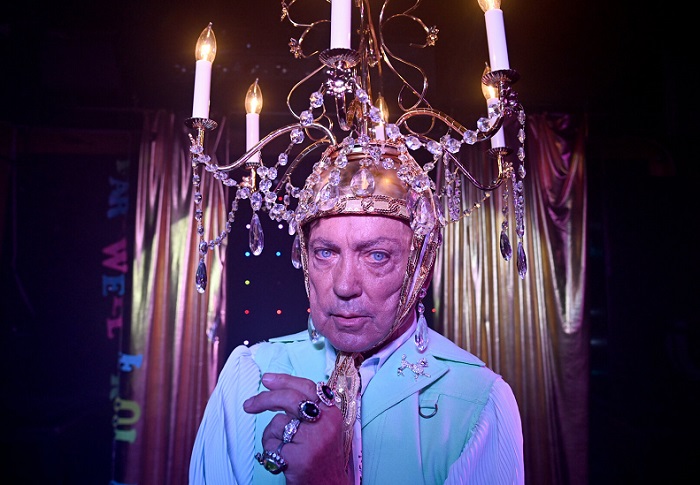
In the film, Keir’s Pat is pulled out of the grey misery of his retirement home and given a mission. He is to fulfil the last wish of a one-time regular of his “famous” salon. Pat must provide a spectacular hair-do to this recently deceased customer in time for her funeral. Frail and a little apprehensive at first, Kier’s Pat blooms in the days that follow. The story becomes a funny, sad melancholy trip into memory and old haunts for Pat as he relives the splendour and sadness of a courageous life. Where some would be tempted to go “big” with such a flamboyant character, Kier and Stephens downplay it all, and the result is a very touching character piece. For Kier, it is a tour de force, already recognised by a raft of acting prizes on the film festival circuit. FilmInk spoke to Udo from his home in Palm Springs which he shares with a gigantic tortoise called Hans Solo.
According to the available data, you have made more than 200 films since you began working as an actor at age 22 in 1966.
“[Laughs] The internet knows more about me than I do. When journalists ask me about them, I say, ‘Half the films are bad, half you can enjoy with a glass of wine, and fifty are good.’”
Any favourites?
“For actors, favourite films are films that change things in your life. When I did Andy Warhol’s Frankenstein [Paul Morrissey, 1973] and Dracula [Morrissey, 1974], I moved from regular newspapers to glamourous mags – I was in Vogue – so they definitely changed things. There were little films I did with Werner Herzog…I like My Son, My Son, What Have Ye Done (2009) and with Lars von Trier, I like Medea (1988). Now, after all these films, I got a wonderful notice in The New York Times about Swan Song. It said: ‘Finally, after fifty years, Udo Kier becomes a leading man.’ [Laughs]. If you have a good supporting part, people say ‘He’s good’ [whenever they see you]. I showed Swan Song to friends and they would call and say: ‘I was crying.’”
The writer-director of Swan Song, Todd Stephens, based the character you play on a real person ‘Mister Pat’ Pitsenbarger. When you were preparing the role, did you do any research – meeting Pat’s friends…?
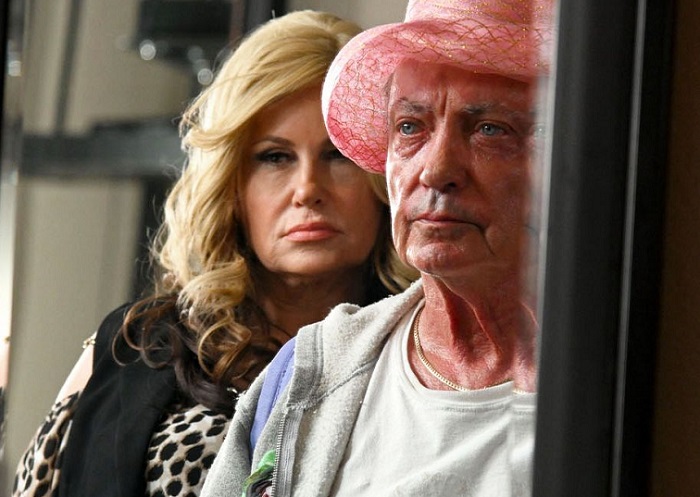
“I went to Sandusky, Ohio [Todd’s hometown and the filming location]. Todd told me that there were friends of the real Pat still alive. I wanted to invite them for a drink and talk to them. I learnt so much from them about the real Pat. His attitudes, the way he was speaking, the way he was moving, the way he was walking. So, I took that in, of course.”
We understand that you researched retirement homes…
“I told Todd that I wanted to spend a couple of days in a retirement home…nobody knows me. I wanted to look out of windows for hours, wander around. There would be no cameras, no crew. I did this. Then we started the movie. Another wish of mine was that I wanted to shoot as chronological as possible. So, we started in the retirement home [which is how the film begins].”
You have said that this film was close to you…
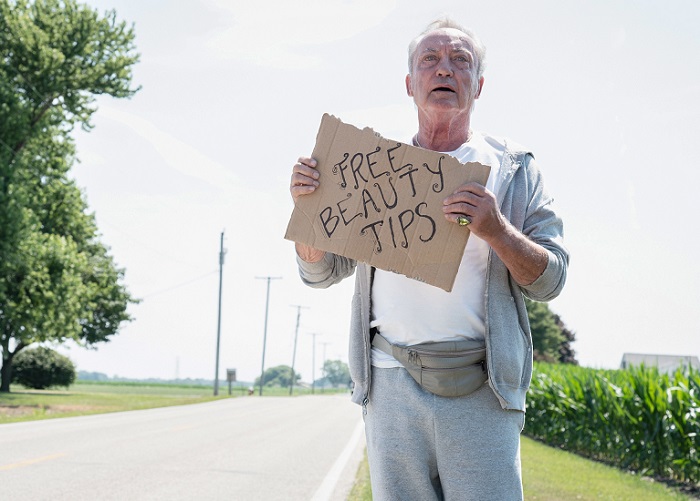
“Let me start at the beginning. I got a script. I liked it. Todd called. I said, ‘Why don’t you come to Palm Springs and talk?’ I have to like the director…if I don’t like the director, even if it’s a good script, I would never do it. So, he came, and we had a splendid afternoon. I told him the truth, what I like. If I was to play the role, I told him I would not like to do a cliché, going over the top. We agreed. Let me tell you about one of the reasons I accepted to work on the film. All this for me was going back. When I worked with Fassbinder and other directors, AIDS came. People died. Many actors I worked with. It’s not like today. You can take a tablet and you are okay. Then, they just died. In the old days, if there were two boys or two girls kissing in a bar, they would have been thrown out. Today, you see the people holding hands in McDonalds. And nobody cares.”
That goes to the heart of the film. There’s a moving scene in a cemetery. You hug a gravestone of a departed friend.
“I had a great time doing that film emotionally. It was a great ‘operation’ between the director and me. I wanted it real. Lars Von Trier – I’ve been in most of his films – always told me, ‘Don’t act.’ What he means is don’t make it visible that you are doing a big number now. So, for that scene, I asked not to see the grave or anything before we shot. You cannot do that in a Hollywood movie – you can’t work that way. The stone hugging was not in the script. If you tell an actor ‘hug the stone’, it becomes dramatic. I just felt like it.”
What was it like shooting this story in small-town Ohio?
“Not much happens there. The whole town was in movie fever. We shot it in eighteen days. We shot on the main street. People would start talking to me: ‘Hello Pat, how are you today?’”
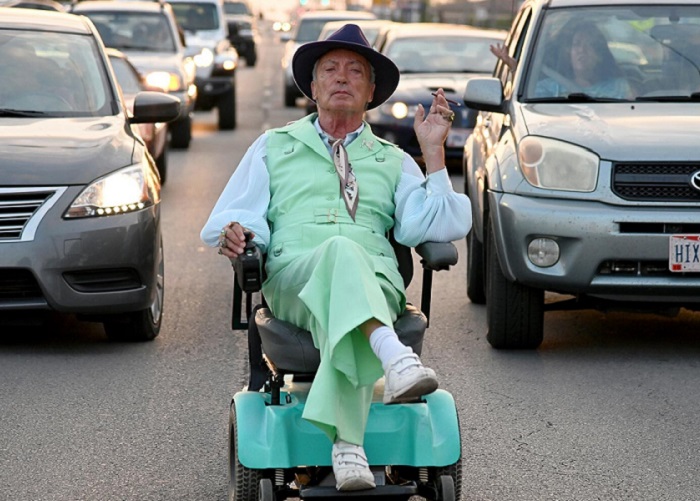
Tell us about the “the money shot”: Pat, dressed to kill, in motorised wheelchair, on the street, he’s doing maybe five kms an hour tops, he’s turning the traffic lane into a car park…
“Well, we had no money for stunts! I got my wheelchair from the hospital. I learned a little bit how to operate it. We went to the main street. We have maybe two cars on the road that were production cars. I got out there on the road in the wheelchair, and they started to all blow their horns. They were thinking: ’What is this crazy bastard doing in the green suit in the middle of the street?’”
We understand there was a crowd funding campaign to finance the film?
“Yes, there was a little crowd funding. I was sitting in front of a camera saying, ‘Send the money, send the money!’ We got 100,000 to start.”
Swan Song is released in cinemas on December 26. Click here to read our review.
