


by FilmInk Staff
Mildura is over 1000kms from Sydney, more than 500kms from Melbourne and about a million cultural miles from the Art world’s movers and shakers in centres like London and New York. Yet, this big country city, better known for its grapes, is home to a collection of superb paintings from two once celebrated artists, who are now, almost completely forgotten.
Irishman William Orpen (1878-1931) and Welshman Frank Brangwyn (1867-1956) were rarities in the Art world; they were both rich and famous in their lifetimes but early in the 20th century their classical style had fallen out of favour.
An Improbable Collection, a new half hour film from lauded Australian director Bruce Beresford, tells the Brangwyn/Orplev story. Like the art of its subjects, Beresford’s documentary is beautiful, charming, elegant, passionate, and irreverent.
Better known for his features Breaker Morant (1980), Driving Miss Daisy (1989), and Mao’s Last Dancer (2009), Beresford is an art lover and collector and his enthusiasm and vast knowledge for his subject is evident in every frame.
We spoke with Beresford – who was surrounded by a library of books on Brangwyn – on the eve of the film’s premiere at this month’s Melbourne Documentary Film Festival.
In the 1960s you were based for a time in London, working in the Film Unit at the British Film Institute, and while there you made many highly regarded films about famous artists and painters, so An Improbable Collection is, in a way, a return to your roots?
“My God, the Sixties, I’m so old! But yes, the new film is a return to how I started, I suppose. Those Art films came about because I was commissioned by the British Arts Council. You see, at the time there were big union problems. They insisted on massive crews and having [roles] on board that you didn’t want. That’s why so many top English directors left! I had the same problem in the early sixties when I first arrived in London. I couldn’t get work because I wasn’t in the union. The Arts Council wanted a non-union crew to make these films…the BFI said: ‘We have an Australian called Bruce!’”
How many of these films did you make?
“Well, there were about ten of them. We made films on Matisse, Barbara Hepworth, Henry Moore and the Pop Artist Roy Lichtenstein and one on Magritte just after he died, in 1967.”
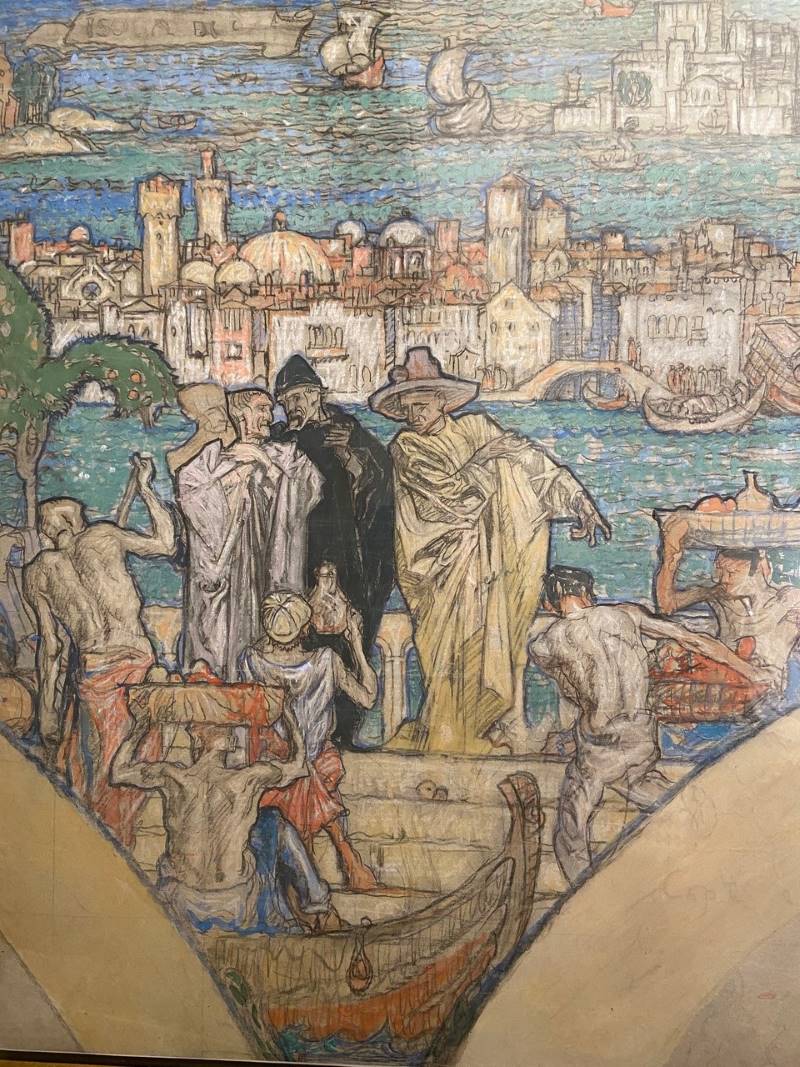
In the film you reveal that both Brangwyn and Orpen were hugely successful in every imaginable way; they had money, fame, were in constant demand…and then all that disappeared for them…
“One of the things that prompted me to do the film was that two of the painters I admired so much, who were once known internationally, are now totally forgotten.”
Do you remember when you first saw their work?
“It all started when I was in London in the ‘60s. I saw an exhibition at the Royal Academy of Art called Pictures from Provincial Collections. They brought to London a lot of pictures that were in regional galleries all over England. The picture that struck me the most was a Brangwyn. It was men digging up a road. It was one of the greatest things I had ever seen. I thought, who is this Brangwyn? I had never heard of him. I started to do a lot of searching around. There were a lot of books about Brangwyn up until about 1925, but after that nothing. So, then I started to get in touch with little galleries and they had a lot for sale for next to nothing. I have now about 15.”
How did you discover that there was a collection in country Australia?
“I was buying some Brangwyn drawings in England and the dealer told me that there was a great collection in a place called Mildura!”
Why did you finance and produce the film alone without the usual suspects – Galleries, Arts boards, Screen Australia, State film support, etc.?
“Well, no one had ever heard of either of them! But in fact, the idea for the film goes back years! I was going to do it with Barry Humphries. We were financed by the ABC. Then one day, I read in the Sydney Morning Herald it had been cancelled. I never got an explanation. Over the years, Barry tried to help me [raise money] through collectors. We moved onto other things. Years went by. Then the Covid thing happened, and I thought ‘bugger it, I’ll do that film. I’ll pay for it myself’. I wrote a script. I did a lot of research. That was a big job.”
What strikes you the most about Brangwyn and Orpen’s Art?
“I particularly like Brangwyn’s bold use of colour. His wide variety of subjects. His compositional flair is phenomenal, especially over a huge canvas, a very hard thing to do.
“With Orpen, there was more than just technical skill. He captured, as we say in the movie, the person that lives [behind the picture in the portrait.]”
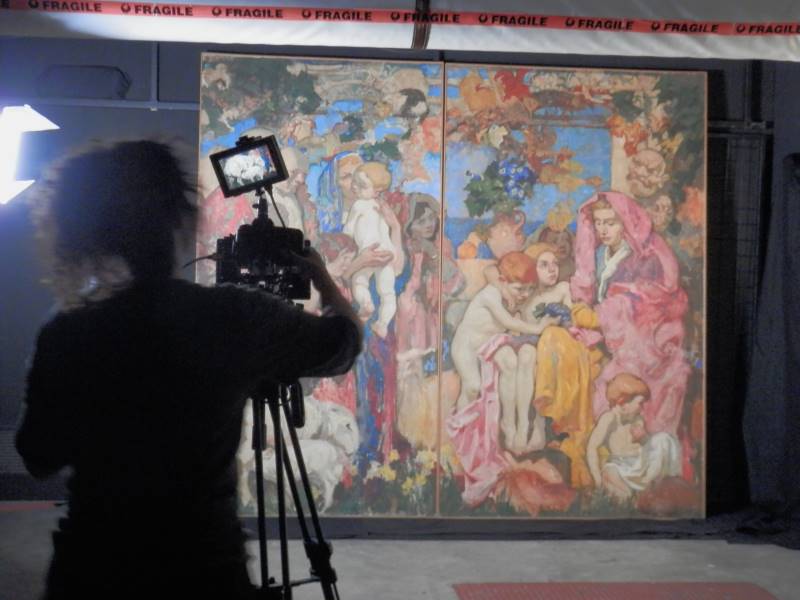
The film is very conventional and very entertaining; a voice-over delivers the facts, the history, and biography but there is very little editorialising in your narration. It’s all deceptively simple. And it’s very beautiful too.
“Cordelia [Beresford’s daughter] shot it and she has a very good eye. I didn’t want to quote the opinions of art critics – the only opinions are mine and there are a few quotes from contemporaries of the painters. Everyone like the Rockerfeller Center [in New York where Brangwyn’s work features] were very helpful and co-operative.”
The film is very witty, even irreverent. At one point you matte in these outrageously colourful murals of Branwyn’s that were, at one point, supposed to hang in the British House of Lords – and toggle the image between these and what the sober images that remain today. Brangwyn’s were rejected. But it illustrates just how they might have changed the atmosphere!
“[Laughs] Yes. Editor Mark Warner did a great job. They were the murals that one critic called ‘all tits and fruit!’ [Laughs]. I wanted the film to be accessible and for the paintings [to speak for themselves]. They are extraordinary and today they hang is this great hall in Swansea, which we see. The film is only thirty minutes, a very tricky length to sell, I might add, but it says all I want to say. To make it longer, it would have had to have shoots in England and America. I didn’t have the finance for that.”
You’ve said paintings are important in planning a film.
“Yes! I remember when we were preparing Driving Miss Daisy, cinematographer Peter James and I went to galleries in the States to look at how the American painters used light. I always thought interiors in movies were overlit. We studied how painters used light through windows as [a dramatic source] for their subjects and Peter ended up lighting Miss Daisy from outside the window! It looked incredibly beautiful, and I thought he would walk away with an Oscar. But he wasn’t even nominated.
“On Breaker Morant we had an ‘unlit’ look.”
Breaker is very painterly in its compositions. The images seem very organised to produce certain dramatic effects in emphasis and tension.
“Yes. I think that’s very true. I’m very involved in every aspect of any film. I’m always surprised when directing [is reduced] by camera people saying it’s about the actors. I select the lenses. I storyboard. You have to control everything, otherwise it doesn’t work.”
The big and important theme in the film is about the way Artists are as subjects to fashion the same way as popular Artists.
“Yes! I mean Caravaggio was scorned for years. I remember going to see Andrew Lloyd Webber and talking to him about a project and visiting his home and he had this superb painting by Sir Edward Coley Burne-Jones (famous for his stain-glass Art). Lloyd-Webber told me he bought it in a junk shop after borrowing 50 pounds when he was fifteen years old [in the early ‘60s). It’s now worth millions!”
