


By Liam Heitmann-Ryce
Australia, both as country and concept, is something of a paradox. An enormous sunburnt landmass dumped at the bottom of the planet, a million miles from anything else, one would be forgiven for presuming the disconnected nature of its inhabitants. Yet this big red rock has housed some of the finest writers, musicians and artists in the English-speaking world, many of them well-regarded for their collaborations and joint ventures.
The big, lonely landmass, then, understands the meaning of that old adage “no man is an island.” Composer Bryony Marks shares that belief, having worked on projects spearheaded by Australia’s best-loved and most highly acclaimed authors. With 2011’s Cloudstreet (adapted from the applauded novel by Tim Winton, an icon of Australian letters) and the ABC miniseries Barracuda (from the book by Christos Tsiolkas) listed among her composer credits, Bryony has flawless taste in picking projects. “I am drawn to projects which move me,” she says, “and which speak to the human condition in all its crazy glory. There’s no one subject, genre, sub or dominant culture that particularly resonates for me. My favourite projects have shared an element of authenticity, of honesty, expressed in manifold ways.”
Bryony Marks is also an artist whose work holds a very special place in my own heart and head. I was 20-years-old when I first saw the small-screen adaptation of Barracuda broadcast on UK television while in my second year of uni. Much of Marks’ score is driven by propulsive guitar strumming and more experimental ambience, offering a musical embodiment of our young protagonist’s triumphs, failures and incendiary inner turmoil. Charting the powerful determination of gay swimmer Danny Kelly, the working-class child of Greek immigrants, as he navigates the latent homophobia and racism of an elitist sports academy in late-90s Melbourne, Barracuda deals with complex themes that the atmosphere of Marks’ music allows the audience to better understand. The small cue that leapt out at me in the second episode, “In the Pool”, really set the tone for just how prominently her music would serve as an emotional aid to this series: a minute-long sparkle of piano and guitar, it patters across a stunning lateral tracking shot of Danny flying over the length of a swimming pool.
Marks had read Tsiolkas’s 2013 novel before she was approached to score its adaptation. “What a visceral, frightening, complex, brilliant read it was,” she recalls. “In part a coming-out and coming-of-age story, with Danny’s richly drawn Greek/Irish family life in contrast to the frigid Anglo restraint of the Eastern Suburbs boys. It was mesmerising.” Straying from the narrative of the book, neglecting Danny’s adulthood for a four-year period of his adolescence in the run-up to the Sydney 2000 Olympics, the series handles Danny’s troubling homosexuality with more suggestive deft than the shocking slap of Tsiolkas’s original prose. An astounding array of feelings pass unspoken, with many of the series’ standout moments presented in silent closeups or the pointed use of slow motion. The image of Danny playfully wrestling his aloof, wealthy new classmate into a swimming pool – and holding him in an underwater embrace as they slowly sink to the bottom – has forever been impressed into my memory. The programme’s approach to societal divides of wealth, class, and sexuality at the dawn of the millennium is remarkably poignant, and remains one of my most influential viewing experiences as a young adult.

Unsurprisingly, Marks “jumped at the chance to work on this material with such a talented team – exceptional producers Tony Ayres and Amanda Higgs; and director Robert Connolly, who is rigorous, passionate, highly creative and communicative.” A textbook example of Marks’ affinity for collaboration, she reflects fondly on how Connolly “extended me and challenged me, particularly in the long musical sequences composed for the swimming races. Everyone I worked with on Barracuda stridently wanted to honour the book, in much the same way that the cast and crew felt on the earlier adaptation of Tim Winton’s much-loved Cloudstreet. It’s hugely exciting,” she says, “and a little terrifying for all involved.”
Another major credit in Bryony’s body of work is long-running “dramedy” Please Like Me, created, written by, and starring gay Australian comedian Josh Thomas. Following a fictionalised version of himself, the show delves into everything from suicide attempts, homophobia, family relationships, and the funny, messy process of finding one’s place in the world. What ultimately drew Marks to the recording studio was the prospect of working with one of her favourite, long-standing collaborators – and indeed her husband – the show’s regular director Matthew Saville, who has also helmed films like Noise, A Month Of Sundays and Felony.
The husband-and-wife duo have worked on numerous projects together (Marks scored all of Saville’s aforementioned films), and Marks’ eagerness to work on Please Like Me was further heightened by her admiration for the show’s creator. “Josh is one of the most honest people I know,” she tells FilmInk. “Please Like Me’s hilarious and devastating take on coming out, learning how to live as an openly gay man – as well as its portrayal of struggles with mental health – as juxtaposed with the banalities and oddities of its characters’ domestic lives, was quite extraordinary to score.”
Such was the strength of their creative partnership that Bryony and Josh united once again for his new American show Everything’s Gonna Be Okay, “which has been fantastic to work on as well. Many people want safe scores that deliver a literal reinforcement of the action or emotion of each scene, but because Josh trusts me, I’m able to experiment.” This is an arrangement that has allowed her, as she puts it, “to play like a kid in a sandpit – which, as you can imagine, is quite joyous.”
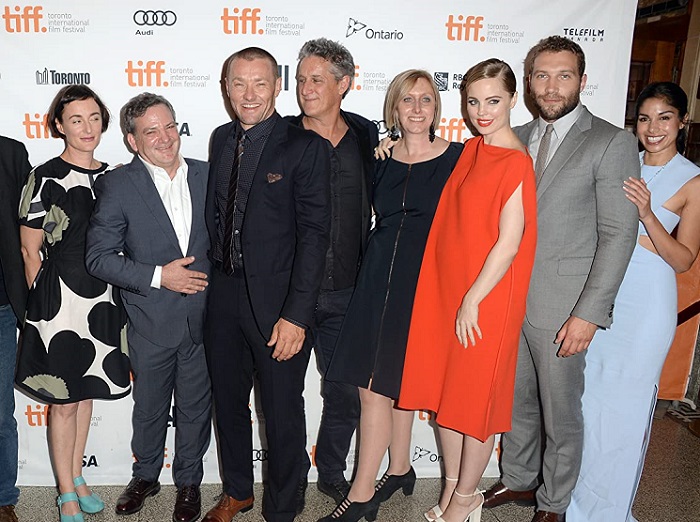
A chance encounter with the Australian-German independent production Berlin Syndrome, which was broadcast on TV the night before I had an interview for a job in Germany, was another major bridge to Marks’ music. Few other moments in film have brought as many tears to my eyes as the closing minutes of Berlin Syndrome, as scored by Bryony’s achingly beautiful piece for string quartet “Out”.
The point at which Marks is now, as a commercial composer, is one that she considers to have been “a dream run”, particularly given her minority status as a woman in a predominantly male-driven industry. Marks is keen to underline how clearly she recognises her own privilege as a “tertiary-educated, able-bodied woman,” and, unlike many of her female colleagues, does not “feel as if my career has been negatively impacted in any way by dint of my gender. Not only have I had plenty of work so far, but I’ve also been fortunate enough to enjoy creatively fulfilling work alongside exceptional collaborators.”

Above all else, Marks recognises her privilege and feels that she is lucky to be where she is. As a citizen of that big red rock a million miles from the rest of the world, Marks recognises the need for partnership and exposure, and is a keen advocate for platforming other experiences. “I’m so heartened,” she says, “by the initiatives in Australia aimed at diversifying and expanding the very limited pool from which talent has been traditionally sourced.”
She is proud to be a part of this change to the status quo, as a component in the presentation of media that portrays experiences beyond that of the “white, hetero, middle-class” majority. Having created the soundscape of Australia’s two most high-profile queer television shows of the past decade, she is a keen supporter of minority voices, “working with great people, who happen to be gay, on fantastic, meaningful stories.”
As a gay viewer myself, this is certainly the basis of my connection with Bryony’s music. She is the sound of stories that are not always told, and need to be heard. At the end of the day, she feels simply grateful to have been given such exceptional opportunities within an especially fickle industry. “It wasn’t until I was 33, and pregnant with my first child, that I started working professionally, and I haven’t stopped since. Music allows me to contribute to the world in a way that I find meaningful, and this is the greatest privilege of all.”
It is a craft that she is still learning, and she doesn’t believe that she will stop learning. Between her own identity and the music that she makes, “there is no separation, and that’s the way I like it: it’s all just living a life.” And what a generous, evocative, sensational life it is. May I be forever thankful for all that it has given my open ears.
Liam Heitmann-Ryce is a writer and TEDx speaker based in the UK.
Main image courtesy of Norman Parkhill, inSync Music
