


By Karl Rozemeyer
It’s late afternoon in Bulawayo, the second largest city in Zimbabwe. Damien Mander has just pulled over his vehicle and opened up his laptop. “I’m just starting to field a bunch of inquiries and getting really positive messages of outreach,” he says. “It’s a really big day for the programme and the organisation. It’s been a long road. It’s great that these women are getting the voice that they deserve.”
The programme is Akashinga, meaning “brave ones” in the Shona language. It’s a radical new approach to conservation management that empowers a crack unit of armed women-only rangers to combat anti-poaching groups in Zimbabwe. Abused and marginalised women are carefully selected and trained. And through protecting local animal wildlife, each ranger transforms her life and, in turn, uplifts her community.
The organisation is the International Anti-Poaching Foundation, founded by Mander, a former Australian special forces soldier and anti-poaching advocate and activist.
And it’s “a big day” because today, August 14, is the premier of Akashinga: The Brave Ones, a short film executive produced by three-time Academy Award winner James Cameron that highlights the work of this unique team of rangers.
The long road that brought Mander to this point began decades earlier. After starting his career as an Australian Royal Navy Clearance Diver, Mander then worked as a special operations sniper in an elite counter-terrorism unit in the Australian Defense Force. At 27, he entered the private sector as a project manager at the Iraq Special Police Training Academy. “I joined the military for adventure,” he muses. “I went to Iraq to make money. I came to Africa looking for a fight, not a cause. It was supposed to be a six-month thing over here, really for my own gratification.”
As part of the military apparatus in Iraq, “looking after resources on the ground” and “fighting the arguments of old men,” he had everything he wanted or needed, backed by a $600 billion-a-year annual U.S. defense budget. When Mander arrived in Southern Africa he witnessed wildlife rangers “protecting the heart and lungs of the planet” with extremely limited – “fuck-all” is his adjective – resources and spending up to eleven months of the year away from their families. He realised that his endless search for his next adventure was selfish.
He admits that as a former hunter, he had been a person who didn’t care much for Nature, who had little respect for animals, and had little awareness about how the biodiversity of the planet “fits together.” Nature, he notes, has had billions of years to evolve. By contrast, “we as humans have a single lifetime, seventy or eighty years, to cut away the bits that don’t work and keep the bits that do and try and grow and learn from your mistakes and move forward. I wanted to do something constructive.”
While he describes his commitment to conservation as an evolution, there were traumatic catalyst moments along the way. Mander recalls his first sighting of an elephant with its face severed off. “Something that is as big as a truck, killed for something that you can hold in one hand,” he says, “because someone on the other side of the world wants to put it on their desk.” There were other breaking points that would alter the course of his life. He recollects coming across a buffalo caught in a snare near Zimbabwe’s Victoria Falls. The animal had to be euthanised. “It had ripped its pelvis trying to get out of the wire snare. She started to give birth to a stillborn calf when we began to euthanise her. It’s a fucking animal that doesn’t understand what’s going on and it’s just trying to…” Mander trails off briefly before adding dryly: ‘Humans want bigger houses and faster cars, fancier suits, more money. Animals just want one thing: they want to live. And we as a species continuously take that away from them.”
Having made “quite a bit of money from a soldier’s standpoint,” Mander cashed in on his residential property investments in Australia and founded the International Anti-Poaching Foundation and set about launching ranger training programmes in Zimbabwe and Mozambique. Then in 2012, investigative journalist Rafael Epstein reported on a secret group of Australian Special Forces operating as spies in Zimbabwe. Mander was not in Zimbabwe at the time. “I was asked by Central Intelligence and Army intelligence to come back (to Australia) and to answer questions in relation to espionage,” he recalls. “I had just finished investing my life savings into the country and it took me two-and-a-half years to clear my name and get back into Zimbabwe.”
Despite the espionage accusations, Mander returned to Zimbabwe. The decision may seem surprising to some. “Look, honestly, I love Zimbabwe. I love the people. It’s wild and it’s beautiful and it needed the work.” He points out that with so many conservation organisations jostling for projects, public attention and funding, wildlife philanthropy can be a cutthroat enterprise in which the plight of many countries is overlooked.
Also, Mander wanted to improve how wildlife rangers operated. In fighting to save threated rhinoceros populations in Mozambique, he learned an important lesson. “While we were very effective at what we did, we were spending a million dollars a year to have a war with the local population.” He began to realise the drawbacks of what he terms “fortress conservation,” which he describes as “putting up bigger fences and more guns to try and protect areas on a continent that the UN population census says will have two billion people by 2040.” The key to change, he believes, is to be found in the local population. “I always knew that it would be the people of this continent that determine the future of conservation, and not bigger fences and militarised conservation.”
Not only in combat as a soldier but even in peacetime, Mander had never worked with a woman. “The units that I was part of were the all-male units. These are the ultimate boys’ clubs. You cannot pay an entrance fee. There is only one way to get in and I suppose for the reason of ego, we wanted to keep it that way.” In Africa, it became increasingly obvious to Mander that conservation was wholly dominated on the frontlines by males. “There were other programs that included women, but (women) weren’t given access to all the roles,” he notes. Then in 2017 he read an article with a link to a 2015 feature on the US Army Rangers training and preparing women for full deployment. Almost a decade to the month before reading that article, Mander had been on a mission in northern Baghdad during which his convoy was hit. A couple of people at the checkpoint were killed and his team was quickly surrounded. US Army Rangers came in and saved them. “So, I was reading that article and thinking that if the unit that was good and gracious enough to save my life a decade earlier is now training women for frontline roles, let’s try with women rangers. Not army rangers but wildlife rangers.”
Mander determined to design a programme for women that would not simply serve as a fundraising photo op. It was to be a programme “with zero concessions.” Akashinga was launched with 16 women. Victims of sexual abuse, domestic violence, Aids orphans, single mothers or wives who had been abandoned, all the women were aged 18 to 35 and were recruited from surrounding villages. “In fact, we put them through more than what we put the men through because in the eyes of everybody, they had more to prove,” Mander says. “Also, when I first arrived in Zimbabwe in 2009, it had the lowest life expectancy in the world for a woman. It was 34 years of age. That has improved marginally since then.” By selecting from the most in need, he adds, “we didn’t realise we were going to get the toughest.”
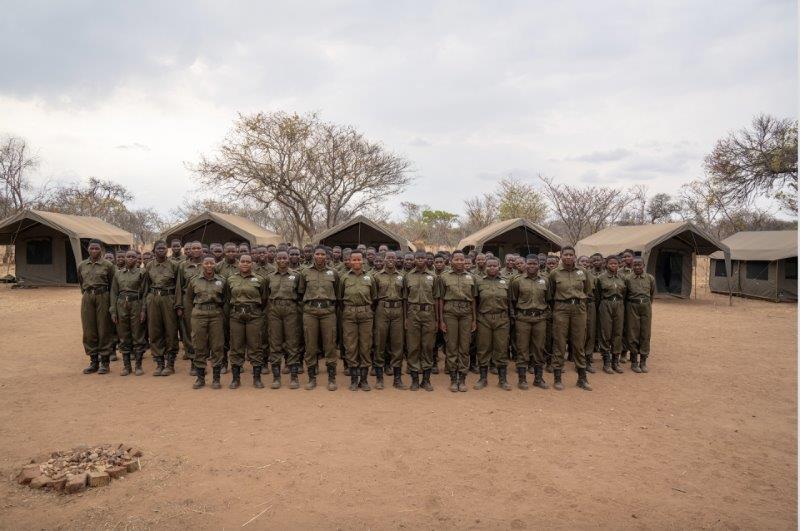
The Akashinga programme has since expanded in numbers. Applicants undergo a pre-selection interview, basic fitness and aptitude testing, before moving onto a 72-hour selection process. In the last election cycle, 80 were chosen from a group of 500. Not all complete the training. For Mander, the two essential criteria are spirit and character. “The rest can be trained, provided that they are fit and healthy,” he observes.
While the women are prepared for combat against poachers, Mander has been struck by how effective these teams of women are at de-escalating tension. “Out of the over 200 arrests that they have made, there has only been shots fired once,” he notes. Mander believes that carrying guns must be viewed as a tool of last resort. “I wish they didn’t have to carry them, but it’s the world that we have created. If you look at some contexts within law enforcement, [carrying a gun] becomes a cloak to do unethical things and a layer of protection for people to exercise their egos,” he says.
“The women seemed more focused on trying to build community relations and supporting their family and having harmonious relationships in the communities that they were raised in,” he continues. “We’ve come to realise that there’s something much more valuable in law enforcement than biceps and bullets – and that is having these relationships, having the community believe in what we do, not having a war with them. In a way, a small group of women in Zimbabwe have achieved what very few armies or police forces in history have done and that is win the hearts and minds of the community.”
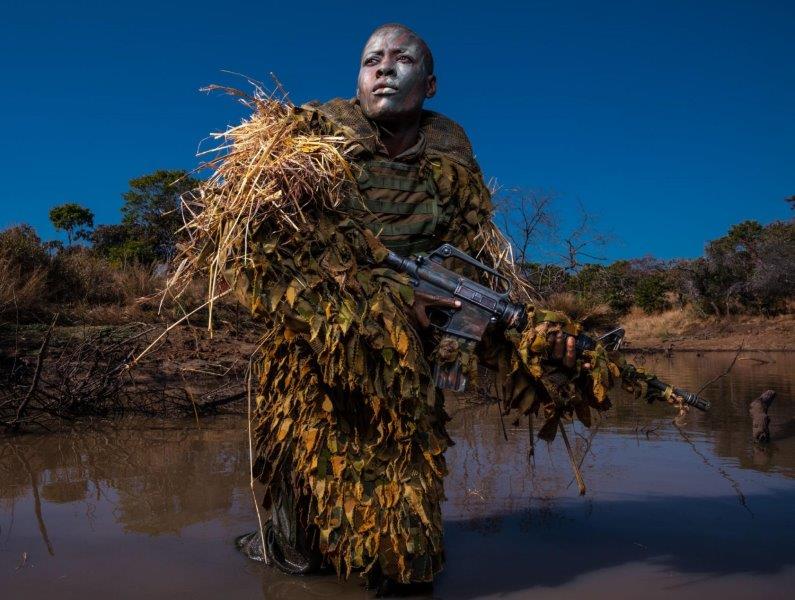
Mander also highlights that the Akashinga programme hasn’t experienced a single incidence of corruption in its three years of existence. This shifts the entire economics of conservation. In other models in Southern Africa, men are recruited from other parts of the country as rangers because men from the local community are more likely to collude with people that they have grown up with and provide information on where rangers are patrolling or the location of rhinoceroses or elephants. “If you can remove corruption from any equation here, you are already halfway home to achieving what it is you are trying to do. And so now, as we scale, we employ exclusively from within 20 km of our boundary. What it does is it puts [salaries], the largest line item in the budget, back into the community at a household level. So almost two-thirds of our expenditure operationally goes back into the community, and 80% of that is at a household level. Where a woman spends 90% of her salary on family and her community, a male spends 30 to 40%. So, it turns conservation funding into community development, which is women’s empowerment.”
Mander hopes to expand the Akashinga model. “At the moment, Akashinga is aiming for a thousand rangers under our own umbrella by 2025, and all the areas that we are acquiring are in partnership with local communities in long-term leases,” he says. The land in which they operate are former trophy hunting areas. Through activism, there has been a huge downturn in trophy hunting. Reduced wildlife populations as well as shifting policies that regulate the export and import of trophies like elephant ivory have resulted in former trophy hunting areas being left vacant. The International Anti-Poaching Foundation aims to acquire more and more of these areas as opposed to national parks. They have the same biodiversity as national parks but are of greater strategic importance because they border communities, allowing for development programmes that employ local women as rangers to be launched. “The longest contract that we have is for 45 years on a piece of land,” Mander says. “The way we look at it is we are protecting ecosystems. It’s not just about protecting the sexy ones – like the elephants and the rhinos – but it’s about preserving these ecosystems.”
Zimbabwe is now home for Mander. “I spend pre-COVID up to three or four months a year traveling internationally speaking on the National Geographic Speakers Bureau, lecturing around the world, creating awareness, meeting with donors and investors; but this is home. This is where our team is. We are expanding our programmes across the continent.” Now more than ever, he believes awareness of the importance of rangers should be highlighted: “Civilisation is being brought to its fucking knees by a small scaly anteater called a pangolin. There’s a lot of talk about shutting down wet markets – and stopping animals from getting there in the first place. So, not only on behalf of Nature but on behalf of Humanity as well, rangers are the first and last line of defense. So, I suppose the longer I get into this lifelong mission, the more it resonates with me how important it is.”
