


by Helen Barlow
The sounds of didgeridoo playing mixed with the sounds of the Arabic trombone greeted the Australian film contingent as they took to the stage in Marrakech for a tribute to Australian cinema.
Jury head Tilda Swinton introduced the throng, declaring that her mother was born in New South Wales and that she would be coming to Australia next year to make a film with George Miller (Ten Thousand Years of Longing?), the director of Mad Max which screened after the ceremony.
Pioneering director Gillian Armstrong spoke on behalf of the Australians, recalling how as an 18 year-old student she had gone to the cinema and been horrified to hear Australian voices on the big screen. “It sounded so odd, this is not a real movie. Movies have American voices. I’d never seen an Australian film,” she told the crowd. “Why? We weren’t making them and that was not so long ago. The US distributors had killed off our 1930s flourishing cinema industry at a time of change, the introduction of sound.
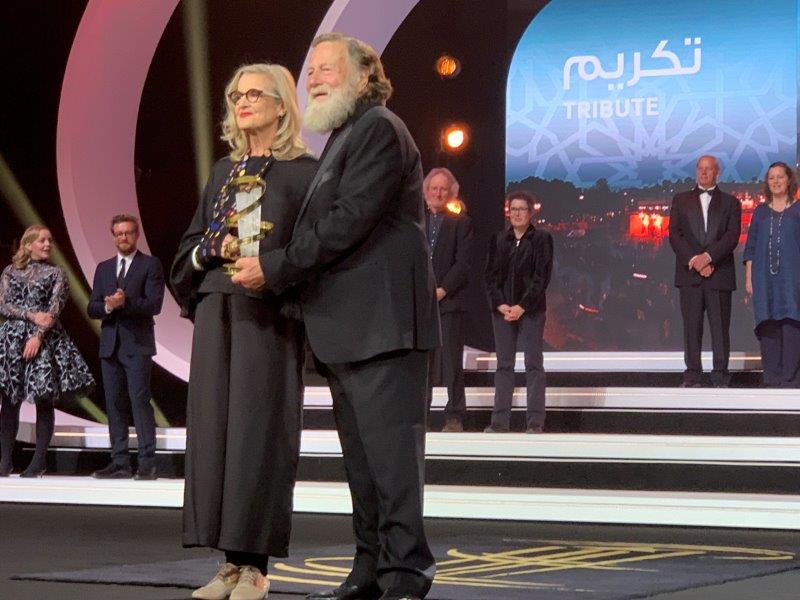
“In the 1970s, a passionate group of film culture lovers lobbied the government about the need to tell our own stories; yes in those rather ugly whiny Australian voices, but they are ours. This successful lobbying set up the Australian film industry and led to the Australian Film Commission, our national film school and the development, support and investment in production. This led to three of my all-time favourite films Picnic at Hanging Rock, The Devil’s Playground and Breaker Morant.”
She went on to commend the emergence of filmmakers and actors who went on to forge international careers, including women filmmakers like Samantha Lang and Shannon Murphy.
“Perhaps the biggest change are our powerful indigenous stories from the extraordinary Walkabout to Rabbit Proof Fence and Charlie’s Country. Now we have brilliant indigenous filmmakers, like Warwick Thornton and Rachel Perkins.”
She went on to talk about Australian filmmaking as it examines our identity as Australians. “What makes us unique is our often oblique language, our character, our diversity, our rather special humour and our outlook on life, having a go, a fair go. Let’s keep reminding everybody it means justice and fairness.”
She added how we aim to tell our own history, to tell about our heroes, our dark side and our own underdogs. “We love our losers and best of all we love to laugh at ourselves.”
