


By Ally Kornfeld
Becoming a professional comedy writer and producer in Hollywood is no joke. It’s a long competitive road, full of highs, lows, self-doubt, existential questioning, and attrition. Watching talented peers pivot their careers and move away is common and often leaves us questioning if we will one day do the same. Because the older we get, the more we realise success doesn’t necessarily make one happy, and that happiness is internal.
Here are some golden lessons that I think have contributed to my sense of resilience and peace of mind living and working as a writer-producer in Los Angeles.
The Subjectiveness of the Comedy
It’s been fascinating to observe just how subjective the world is to comedic work. I’ve produced sketches performed exactly the same on two separate nights where it killed on one night and bombed the next. Celebrated directors have either related to and heightened my work, or taken the exact same work and pointed it in a completely different direction that appeals more to their sensibilities. Which is to say, I’ve learned not to be precious with ideas and to make praise and criticism feel like more of an experimental outcome, rather than a reflection of my self-worth. Someone recently told me you can’t write to please everyone, just focus on the audience that get it. That’s how to build an audience.
Managing Emotions and Building Community
Surprisingly, concentrating on this has had the greatest effect on my ability to enjoy my successes and defeats and to keep grounded through the process. In Los Angeles, there is a culture of self-care, reflected in its healthy lifestyle choices and plethora of yoga studios. And emotional well-being seems to be culturally acceptable to talk about and get help with. Many of my peers have life coaches, career coaches, fitness coaches and therapists and as a result, get to see faster changes and progress where they may have been stuck. Building community has been key to managing emotions. It took me a long time to realise just how okay it is to reach out to others in the industry with a text – “does this idea work?” Or what do you think of this, or even just to vent. It’s okay to ask for support because it gives others permission to do the same. Writing around other writers has also helped, as it can be a solitary job, and having a friend tapping on a keyboard nearby can be incredibly motivating.
Creative Collaboration
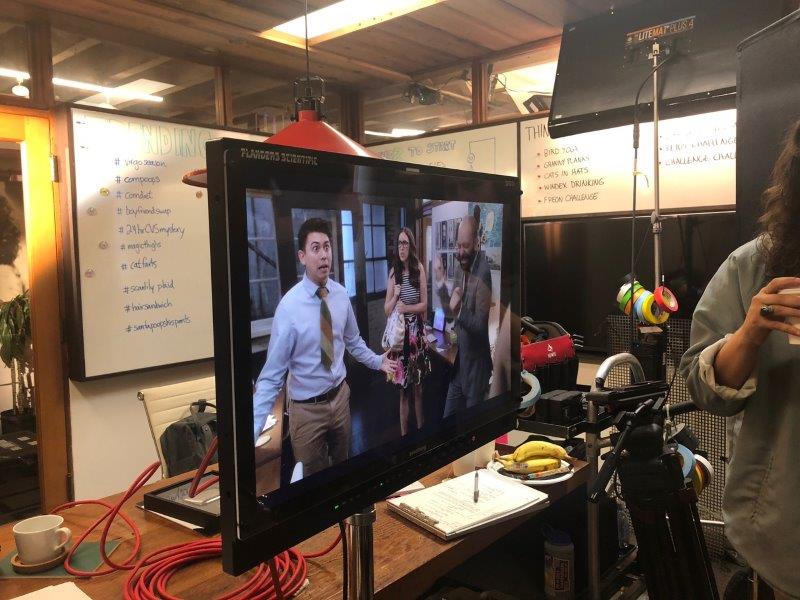
When showrunning my own projects, I’ve learned that it’s vital to make sure we’re all on the same page in terms of creative vision, tone and outcome, up front, so that we can all see when an idea is contributing towards or away from this goal. I love asking others what they think and how they would do things. It helps foster a collaborative environment for writers, crew, and post teams throughout the entire process. It’s also extremely rewarding to have a team of people elevating each other’s work and feeling ownership and pride in the finished product. That’s not to say that collaborating isn’t challenging at times, but if the vision is strong up top, and I trust the taste of those around me it’s easy to concede and make way for other ideas.
Reading a Writers Room
Reading an established writers room takes a lot of acceptance and observing of behaviour and patterns, that to certain brains can feel intuitive and others not so much. In a room full of comedy writers, where egos aren’t kept in check, and everyone is vying to contribute, it’s easy for an atmosphere of competitive dominance to develop, where one feels pressure to adapt to a dysfunctional communication style or stay silent. It takes a rare leader to rein this in, and I’ve learned that in show business, it’s luck of the draw as to how functional a room is, and even if it’s good, there’s no guarantee the output is. I always love asking what a showrunner expects in terms of contribution from people in the writers room. What I’m looking for are their values. If the big picture is to collaborate and serve the best possible story we can make, then I get excited, as rooms tend to be more democratic and the best ideas win. However, intention and practice can greatly differ. It’s always extremely helpful to be able to execute a showrunners’ vision if the vision is clear and communicated.
Networking
Networking is something that doesn’t come naturally to many writers and certainly not for many Australians. But in Hollywood and New York, reaching out to strangers and acquaintances to have coffee, or drinks or even a meal is perfectly acceptable and encouraged. People have spreadsheets of contacts to keep up with and make it a habit of checking in regularly. The goal is to develop relationships rather than getting something out of the meeting in the short term. Once I realised that most people already have a network of friends that they prefer to collaborate with and help before being open to working with a complete stranger, I understood that relationships are the real desired outcome. And this takes time and persistence and courage to build.
While this is by no means an exhausting list, and I plan to continue learning new lessons as long as I can continue to create, I hope it is useful to those forging a career in this field.
—-
Ally Kornfeld is a Staff Writer on TXT Stories for Facebook Watch, wrote on Warigami for CW Seed and is the Co-Creator of The Influencers [below],a new digital comedy series to be released later this year. Previously she wrote and produced sketch comedy for the Magnet Theater in New York City.