


By Grant Watson
Yesterday the Japanese film studio Nikkatsu confirmed the death of director Seijun Suzuki, following a prolonged battle with chronic obstructive pulmonary disease. He was 93.
Suzuki was the perfect specimen of a cult film director. He spent a long career directing distinctive and idiosyncratic feature films that, while failing to establish a large fan base at the time, have subsequently become popular among foreign film enthusiasts around the world. Quentin Tarantino is one prominent fan, drawing on Suzuki in the creation of many of his films – particularly Kill Bill (2003). Takeshi Kitano and Wong Kar-wai both extensively praised his works.
Today he is a widely feted and hugely influential film director. 45 years ago his inventive films earned him warnings from his studio, then angry recriminations and finally, in 1967, they cost him his job. Back in 2001 Suzuki laughed while telling Midnight Eye that ‘the best thing for a movie is to have a lot of people come to see it when it’s released. But back then my films weren’t so successful. Now, 30 years later, a lot of young people come to see my films. So either my films were too early or your generation came too late. Either way, the success is coming too late.’
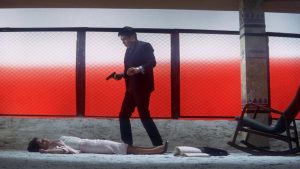
Seijun Suzuki started his career as an assistant director at the prestigious Shochiku film studio, but when he saw a faster track to directing than that studio’s onerous apprenticeship program he jumped ship to Nikkatsu. With 1950s Japanese cinema losing audiences to television, Nikkatsu had started to specialise in cheaply made and comparatively violent crime films. It was at this studio and in this genre that Suzuki established his reputation. With a tight schedule and low budgets, Suzuki enjoyed a creative freedom that directors of more expensive productions lacked. It led him to increasingly experiment with the content and tone of his films. He was extraordinarily prolific: between 1956 and 1967 he helmed 40 B-movies for the studio, including modern-day classics like Youth of the Beast (1963), Gate of Flesh (1964), A Tattooed Life (1965), Tokyo Drifter and Fighting Elegy (both 1966).
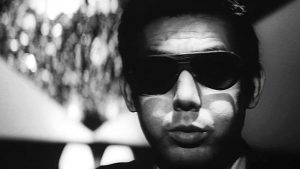
Suzuki pleased his bosses at Nikkatsu because he made films efficiently and cheaply. He had a strong working relationship with his actors, most notably the iconic Nikkatsu star Joe Shishido. At the same time, he frustrated those same bosses with his constant dives into bleak, absurdist humour and unusual shooting style. The increasingly experimental style of Suzuki’s films ultimately drew the ire of Nikkatsu’s chairman Kyusaku Hori. Following the commercial failure of his 1967 film Branded to Kill, he was summarily dismissed from the studio. When Suzuki successfully sued the studio for wrongful dismissal he found himself blacklisted from the entire industry. He did not direct another film until 1977. Ironically it is Branded to Kill that will remain his greatest legacy. It is a tremendous work of surrealist action, with an off-kilter plot and a striking pop art aesthetic, and has been cited as a major influence by directors as diverse as Park Chan-wook, Jim Jarmusch and John Woo.
Seijun Suzuki’s final film was Princess Raccoon (2005), a musical romance that premiered at the Cannes Film Festival. Respect and admiration did come for Suzuki in the end, but it certainly took the long way around. Today – and into the future – he is as necessary to an understanding of Japanese cinema as Kurosawa or Ozu, and as accomplished and distinctive a director as either of them.
