


By James Mottram
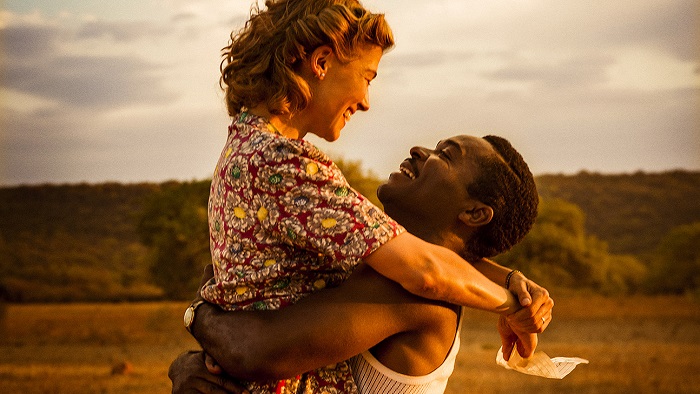
Though she’s been a Bond girl (in the sub-par Pierce Brosnan effort, Die Another Day) and in amongst the action in films like Wrath Of The Titans and Jack Reacher, British actress, Rosamund Pike, made her biggest splash in David Fincher’s hit literary adaptation, Gone Girl. As the snaky, duplicitous Amy Dunne, the previously demure Pike was a full-tilt knockout, surprising audiences with the wilful manner in which she attacked the role. Pike now takes a total left turn in the period drama, A United Kingdom. Initiated by British actor, David Oyelowo (Selma), and directed by African-heritage British female filmmaker, Amma Asante (Belle, Way Of Life) the film tells the true story of Prince Seretse Khama of Botswana, who caused an international stir when he married white Londoner, Ruth Williams, in the late 1940s. A warm, stoic, heroic woman faced with all manner of obstacles, the character of Ruth Williams offers Rosamund Pike another fine showcase for her considerable talents. FilmInk spoke with the actress at The London Film Festival.
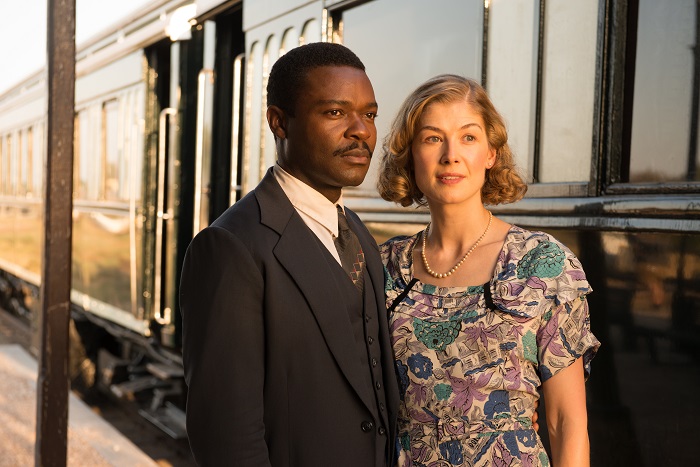
Your director on A United Kingdom, Amma Asante, said that a multiracial relationship is not that interesting in itself anymore… “Well, on film, it’s quite interesting to me, because when I was growing up, the idea of a black man falling in love with a white woman wasn’t depicted on my cinema screen. I don’t think there’s been a big love story – a big cinematic love story – since Guess Who’s Coming To Dinner, which was way before I was born [laughs] in the 60s. It may be not interesting for Amma Asante, because that’s her life. She’s married to a white man, and David Oyelowo is married to a white woman, but for me, it was a huge eye opener. Love is always heroic, but to love outside the box, as it were, is that bit more heroic, because it does present other difficulties. Even David has talked about him and his wife being subjected to racial abuse when they were first married, and him being shocked at the sudden eruption of anger that came out of his wife. Being on this film has opened my eyes to all kinds of things, and also to the obstacles in the way, to be blunt, of people of colour in our industry. David has said plenty of times that he can be offered the second lead, but the lead has to be white. The sidekick, the other guy, can be black. It’s just been very eye opening.”
Was that the main appeal for you? “The love story is what really drew me to the film. When David first wrote to me, he sent me this deck of photographs that were taken by Margaret Bourke-White for Life magazine. I knew that it was a love story, but I didn’t know anything else, and I saw these pictures, and these faces, and something touched me, really deeply. I saw the love in them, but also what it would cost them, to get to the point where those photographs were taken. That moved me so much. Love always makes you vulnerable, and that’s what attracts me to love stories. When they’re good, you can see people laid bare. Ruth was rejected by her family. Because everybody was doubting her, so she had to be certain. And the other thing that I’d never seen was the experience of a white person trying to belong, or craving to belong, in an all-black world. I’ve never seen that on screen. Ruth really wanted to be included, and she wanted to understand.”
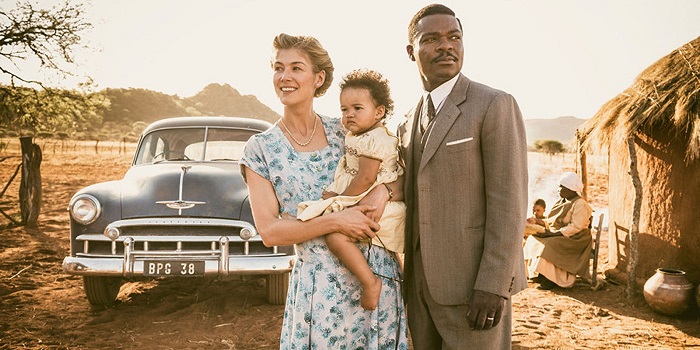
Is it tough to find roles like Ruth? Do you have to sieve through an awful lot of stuff? “I had never come across a role like Ruth. I was certain, when I read it, and I was then offered other things, and this is a low budget movie. The money’s on the screen, as opposed to other people’s salaries, which is often the other way around [Laughs]. But there was nothing that would have stopped me doing it. I would have moved everything around to do this film. If I’d not been able to do another film that year, I wanted to play this character. For some reason, she spoke to me very deeply, and I admired her hugely! And I just loved her certainty. Women can be very strong in support. It sounds terribly old-fashioned, but I believe that Ruth’s tremendous strength is through her unwavering support of Seretse. Her acts of love were the things that were heroic.”
Can you relate to her? The feeling of being an outsider? “That’s funny. I always feel like an outsider! People don’t believe me, but I do! I always feel like I’m on the outside of things. t’s just the actor in me. That’s just part of our dysfunction. I’m way more insecure than people would imagine. There’s an element of performance in just being here in the room with you. There’s a release in being someone else, and that’s clearly not normal! [Laughs] That’s clearly a dysfunction, because most people are perfectly happy being themselves, right? So that makes you an outsider, even if it’s not a particularly noticeable trait that people would pick up on.”
Are you always happy to take a break from acting? “Yeah, I like to go and just be very private. I’m not very at ease in social situations and parties. I’m not a socialite at all, and I always feel very uncomfortable. I’m fascinated by people who find that very easy, and I can do it when I’m promoting a film, but other than that…”
Did you always want to be an actor? “Yeah, since I was really small. I knew it, and I don’t quite know why, but I did. My parents were very musical [Rosamund is the only child of a classical violinist mother, Caroline Friend, and an opera singer father, Julian Pike], but music just wasn’t the way that I wanted to express myself. Because in music, you still have to be yourself, you see? If you’re performing, you’re still you! And I liked being other people. [Laughs]”
Is it difficult for you to find strong female characters? “Recently, I’ve found amazing characters, so I’ve been really fortunate, and I’ve had very profound experiences learning about different things.”

How much did Gone Girl change things for you? Did the scripts that were becoming available to you suddenly change? “It changed things a lot. I haven’t watched Gone Girl again since I first saw it, so it’s very hard for me to gauge what people see in it. I don’t know what people see in it, but I think maybe one of the things that they saw is a range. There’s quite a big range of emotions in that film. I even got fan letters saying, ‘I was so worried when you were cast. I thought you were way too sweet, but God was I wrong!’ [Laughs] That was nice. So maybe people felt that if I could do that, then they could test me in other ways, and that’s exciting! They’re going to say, ‘Well, if she could do all that, maybe she can do this, and that.’ It’s quite nice to be Ruth Khama, after Amy…Ruth is so different, and so steadfastly loyal.”
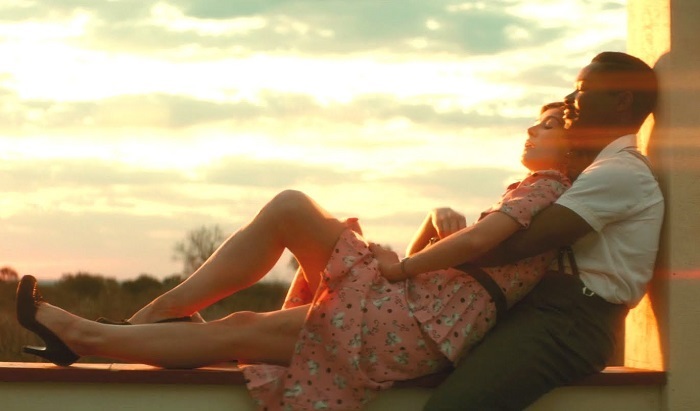
Did you try and push the envelope with the sex scenes in A United Kingdom? “Interesting question! Bold question. No, actually…Amma said, ‘You know, there’s so much carnality.’ She said that often when the black man is shown onscreen, he’s a sexual predator, and the sexual prowess of the black man is a fantasy for people, and she really wanted the love scene to be different. They would have been virgins, seeing each other for the first time. Amma was adamant that’s what she wanted it to be about. She wanted it to be about touch, and seeing, and intimacy. And she was certain. And then she just wanted to cut to the intimacy of waking up with someone, which is something that probably only a black woman would say and articulate, and put out there.”
Is it different being directed not just by a woman, but by a woman of colour? “Oh, yeah. Amma is a great bridge to a lot of it, because she’s English. She’s of Ghanaian descent, but she’s grown up in England, so it means there are bridges. She’s a woman, and she’s from London, so that’s what she and I have in common. Amma and David are both of African descent, but they’re both coming from London. The conversations about what it feels like to be a person of colour in our industry…I am out of that conversation, obviously. I’m trying to understand, and it’s opened my eyes. Have you ever watched [black comedian] Lenny Henry’s BAFTA Awards speeches? They’re brilliant. And he did one, and then he did another one ten years on, and he was like, ‘Not so much has changed as I wanted it to.’ He’s talked about Luther, the TV show, which has obviously been a great vehicle for Idris Elba. But Lenny Henry was like, ‘Okay, Luther is great! He’s leading a TV show, and he’s a black man, but he’s not got a black wife, he’s not got a black friend, and he doesn’t hang out with black people.’ [Laughs] As a white person, you don’t notice that. They’ve retrained my eyes…Amma has given me new eyes for sure, 100%.”
A United Kingdom is released in cinemas on December 26. Click through for our review, and for interviews with director, Amma Asante, and co-star, David Oyelowo.
