


By James Mottram
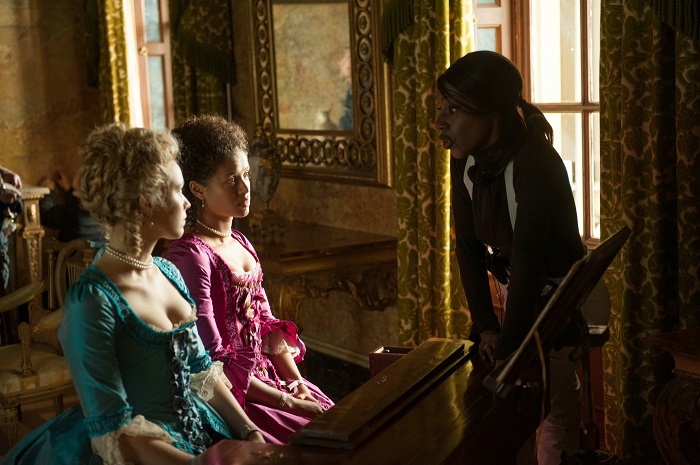
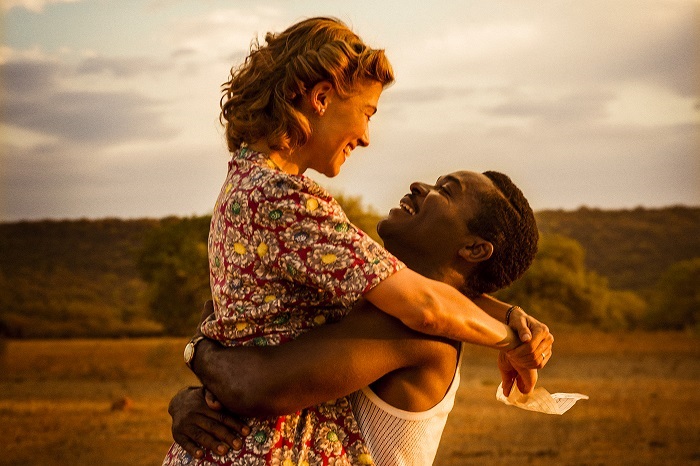
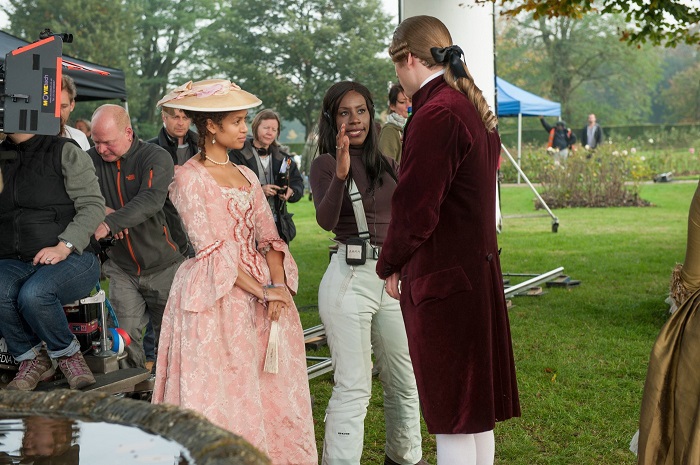
After making a splash with her gritty 2004 indie drama, A Way Of Life, and then scoring rave reviews for her 2013 period drama, Belle (the story of a mixed race woman raised in England’s high society), director, Amma Asante, now stretches even further with A United Kingdom. Another provocative drama floating on the issue of race, the film tells the true story of Prince Seretse Khama of Botswana (Selma’s David Oyelowo), who caused an international stir when he married white Londoner, Ruth Williams (Rosamund Pike), in the late 1940s. British-born, Holland-based Asante had never heard about the story, and the project was brought to her by David Oyelowo, with whom she’d worked many years before on a BBC TV production. “When David originally found the project, it was pre Selma, it was pre Gone Girl [Rosamund Pike’s big breakout film] and it was pre Belle,” Asante tells FilmInk at The London Film Festival. “So we three Brits hadn’t quite made the films that we were about to make, if you like, when he first found the book. So once these films happened, we were a natural trio to come together. Plus, with Belle, Selma, The Butler, and 12 Years A Slave, there was sort of some proof that surely you can tell stories with a black lead, and not have that be any barrier, to a general universal audience. It was good timing.”
How would you explain that this is such a little known story? It obviously had a big social and historical impact both on Botswana and The United Kingdom… “I think for few reasons. Firstly, history has been told usually from a male point of view, and usually a pretty white point of view, even in African schools, particularly when you’ve been a colony of the Empire, like my parents’ country of Ghana. Secondly, it’s the location. You have this big country right next door to Botswana – namely South Africa – which has its own huge journey, of race, and racism, and of course, Nelson Mandela. This tiny country next door has been lost in the stories of race, in the stories of independence, and in the stories of African heroes. And now that we’re at a point where we are putting more characters of colour at the centre of their own stories, and now that we’re at a point where we’re putting more directors and writers of colour behind the camera, who are looking for those stories, we’re able to start to tell the stories of our history, or the stories that we were previously told that nobody was interested in. But of course, we find that they are. It’s complex, but that’s one of the great things about the film.”
Your leading man, David Oyelowo, has just said that he’s getting very bored of talking about diversity… “We are exhausted with it. But at the same time, neither of us wants to be the exception that proves the rule. We don’t want to be the one that got through, and therefore people can say, ‘Oh well, Amma exists, David exists, therefore everything’s okay.’ It’s not okay yet. Things are getting better, but they’re not good at the moment, so of course while we are tired of talking about it, we have to, and we want to, because we hope that we’re at a point where, if we keep our foot on the pedal, if we keep up the momentum, if social media keeps on being as responsible with this subject matter as it has been, and galvanising conversation and opinion, may be this time, we can get over to the other side. If you look at the metaphor of crossing a river, we’ve kind of got halfway, and then we’ve had to go back. And in those times, we’ve become a fashion or fad. ‘Let’s do Africa. Let’s do black characters.’”
The British Film Institute have done this three-month season celebrating black filmmaking, which is great, but at the same time, it’s turning it into a “thing”, isn’t it? Wouldn’t it be a lot better if they just programmed black films all the way through the year, and it wasn’t a “thing”? “It would be, but if you’re trying to address an imbalance that already exists, how do you do it? Because that’s already happened. But let me say as a filmmaker, and as an audience member, there are names on that list that I hadn’t previously heard of, and I now know they existed. There were black filmmakers making movies in the 1920s and 1930s, and I’m going, ‘How could I, as a filmmaker, not have known about these particular characters?’ So, yes, it would be great if they were programming them through the year, but that hasn’t previously happened. Hopefully this will open a door, so that we can now consistently programme films like this through the year. I love going to The Curzon Cinema [in London] on a Sunday to watch an old movie and have dinner. Why can’t some of those movies be black? Or made through the gaze of a black filmmaker, or with a black person at the centre? Hopefully, this is the start of something, but we know that it’s not going to change overnight. But we want to know that it’s more than talk, and that the will is there, and that all of us in our respective positions are doing something to help push it forward. It’s audiences, it’s financiers…it comes from every direction.”
Do you think that social media is an important factor? “Yeah! Let’s take my first film, A Way Of Life, which I made twelve years ago. I honestly used to think, ‘Am I the only person who feels like this’? I used to feel quite lonely, and alone. What’s really wonderful now is, as an example, Julie Dash, who made Daughters Of The Dust, a film that I hugely admire, and a filmmaker that I hugely look up to, as a black female, will be there, on the red carpet tonight, as A United Kingdom screens at The London Film Festival, and where did I meet her? Twitter! Where was I able to engage in a conversation with her? Twitter. Where was Oprah first able to make a comment about my film, Belle? Twitter. It allows people to know that they’re not alone, and that other people think the same way as them. And for people who don’t think the same way, it allows a conversation, a debate, and a discussion.”
The whole “Oscars So White” campaign started on social media too… “And I wouldn’t be an Oscar member today without it, necessarily. That’s a structure that’s putting action behind words, but the Oscars reflect an industry that has to change. The Oscars can change, in the sense that, when films with people of colour attached to them are made, they need to be judged fairly, yes, but first those films have to be made, and it’s an industry that has to make those films. And it’s not moral. This isn’t about what’s moral, this is about box office as well. I’m desperate to go see more movies about women, or that involve women as more than the side chick, or that involve women as having a three-dimensional, multi-faceted journey, like the guy usually does. [Laughs] That’s what I’m desperate to see, and I’m desperate to see that in all kinds of stories with all sorts of ethnicities as well. When I made Belle about a black girl in 18th century England, I really hoped that you didn’t need to be a black girl, living in 18th century England, to identify with her. I hope that she was a universal character in many ways.”
So did Oprah get involved in Belle? Or was it more that she just saw it? “Oprah saw it, and then she was just a heavy supporter. She was very much behind it, and she had us over to her home for lunch, and threw a great big lunch, and really ensured that Entertainment Tonight were there to film that, which was great promotion for the film. Similarly, Prince saw the film, and then threw an after party for our London premiere. It was amazing! And then he played a three-hour set for us! But he heard about the film through social media. He heard about the film because people were talking about this period drama, that featured a woman of colour at its centre. When you’re making a film this size, and it’s an indie, you need those big powerhouses, to help promote the film. We need all the help that we can get, in many ways, and social media helps that a lot!”
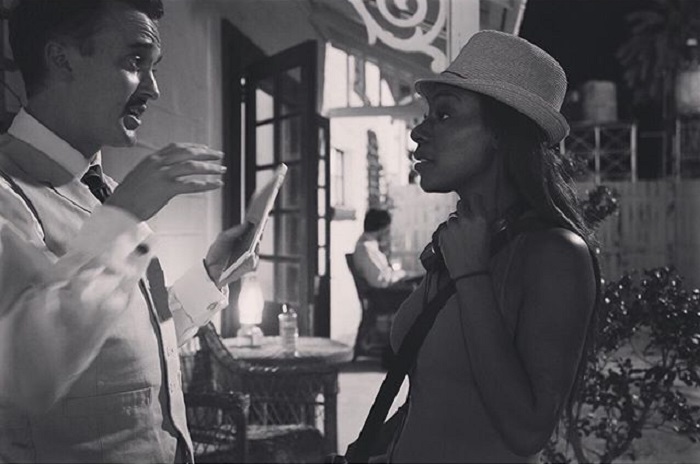
Do you think things have changed a lot since you made A Way of Life? “Yes.”
Do you think that your films will be easier to finance? “In all honesty, I really don’t know if it ever gets easier. The interesting thing actually, when you go to somewhere like Toronto, or the London Film Festival here, and you get to meet other directors, is that you sit down, and you talk to even white male directors who are making indie films, and of course, we discuss the difficulties. It’s difficult even for them! Nobody’s saying that they lie on their back and it comes to them easily. It just doesn’t! I’ve just had an incredible angel funder come onto my next film, and save it! I’m so grateful to that person, because it was a film that collapsed in 2009. Twelve years ago, I wouldn’t have had that, because I wouldn’t have had three films behind me, to prove myself. The fact that I am a black, female filmmaker, who can say today that she’s got three films behind her, says that something is shifting. But again, I don’t want to be the exception that proves the rule. It’s really going to shift when I can go, ‘Yes, look at this person, and that person, and that person’, as opposed to just myself and one other.”
A United Kingdom will be released on December 26.
