



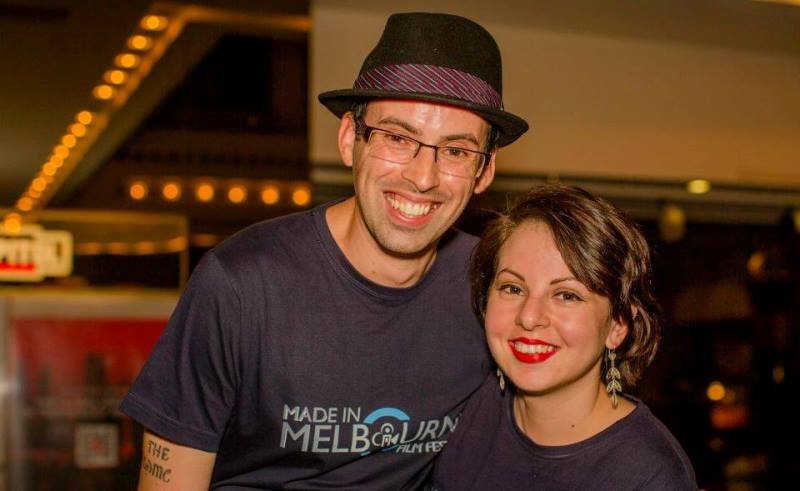
Ivan Malekin and Sarah Jayne
Correction: December 14, 2015
FilmInk would like to sincerely apologise for the use of the term, ‘police murder’, in this opinion piece by Ivan Malekin and Sarah Jayne. This should have been caught by our editorial team, and appropriately rephrased as a ‘police shooting’. We deeply regret any offence that this may have caused, and we certainly did not intend to defame anyone. We sincerely apologise for this editorial error, particualrly to the police officers involved in the incident, and anyone else that may have been upset or offended.
This opinion piece has been written in response to Emma Roberts’ piece published on December 8.
The Made In Melbourne Film Festival is the only festival exclusively for local filmmakers. The four-day 2015 event (Nov 26th to 29th) at Backlot Studios marked seven straight years for the festival, growing from a lone night of ten shorts in 2009 to showcase over fifty films in 2015, including features, high school films, and music videos in addition to shorts. MIM has screened at venues such as the majestic Astor Theatre, the Capitol Theatre, the funky BMW Edge, as well as various cinema bars around Melbourne, drawing crowds of 300+ to watch and engage with the best in Melbourne filmmaking.
MIM provides opportunities for filmmakers not only through the official festival program but by helping to organise a range of additional screenings for all entrants to the festival. We’ve collaborated with White Night Melbourne, Destination Docklands, put on programs from Berlin to regional Victoria, launched a best-of show on Channel 31, and are affiliated with the three longest running monthly film nights in Melbourne – Comfy Shorts, Final Cut, and West Side Shorts – providing additional screenings for independent filmmakers at these events throughout the year.
MIM has established itself as a volunteer-driven festival providing multiple opportunities for local filmmakers to screen their art.
We enjoy putting on a show for our audience and seeing the delight on the faces of local filmmakers as we showcase their work on the big screen. So to learn that one of our patrons, Emma Roberts, did not enjoy the 2015 program is disappointing. To learn she had such a problem with the program that she felt the need to attack us on Twitter and write to our sponsors urging them to abandon the festival is disheartening.
Emma Roberts was only at the Opening Night of the festival. She wasn’t happy. We were not aware of this at the time as she did not actually speak to any of the MIM team members running around in MIM t-shirts at the event – rather we woke up the next day to 11 tweets from her slamming the festival. Emma hasn’t called us to discuss her concerns nor bothered to email us.
She writes “in three of the nine films, a woman was brutally murdered (twice in a domestic setting); another film slut-shamed prostitutes for not adhering to patriarchal norms of ‘real love’” and in her view our bias against women is clear. But let’s take a closer look at the offending films:
Balloon Ride by Evan Hughes is a five minute animation about domestic violence told from the point of view of a child. The child clings to and connects with his long-suffering mother and cowers from his abusive father, dreaming of floating away with his mother and a red balloon to greener pastures free of violence and abuse. The tragedy is his dream is shattered when his father goes too far – a sad reality for thousands of families caught in the vicious trap of domestic abuse and a harrowing statement against gendered violence.
Some Kind of Beautiful by Rahul Prasad features another “absolutely unjustified and tasteless” scene of rape. There is actually only one scene of rape in the film and it goes for a total of two seconds. The film is about a young girl dealing with abuse from her stepfather, neglect from her mother, and bullying from her peers. It is actually inspired by a true story – the police shooting of 15-year-old old Tyler Cassidy – and is about looking beyond the surface to try and understand why somebody – someone’s child – could be in so much pain. So we are not sure why Emma would claim the rape scene is unjustified as the whole story stems from the young girl’s abuse from her stepfather.
Incidentally, Some Kind of Beautiful was produced by Rahul’s wife, Angela, and Annette Crockford, the actress playing the police constable, won Best Actor at our Opening Night. The film also previously won the jury award at the Lady Filmmakers Film Festival in Beverley Hills.
The third film, The Tallest Man by Alexander Moore, features an unhinged man having a dinner conversation with himself before a shocking twist reveals he has murdered his wife and her male lover. It is a dark but sublimely crafted and performed piece and hardly the first film to feature a jilted lover taking revenge. We wonder, if the roles were reversed, and a woman was the jilted lover taking revenge, would there still be an issue?
The ‘slut shaming’ film is Valentine’s Day by Matthew Victor Pastor, just recently awarded the ‘Best Director and New Voice’ award at this year’s Victorian College of the Arts Film awards. Being a Filipino-Australian filmmaker, the film is deeply personal for director Matthew, and is a sad story about love and suffering and the harsh reality of the sex industry in Asia. It actually stars Matthew’s wife Lisac Pham, who helped produce it, so we doubt she would agree if told her film does nothing but shame her.
We could go on. For every film Emma has a problem with, we can list why we believe it is deserving of its place in the program. But here is the crucial thing … film is subjective. Just because Emma Roberts didn’t enjoy the program doesn’t mean others didn’t. Just because Emma Roberts had a problem with the program doesn’t mean others did. In fact, apart from Emma and her select friends, the response to MIM 2015 has been overwhelmingly positive.
But yes, it is true all the directors on opening night were male. And only 20% of directors for the whole program were female. Emma has now manipulated the figure to claim only 8% of narrative films were by females as for some reason music videos and high school films (always one of our strongest sessions) no longer count. Had Emma stuck around to watch the music videos she would have found each tells a fictionalised story so is this not the definition of narrative? And what are the High School films if not narrative – videos of children running around playing tag on the playground?
Whatever the case, sadly, despite promoting to women’s film groups on social media, 20% is an accurate reflection of the percentage of female directors that entered MIM. Recently, Tropfest has come under fire for only having one female director in their Top 16. Like us, they claim it is a representation of the amount of entries they received. Tropfest must get close to or over a thousand entries so it is harder for them to count but we received 141 entries in total. It’s not a bad number. We are a small and exclusive festival which relies on word of mouth and social media to promote our submissions open – no point in us using tools like Withoutabox or FilmFreeway as we are only targeting Victorian filmmakers. But the low number makes it easy for us to count how many female filmmakers actually entered … 28. Emma’s concern has actually made us ask ourselves why the number is so low – we know many talented female filmmakers that for whatever reason didn’t enter – and we have already taken steps to address this in future and encourage more female filmmakers so we have more choice. But, in the end, we can only program the best films we actually receive.
But still we have been judged and labelled offensive and a ‘sexist film festival’. See Emma’s tweet below gloating about how she has financially ruined us.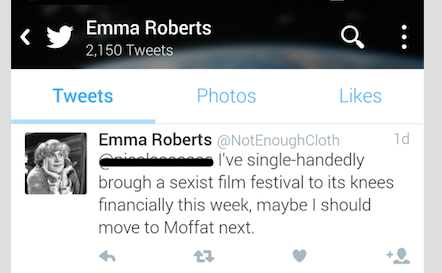
She has since deleted the tweet as it, perhaps, makes her look a little sanctimonious. Oh, to live in a universe where deleting something makes it all go away.
What many people don’t know about MIM is, despite having great help at the event (thank you volunteers) and a smattering of support from friends during the build-up, predominantly MIM is run by two people (Ivan Malekin and Sarah Jayne) in our spare time. We begin in January and take too much time away from our day jobs in peak periods like November at our own expense, rushing like mad to get everything ready from tech, to press, to prizes, to sponsors, to goodie bags, to promotion, to admin, to ticket sales, to our little Toyota Echo crammed so full of popcorn boxes that we can’t see out the back window as we drive to the venue … and we do it not because of any financial reward (there is none – MIM is a not-for-profit organisation – we regularly operate at a loss) but because we enjoy it. Much like making an independent film.
So to be attacked by a patron that identifies a problem, or believes they have, but rather than communicating and offering solutions to amend the problem, instead sets out to cripple the festival strikes us as being quite sad and selfish.
We are not going to apologise for doing the best we can. We don’t have time to respond to Emma’s tweets and debate her during the festival (it may be 2015 but we still don’t consider Twitter a courteous and professional form of communication) and when the festival is over for the year, perhaps, after working on MIM for so so long, we just want to go lay on a beach for a little while and read a good book and not have to think about MIM and film and critics. After all, “it’s better to create something that others criticise than to create nothing and criticise others.” (Ricky Gervais – hey look, Twitter comes in useful).
But here we are. Apparently Made In Melbourne is Made by Men?*
Ivan is fairly content to be labelled a man but Festival Coordinator Sarah Jayne is less enthusiastic about the label. Further evidence that Sarah Jayne is indeed a woman, she has organised two women’s only film nights recently, is a member of Women In Film and Television, and, together, Ivan and Sarah are currently producing Daughter, a film which deals with gendered violence and victim blaming and is funded by the City of Port Phillip.
One of our Opening Night judges was Sue Maslin, Patron of Women In Film and TV Victoria. Sue enjoyed the program, by the way.
Winner of Best Feature Film was Pretty Good Friends by Sophie Townsend.
Winner of Best High School Film, decided by the audience, was Women in the Media by Kayleigh Carmichael, a documentary that explores the role of women in the entertainment industry.
Winner of Closing Night Best Film was Go Fish by Kristin Skye Sargeant.
But we feel a little like somebody accused of racism pointing out how many black friends we have. The fact is, all the Opening Night films may have been directed by men, but we don’t actually program films based on what the director has between their legs. We simply program the best local films we have – stories with power, punch, humour, sadness, beauty, colour, love, life – and if people like Emma Roberts disagree with this impartial approach they are welcome to disagree. We program on merit (our opinion) alone. It may not be popular with everyone. But it is honest. And unbiased.
So despite Emma’s opinion, MIM 2015 was actually a great success. Sold out sessions, more awards and prizes, swanky new venue, more smiling filmmakers and patrons than ever before. We’ll be back in 2016. We’re planning even more nights and sessions. We will not only encourage female directors to enter, we’ll encourage all local filmmakers to enter. Like always.
And of course, Emma Roberts is welcome to enter too.
Ivan Malekin and Sarah Jayne (pictured) are Melbourne indie filmmakers from the film collective, Nexus Production Group. Individually, they have been involved in the local film industry since 2006, and collectively they have produced countless projects together, including various short film nights and, of course, the Made In Melbourne Film Festival.
*The title of the opinion piece was written by FilmInk, not Emma Roberts.

It’s disappointing that the festival doesn’t represent more female voices by selecting more female helmed content, not only films directed by women but those also produced by one.
Instead they would rather play ‘The Heckler’, a film that had not only already played throughout Melbourne but was already widely available on DVD throughout Australia in retail outlets a month before the festival took place.
I would like to applaud Ivan and Sarah for the festival and all the hardwork they do for independent filmmakers. For the record I think that Emma’s comments were ill informed and misplaced.
We were one of the filmmakers shown on the opening night. I am the producer of Some Kind of Beautiful mentioned in this article and Emma’s article, I am a female. Our two lead actors (females) Jana Gousmett & Annette Crockford, both attended the screening. At no stage after the screening did anyone of us hear from Emma and her concerns. The judges on the night including Sue Maslin, Paul O’Brian and Richard Sowada are some of the most respected and well-known in the film industry. They bestowed on our film the honour of Best Actor on the night and afterwards congratulated us on our film and it’s tough subject matter and our willingness to tackle it. At no stage in the days after or the weeks after did Emma contact any of us for a quote, comment or clarification. I thought good journalism was based on facts, not opinion pieces.
Our film was produced by a female. The two leads and one of the main supporting actors were females. Our production designer was a female. Our costume designer was a female. Our make-up artist was a female. Our colourist (colour grade for the film)? You guessed it, a female! We have made another film since. We actively chose to work with a female DoP and our 1st AD was a female. We are conscientious filmmakers and choose actively to work with young and upcoming talent (especially women).
To be attack individuals who program films that invite comment and feedback for lack of equality when in our case it is was clearly untrue is unwarranted. Instead it would be great to see people supporting, encouraging and informing independent filmmakers, independent cinema and a festival like Made in Melbourne that supports them rather than taking delight in single-handedly bringing a festival down! I have met the organisers of the Made in Melbourne film-festival myself on a few occasions. They are passionate about film, about giving local Melbourne films the opportunities that sometimes don’t exist elsewhere. They are wonderful, professional, passionate and hard-working individuals who don’t stand to gain very much in giving their heart and soul to this venture. For that, they should be applauded and supported and encouraged, not publicly shamed.
We will continue to make films that challenge and create healthy debate about burning issues in our community, which for the record is incredibly hard work. We are grateful that there are still people and film festivals that are prepared to support local talent when many of the big festivals don’t.
Festival programmers need to understand that treating every gender equally does not achieve equality because men and women do not start on an equal playing field. Festivals have a responsibility to target women and create opportunities for women in order to counteract the unconscious bias toward men in the industry.
Emma Roberts may just be one patron but her voice represents millions of women who have been stereotyped, misrepresented and ignored for too long. We need to keep pushing for positive action and ensure that all women (especially trans and women of colour) feel safe and included in the conversation.
Gotta disagree with you there Nina.. by selecting films based on any criteria other than the merit of the films alone, festival programmers do a disservice to their audience and their participants.
I’d hate to think that something I’d worked so hard on had ‘made the cut’ not because it was an awesome piece of work, but because of some physical trait I happen to have that not many others in my field do. That’s condescending at best – it says to the world “female filmmakers aren’t as good as men, so lets mark them differently.” How on earth could that be seen as the right step for gender equality.
To Sarah & Ivan, if you happen to read this – don’t let a little negativity get you guys down. This is just an unfortunate example of strong feminist women and their allies getting caught in the crossfire of other (I hope well-meaning but ultimately) misguided feminists. Your actions speak far louder than Ms Roberts words.
I work with a lot of different filmmakers. Some of them have lady-bits and some have boy-bits. Neither bits seem to get waved around on set, so usually everyone just treats each other like fellow human beings and gets on with the job of, you know, making movies! :)
Hey Dave, all good, you’ve just misunderstood my comment. I said festivals should target women (i.e. encourage women to apply for the festival) and create opportunities for women (i.e. mentorships, support networks) which will give them the chance for their work to be seen by judges. The problem has never been that women aren’t talented enough to win prizes, it’s that they generally aren’t given as many opportunities or as much encouragement as their male counterparts. I don’t think anyone has ever suggested women should win best film prizes simply because they identify as female. Thanks for your positivity and for trying to be an ally to women in the industry.