



by Nataliia Serebriakova
Worth: $18.00
FilmInk rates movies out of $20 — the score indicates the amount we believe a ticket to the movie to be worth
Tallinn Black Nights Film Festival
Cast:
Gabija Bargailaitė, Dainius Gavenonis
Intro:
… one of the year’s most significant debuts and, more broadly, one of its most compelling films …
Maria, a young sex worker, dances on a pole in a Vilnius nightclub with an expression of almost complete detachment. In a brief exchange with a client, she explains that her job is to fulfil men’s hidden fantasies. Asked about her family, she mentions that her mother has recently died and that she never really knew her father, who left when she was very young. Maria has a five-year-old daughter, now living with her maternal aunt. Maria’s age, night shifts and precarious circumstances make it difficult for her to care for the child. She shares a cramped apartment with other tenants, her own corner barely more than a mattress on the floor.
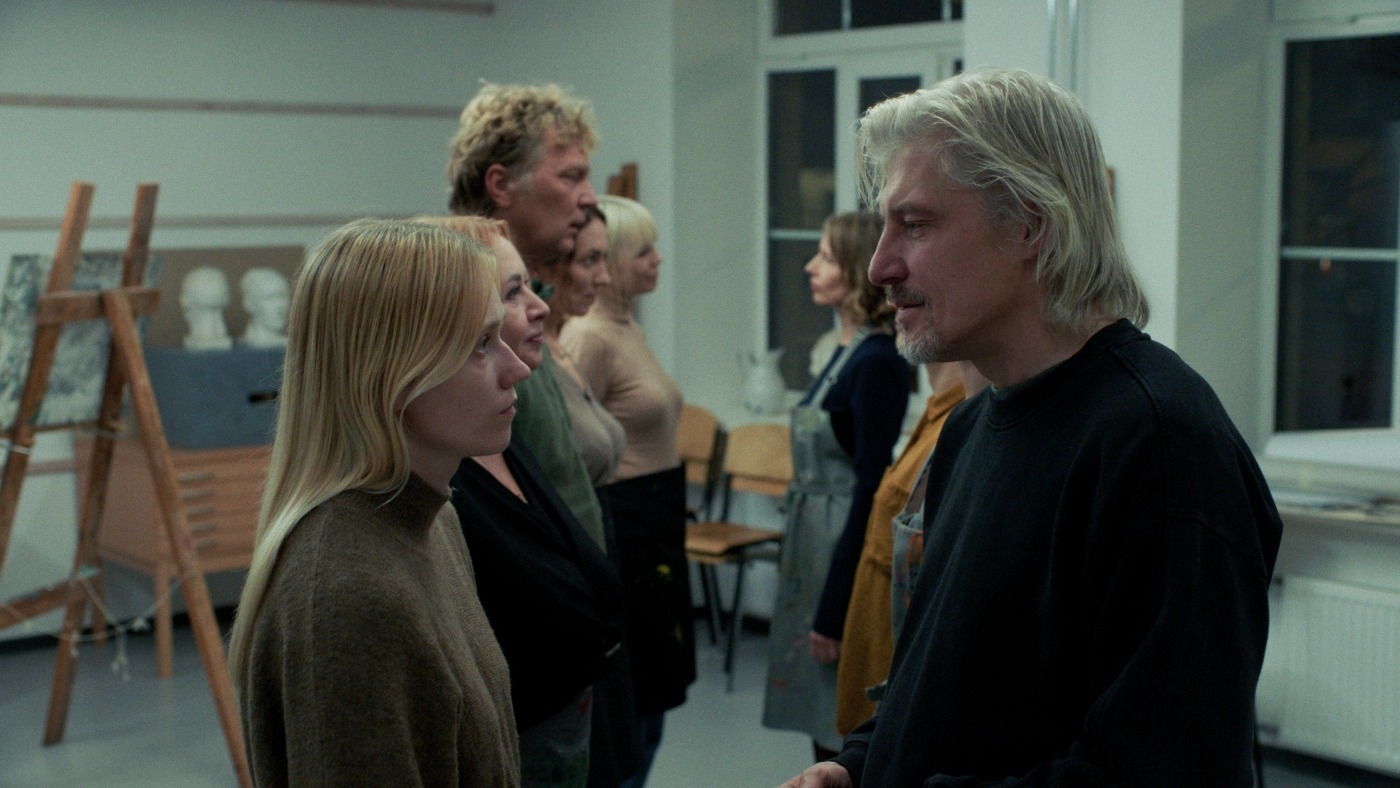
During a visit to her mother’s grave, Maria notices fresh flowers that someone has left there. Could they have been brought by the father she never knew? The possibility sets her on an unexpected search. She eventually discovers a cultured, reserved artist who teaches painting. Rather than introduce herself as his daughter, Maria begins a strange kind of courtship, approaching him almost as if he were one of the mysterious men she encounters at the club. Their meetings take them through the nocturnal city: they drink vodka in a bar, despite his history of alcoholism and sobriety, ride bicycles and visit a secluded spot hidden in one of Vilnius’s courtyards. Maria never tells him who she is. Instead, she watches him closely, trying to work out whether he has recognised her.
In Oblivion, which screened in Tallinn Black Nights’ first feature competition (it got the Jury`s special prize), Danielius Minkevičius connects two stories: a young woman struggling to establish an emotional bond with her daughter and an absent father, and a man whose past has left its mark on a family that he seems to have abandoned. What begins as a search for a missing parent gradually becomes an unsettling exploration of intimacy, inherited trauma and the desire to be acknowledged. Maria’s journey is not so much an investigation into her father’s identity as an attempt to discover whether a relationship can exist before the truth is spoken.
The film’s structure has the unpredictability of an urban road movie. Its episodes feel at once spontaneous and carefully observed, taking Maria through unfamiliar corners of the city and into an increasingly ambiguous relationship. Minkevičius resists the obvious dramatic destination.
The visual approach reinforces this sense of emotional suspension. The cinematography captures Vilnius as a city of nocturnal interiors, quiet streets and hidden courtyards, creating a setting that feels both familiar and strangely elusive. The camera observes Maria without turning her into an object of spectacle, allowing her physical presence and emotional distance to coexist. The production design is particularly attentive to the environments people inhabit: the cramped shared apartment, the nightclub and the artist’s world each reveal something about their occupants without spelling it out. Even seemingly incidental details acquire a symbolic weight, while the recurring bicycle becomes associated with childhood, absence and the possibility of learning to move forward.
The performances are central to the film’s restraint. Gabija Bargailaitė gives Maria a guarded physicality that gradually reveals the effort required to maintain her detachment. Her character is constantly negotiating intimacy as part of her work, yet struggles to establish it in her private life.
The fact that Oblivion was made by male filmmakers could have made its portrayal of a female sex worker particularly vulnerable to the male gaze. Yet the film’s perspective is more searching than voyeuristic. Minkevičius and his collaborators built the character through research, conversations with sex workers and close work with the lead actress. The result is not an attempt to explain Maria through her profession, but to understand the complicated relationship between physical intimacy and emotional disconnection. Her work is neither sensationalised nor used as a shortcut to define her character.
Oblivion is one of the year’s most significant debuts and, more broadly, one of its most compelling films, deserving to be considered alongside Marie Kreutzer’s Gentle Monster for the way it approaches trauma without reducing it to a neat psychological explanation. Minkevičius trusts ambiguity, silence and the emotional intelligence of his audience. His film offers no easy consolation and no promise that confronting the past will make it disappear. It feels like a film whose final moments hit you like a hammer with the devastating realisation that some things – and some wounds – are simply impossible to forgive.
