



by Eugene Blazejowski Walsh
Worth: $13.00
FilmInk rates movies out of $20 — the score indicates the amount we believe a ticket to the movie to be worth
Cast:
Austin Abrams, Josh Brolin, Elisabeth Shue
Intro:
... a gratifying film that delivers on its promise.
Aquatic horror films are unique. Most would recall Jaws, with this subgenre speaking to one of our primal fears – the unknowable depths of the ocean.
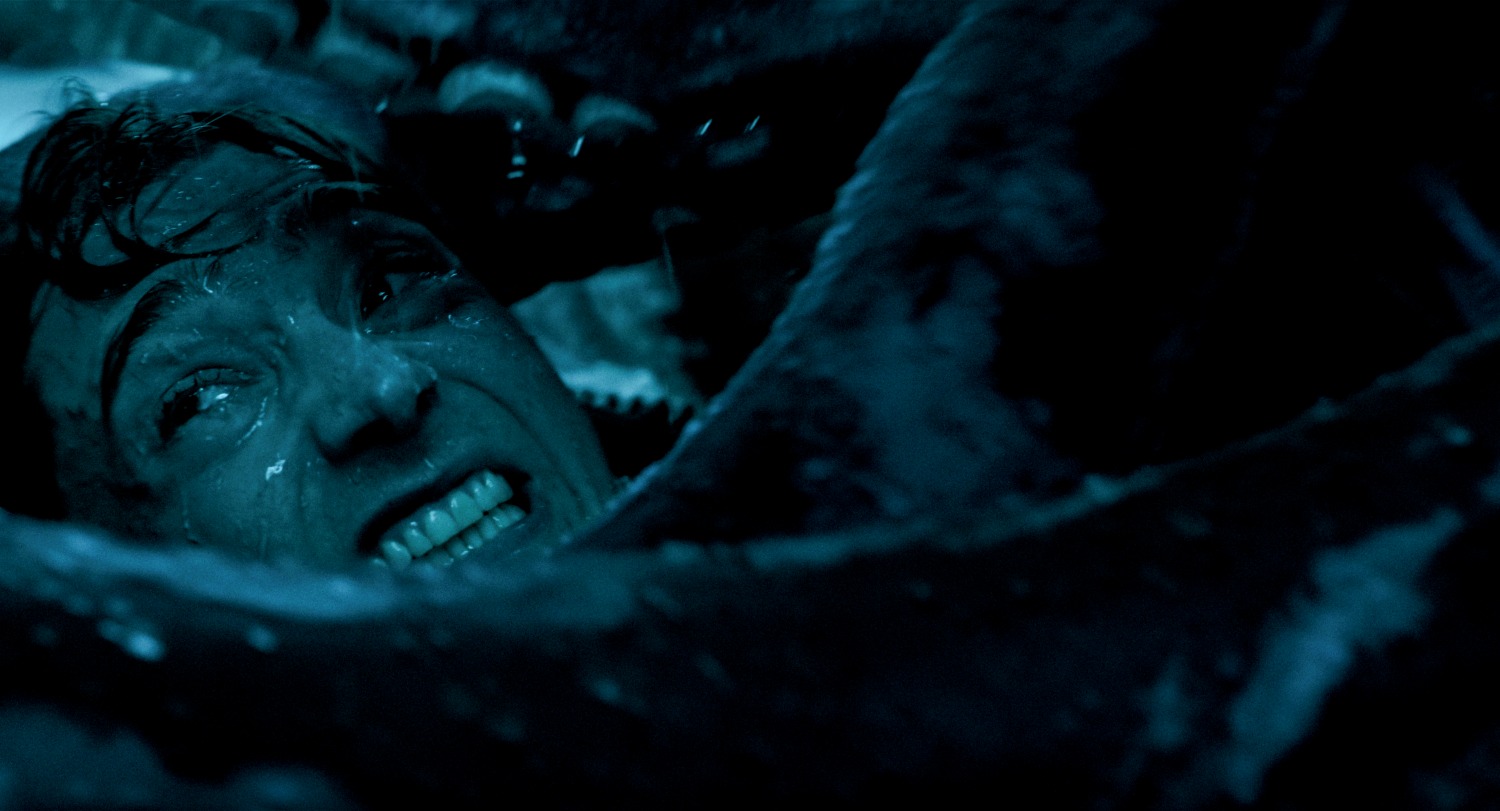
Whalefall, the new film by Brian Duffield, sets out to explore these depths. Adapted from Daniel Kraus’ novel of the same name, it has a lean premise: Jay Gardiner (Austin Abrams) is a scuba diver searching for the remains of his father Mitt (Josh Brolin), before being swallowed by a sperm whale with one hour of oxygen left to make his escape.
Entangled in this survival thriller are softer reflections on father-son relationships and the cycle of life. Some choices flow, namely the performances and the design. Other choices, such as the third-act exploration of the spiritual relationship between Jay, his father and the whale, muddy the waters. All in all, this is a gratifying film that delivers on its promise.
Abrams proves his capabilities as an actor after his recent run as a supporting player in Weapons and a lead in Resident Evil. Given that every scene rests on his shoulders, he never runs short of air. He is fully committed to a Jay that is frightened, funny, and determined.
His journey evolves into one of emotional as well as physical survival. In handling the guilt over his father’s death, Abrams lets the sensitive side of his character emerge, giving Jay more depth than the stoic stereotype typical of this genre.
Appearing alongside Jay entirely in flashbacks that run parallel to the main story, Brolin is similarly excellent as Mitt, at least with what he is given to work with. His characterisation leans into his strengths in playing gritty and morally complex men.
The design of the underwater sequences is by far the standout. The whale – exterior and interior (of which we get to see plenty) – is beautifully constructed. Its entrance, an immense shadow materialising from the dark of the ocean, is well-rendered in VFX, and sure to play on the audience’s megalophobia. This is countered by the squishy and slimy organs that Jay finds himself claustrophobically trapped in.
All of this is captured in extreme close-ups and long shots by cinematographer Aaron Morton, who previously collaborated with Duffield on No One Will Save You. He counters the earlier scenes of horror with ones that are surprisingly gorgeous, exemplified by a memorable black-and-white sequence of deep-sea sonar bursts towards the end.
Supporting these visuals is an echolocation-infused soundscape by Joseph Trapanese that brings a throbbing potency to the tense scenes, and a serenity to the intimate.
Though the various pieces work individually, they don’t fit together into a single unified mosaic. The intention is clear enough, but the execution could have been more even and impactful.
Brolin’s dialogue is frequently too expository, flattening an interesting father figure in service of Jay’s character arc. The third act is specifically hindered by an overuse of Brolin’s voiceover. Understandably, it exists to support Jay’s spiritual journey but overextends into falsely poetic narration about the cycle of life – slowing the pace at its climax.
Whalefall is a story fraught with mounting tension and dripping with texture. Yet the third-act attempt to turn a classic survival thriller into a more reflective one doesn’t quite merge with the established narrative. The film’s emotional current stays muddy even as the imagery is crystal clear.
