


by Cain Noble-Davies
Worth: $12.00
FilmInk rates movies out of $20 — the score indicates the amount we believe a ticket to the movie to be worth
Intro:
… technically polished to an impressive degree, but the specific words, delivery, and ultimate thesis meant to give substance to the style is disappointingly lacking …
When we think of stop motion animation, most examples involve plasticine or puppets or household bric-a-brac. But in the case of Italian filmmaker Stefano Bertelli, it means something different: paper.
Paper animation is as old as the medium itself, and Bertelli’s own cut-out style itself is reminiscent of works like South Park which, despite going digital early on, still maintains that scruffy aesthetic to this day. But Bertelli’s work represents something different within that spectrum, an approach and resulting artistic effect entirely his own, and after plying his trade for years in shorts and music videos as well as a debut feature back in 2015 with Acid Space, his latest shows him attempting something a bit grander, a bit more thoughtful. Emphasis on ‘attempting’.
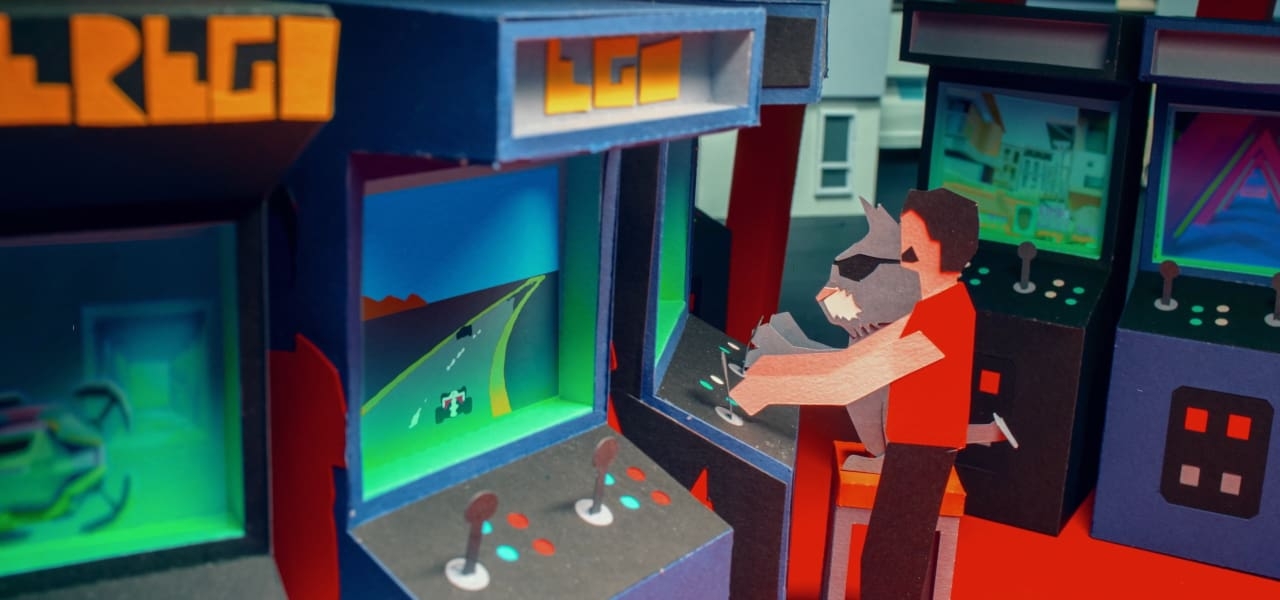
Using a combination of paper figures, papier-mâché, rotoscoping onto paper, and legitimate engineering wizardry, Bertelli and set designer Riccardo Orlandi show an incredible level of detail in how they set up and present everything on-screen in Spacetime Chronicles. From simple walking to the various gauges and levers of a plane cockpit, to an abstract limbo where memories rise out of a cylindrical hole in the floor… The polygonal design of all these objects is a textural midway point between the tactility of claymation and the blocky rendering of pixel art, something the film leans into with sequences imitating video games.
Compare this level of hard graft, this display of craftsmanship that can hold its own against literally any animation studio still operating today, with the frankly disappointing sound of this film. The foley work for the sound effects is solid, but the voice acting… well, we’re not even sure if it qualifies as such, as it carries all the stiffness and jagged pronunciation of AI voice replication. As if the decision to censor swearing in the dialogue (even if they are in another language and not subtitled… although the rest of the film is subtitled) didn’t make this awkward enough to listen to.
Now, there are potential arguments that could be made about this stylistic choice. For a film with such an existentialist bent, showing Fred in limbo as he rediscovers his memories and faces his fears, the janky flatness in the line delivery does add a surreal dimension to the story. Or it could be a juxtaposition between human-made visuals and much colder ‘performances’, drawing questions as to the nature of authenticity in art. Or maybe they just couldn’t get access to voice actors, since this is a production of two people and stop motion is a lengthy and arduous process for even a short film, let alone a full feature.
However, the further the film goes on, the less viable any of these explanations become. On the note of availability of voice actors, considering Acid Space, a much rougher testing ground feature for the techniques employed here, did feature such voice actors, it’s difficult to fully buy that as a sufficient reason. Like, Bertelli himself just speaking these lines into a Blue Yeti would have been an improvement over what we actually get.
If it’s a purposeful juxtaposition, it’s not a particularly meaningful one as it doesn’t serve any relevant thematic ends, and even bites into the watchability of the visuals. It’s almost advisable to watch the whole thing on mute if possible, such is the sensation of the voice replication dragging down the film’s overall engagement.
As for the existential side of things, the dialogue-as-written is rather plain and repetitive in its exploration of memories, endings, and temporal relativity; it needs vibrant delivery in order to make it interesting, which makes the leaden reality a slog to sit through. It’s roughly at the same level of sophistication in terms of theme as Ghost in the Shell II: Innocence, but spoken through ChatGPT, which actively diminishes whatever philosophical potency it may have carried otherwise.
Spacetime Chronicles is technically polished to an impressive degree, but the specific words, delivery, and ultimate thesis meant to give substance to the style is disappointingly lacking; it is a ‘lyrical miracle’ as an animated film. Even the harshest of our criticisms cannot truly take away from the achievements in artistic and aesthetic design here, but seeing all that hard work being poured into something that feels so… soulless makes it harder to fully appreciate than it rightly should. It is both an ambitious step forward for the medium and its capacity for variety and inventiveness, and a 70 minute extrapolation of the Unfinished Horse Drawing meme.
