



by Nataliia Serebriakova
Worth: $17.60
FilmInk rates movies out of $20 — the score indicates the amount we believe a ticket to the movie to be worth
Cast:
Colas Quignard, Mitia Capellier-Audat, Suzanne Gerin, Antonia Buresi
The first image of La Gradiva is already a small drama. A train carries a group of French high-school students south towards Italy. In one of the compartments, Toni (Colas Quignard) stands frozen in the corridor, watching his best friend James (Mitia Capellier-Audat) having sex with a girl. He does not enter. He watches. And somewhere behind him, Suzanne (Suzanne Gerin) watches Toni watching James.
Marine Atlan could hardly find a more precise beginning for her remarkable feature debut. Desire in La Gradiva is almost always experienced from a slight distance: you look at somebody, you imagine something, you want something, but you are not quite able to reach it. Atlan spends much of her film exploring precisely this uncomfortable territory between desire and reality, friendship and love, adolescence and adulthood.
The journey takes the students to Naples and Pompeii, but Toni arrives in Italy with another purpose. He carries a family legend about his origins: he believes that his family once lived near Naples, that his grandmother was connected to an aristocratic household, and that a catastrophe destroyed the life she knew. The trip therefore becomes, for him, a search for a personal history he has partly invented and partly inherited.
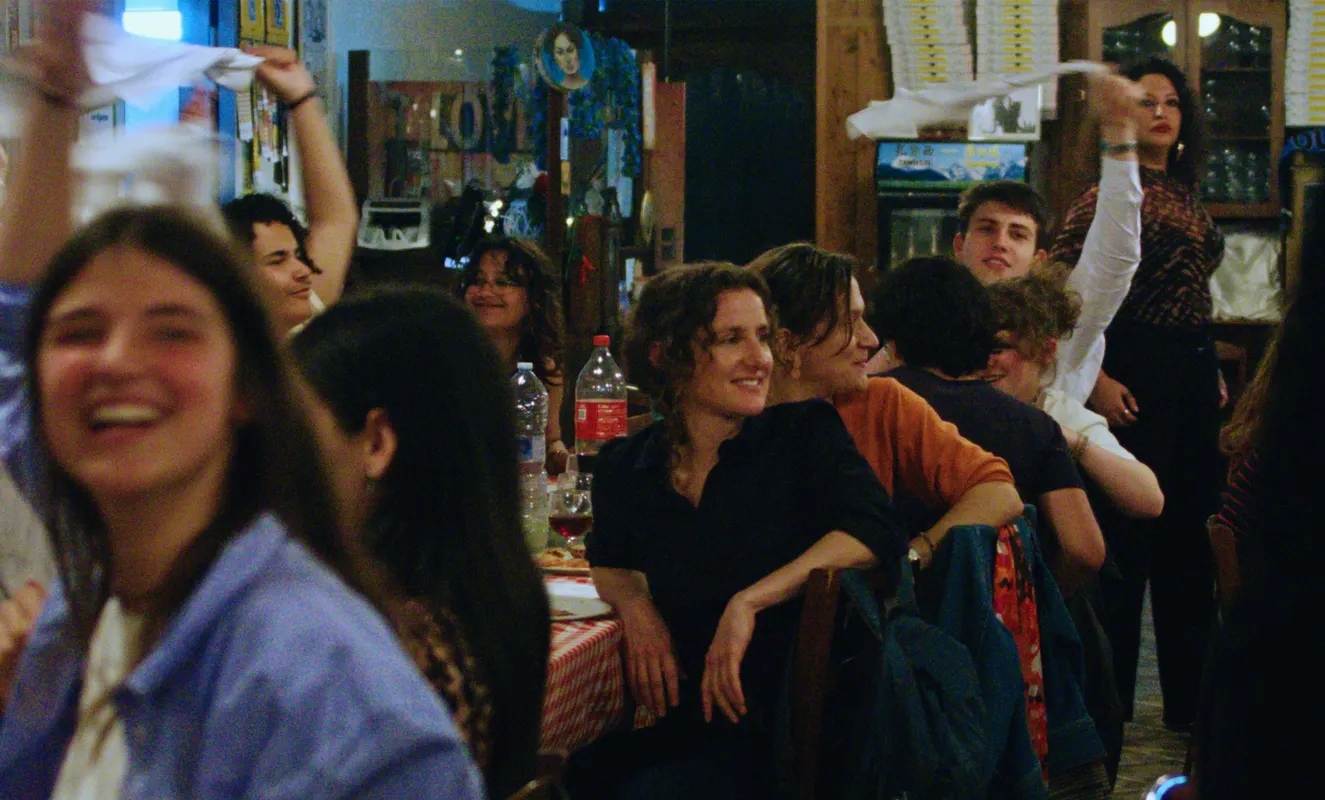
Atlan allows this mythology to coexist with the ordinary chaos of a school excursion. The teenagers laugh, smoke, wander through museums, flirt, argue and make fun of one another. Nothing seems particularly dramatic. The film takes its time because adolescence itself is like that: enormous emotions can coexist with apparently meaningless conversations, and a life-changing moment can emerge from an afternoon that seemed completely ordinary.
At the centre is Toni, a charismatic, talkative gay teenager who appears to be in love with James. James, meanwhile, moves through the world with the confidence of someone who knows that people are attracted to him. He sleeps with girls, enjoys his popularity and seems largely incapable of understanding what his presence means to Toni.
Their relationship is more complicated than a conventional unrequited love story. Toni may want James sexually, but he also wants something more difficult to define: recognition, intimacy, friendship and perhaps confirmation that he matters to the person who matters most to him. The film’s real subject is therefore not simply first love, but the terrifying moment when friendship and love become impossible to separate.
Suzanne occupies another corner of this emotional triangle. Intelligent, observant and artistically inclined, she seems convinced that she is not beautiful enough to be loved by James. She can simultaneously admire him and resent him. Atlan is especially good at showing how cruel adolescence can be without turning teenagers into caricatures. They are not cruel because they are bad people. They are simply still learning what other people can feel.
The adult world is represented by Madame Mercier (Antonia Buresi), the Latin teacher responsible for this group of teenagers in Italy. She is passionate about what she teaches, but increasingly exhausted by the reality of looking after twenty young people who are much more interested in one another than in ancient civilisation. Her relationship with Toni is particularly uncomfortable. She repeatedly reprimands him, reminds him that he has not handed in his essay and seems to assume that he is responsible whenever something goes wrong.
At first, this can look like ordinary teacher frustration. But the longer the film goes on, the more disturbing the dynamic becomes. There is something almost toxic in the way Mercier singles Toni out, and the film eventually makes us reconsider several of their earlier encounters.
Toni’s vulnerability is also suggested by details that Atlan never turns into explanatory melodrama. A phone conversation reveals that his mother in France has serious mental-health problems. Suddenly, the boy’s theatrical confidence acquires another dimension. His stories, jokes and insistence on being seen begin to look less like teenage arrogance and more like a way of protecting himself.
This is one of the film’s greatest strengths. Atlan does not rush to explain her characters. She lets us spend time with them. For a long stretch, La Gradiva appears almost deceptively light, filled with sunlight, youthful laughter and the extraordinary beauty of southern Italy. But the closer the teenagers come to Pompeii, the more the ancient city begins to change the meaning of everything we have seen.
Almost imperceptibly, the film changes. What seemed like a leisurely school trip becomes a psychological drama, and the accumulated tensions between the characters begin to produce consequences none of them can control. The tragedy does not feel like a sudden genre twist. It grows out of everything we have already witnessed: desire, jealousy, loneliness, friendship, humiliation and the inability of young people to recognise the consequences of their own emotions.
Atlan, who comes to directing after a career as a cinematographer, films Italy with extraordinary sensitivity. The landscape is not simply beautiful decoration. Sun, ancient stone, sea, streets and ruins gradually become part of the characters’ emotional world. The film can look almost like a holiday postcard one moment and like a premonition of catastrophe the next.
That contrast is ultimately what makes La Gradiva so powerful. It is a film about first love, but also about the difficulty of recognising what love actually is. About friendship that may contain desire. About the need to be seen. About the danger of confusing another person’s attention with intimacy.
